
Acadia's Alzheimer's Psychosis Bet: Direction Is Priced, Resolution Is Not
We're constructive into Sep/Oct: ~70–80% odds of success, and we like the setup — the alpha's in the magnitude: fade a thin print, add on a strong one.

Acadia (ACAD) heads into a September Phase 2 readout for remlifanserin in Alzheimer’s disease psychosis — a ~$832m slice of enterprise value. Our independent reconstruction centers efficacy on ~3 points of placebo-adjusted SAPS-H+D separation — d≈0.45 under our central variance assumption — and puts statistical success near 80%. That makes a positive readout the likely outcome; what it will actually establish about Phase 3 is far less certain.
Acadia does not need RADIANT to produce a spectacular result this fall. It needs to show it built a better molecule and a better experiment around a mechanism that already has human evidence in Alzheimer’s disease psychosis (ADP) — just never evidence good enough to approve. Remlifanserin (ACP-204) is an attempt to fix pimavanserin’s two failures, the molecule and the experiment, rather than abandon the mechanism.
RADIANT makes that attempt unusually testable. Acadia powered the study at d≈0.40; our independent reconstruction centers on a ~3-point treatment benefit over placebo, which translates to d≈0.45 under our central variance assumption. The raw separation is the more durable forecast because the standardized effect depends on variance RADIANT has not revealed. Pimavanserin’s ~0.32 is therefore our downside anchor, not our base case.
That forecast still leaves two uncertainties: the drug’s true effect and what a ~106-patient-per-arm trial happens to observe. The latter matters because successful trials disproportionately select favorable draws, making observed efficacy look stronger than the effect underneath it. RADIANT can establish direction more cleanly than magnitude.
Our model puts statistical success near 80%, so direction is not where the disagreement belongs. Magnitude is. An observed ~0.45–0.55 is consistent with our forecast; ~0.55+ with coherence across doses raises our conviction.The market is pricing whether RADIANT will be positive. It should be pricing how informative — and how valuable — “positive” turns out to be.
1. Acadia already bet on Phase 3 — so statistical success is only the first hurdle
For Acadia, RADIANT is a rare high-value inflection on an otherwise steady business: Nuplazid and Daybue fund the pipeline but won’t reprice the stock. A positive Part 1 materially de-risks an already-running Ph3 program aimed at a large market with no approved therapy.
It is telling that Acadia didn’t wait for the answer. The master protocol spans ~1,074 patients — ~318 in the Ph2 dose-ranging study, ~756 across two Ph3 confirmatory substudies — and Ph3 screening began before the ~106-per-arm comparison of 30 mg and 60 mg against placebo reads out. Dose selection still depends on Part 1, but capital and calendar are committed ahead of the principal de-risking event.
Management’s own framing makes that commitment more informative. RADIANT is powered for 80% at d≈0.40, while ACADIA’s regulatory base case remains Ph2 plus at least one successful Ph3, and only a “truly striking” Part 1 changes that. Our independent model lands near the same 80% but arrives there differently (Section 4C). The study doesn’t need to settle approvability; it needs enough efficacy to select a dose and justify confirmation.
The hardest outcome to value is therefore the middle: a modest but coherent positive, insufficient to prove remlifanserin is better than pimavanserin, sufficient to keep a running Ph3 moving. That is the distinction between statistical resolution and economic sufficiency.
2. What’s priced in the ACAD for ACP-204 — $832M.
Strip out net cash and the commercial base — Daybue and Nuplazid together ~$2.50bn on a Daybue-weighted view — then ~$0.25bn of other pipeline, and the residual attributable to remlifanserin is roughly $832m, almost a quarter of ACAD’s $3.58bn enterprise value. The catalyst isn’t deciding the fate of a free option; it is testing an asset the market already values north of $800m.
This EV split is struck at ACAD’s $24.84 close on Friday, July 24, 2026; the shares have since traded to $26.01 (Tuesday, July 28) — a move immaterial to a note focused on statistical PoS rather than precise valuation.
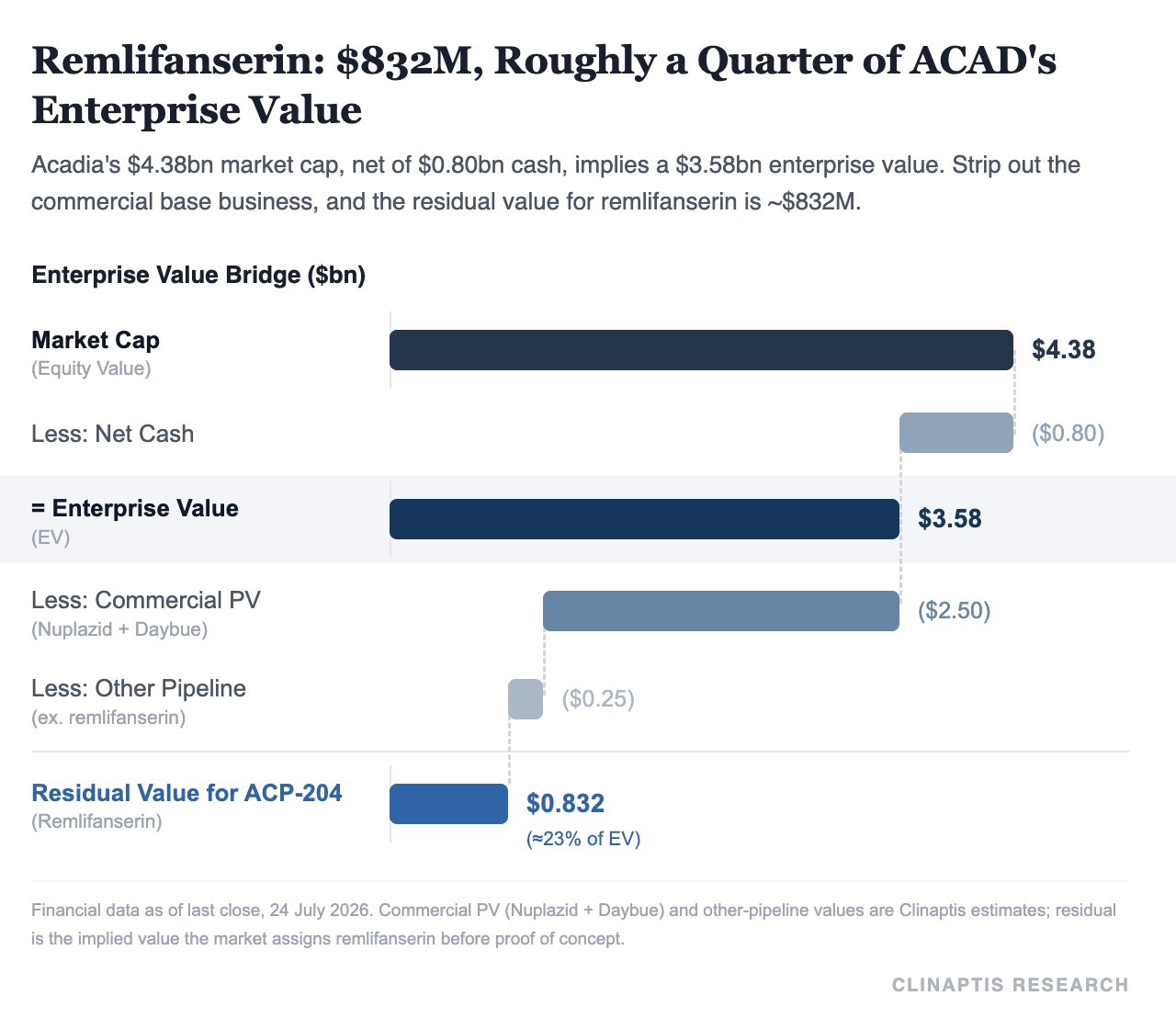
The focus is on the dollar EV, not the probability derived from it. Backing $832m out of our ~$3.30bn unrisked ADP value implies a probability in the mid-20s — but that is the chance of ultimately realizing the asset value, not RADIANT’s Ph2 PoS; the gap is downstream Ph3, regulatory and commercial attrition. On the readout itself we estimate ~80% statistical success, against a Street we read as pricing closer to 30–60% — a personal view, skewed below a coin flip, and where our disagreement begins. The denominator is model-dependent regardless; scale is the durable point, and it reprices as the market updates whether remlifanserin reaches patients.
ADP Market Sizing and Asset Valuation
The commercial assumptions behind that value aren’t aggressive. Our ~$2.3bn peak U.S. base case requires ~12% of a treated-addressable pool of roughly 800k — ~4% of prevalent ADP. Remlifanserin doesn’t need broad first-line adoption to anchor a multibillion-dollar franchise.
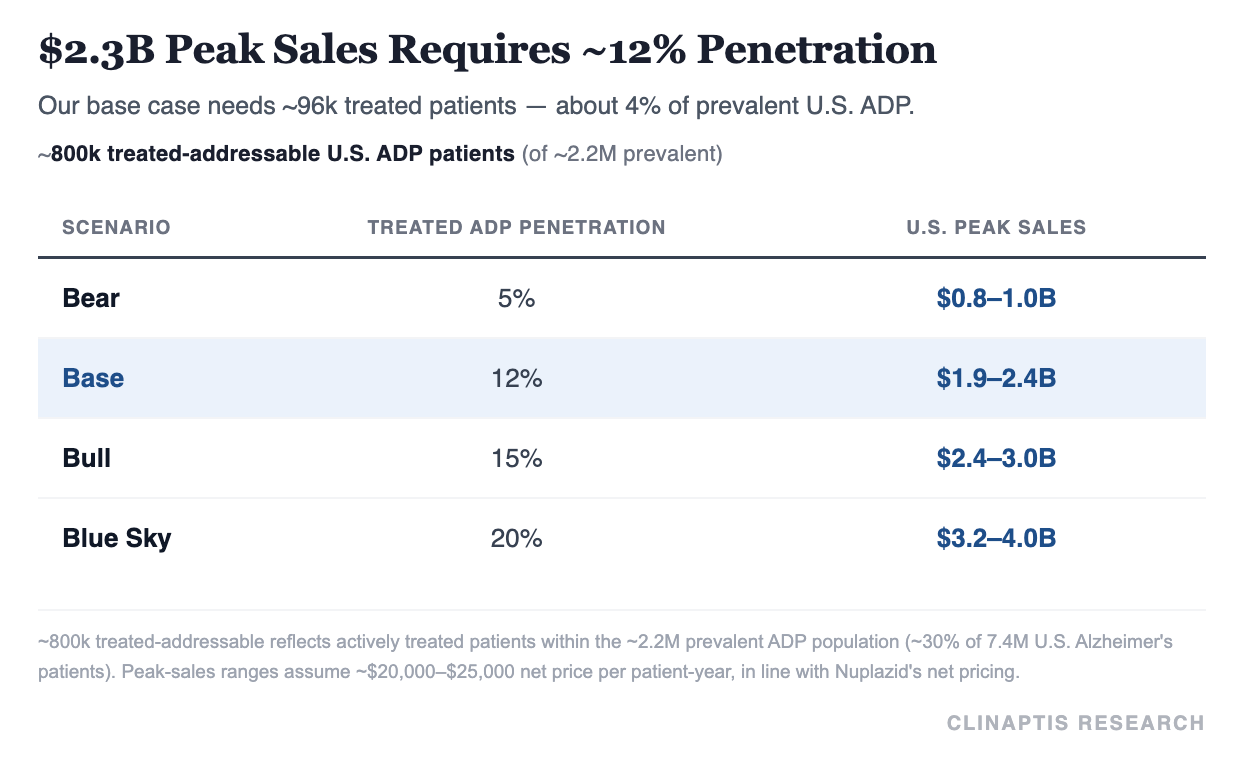
Management’s ~$4bn opportunity, spanning ADP plus Lewy-body dementia psychosis, is optimistic but not aggressive; we anchor on ADP alone and assume no ex-U.S. contribution. The ~$3.30bn unrisked value rests on a 2029 launch, peak penetration by 2035, ~45% mature margin and an 11.5% discount rate — inputs that move the implied PoS but not the point: the market has put ~$832m behind remlifanserin before proof of concept.
But the Ph2 failure doesn’t erase the Lewy-body optionality
The downside isn’t a zero floor. Pimavanserin’s one strong dementia signal — Study-045’s relapse HR 0.054 — came from the Parkinson’s-disease-dementia subgroup, which reads through, suggestively, to a Lewy-body-psychosis indication. Acadia is testing that directly: a ~180-patient Ph2 reads out around February 2028, too late to hedge this catalyst and no longer uncontested, with Cognition Therapeutics’ zervimesine advancing in DLB. In the Failure scenario we hold a $150m other-pipeline placeholder rather than zero.
3. The efficacy bar RADIANT inherits — and why it barely qualifies as one
Pimavanserin is why RADIANT doesn’t start from zero. It is not why RADIANT should succeed: it made selective 5-HT2A inverse agonism plausible in ADP, and never established that it works. The market treats d≈0.32 as the number remlifanserin must beat; that reads more certainty into pimavanserin’s history than the FDA ever did.
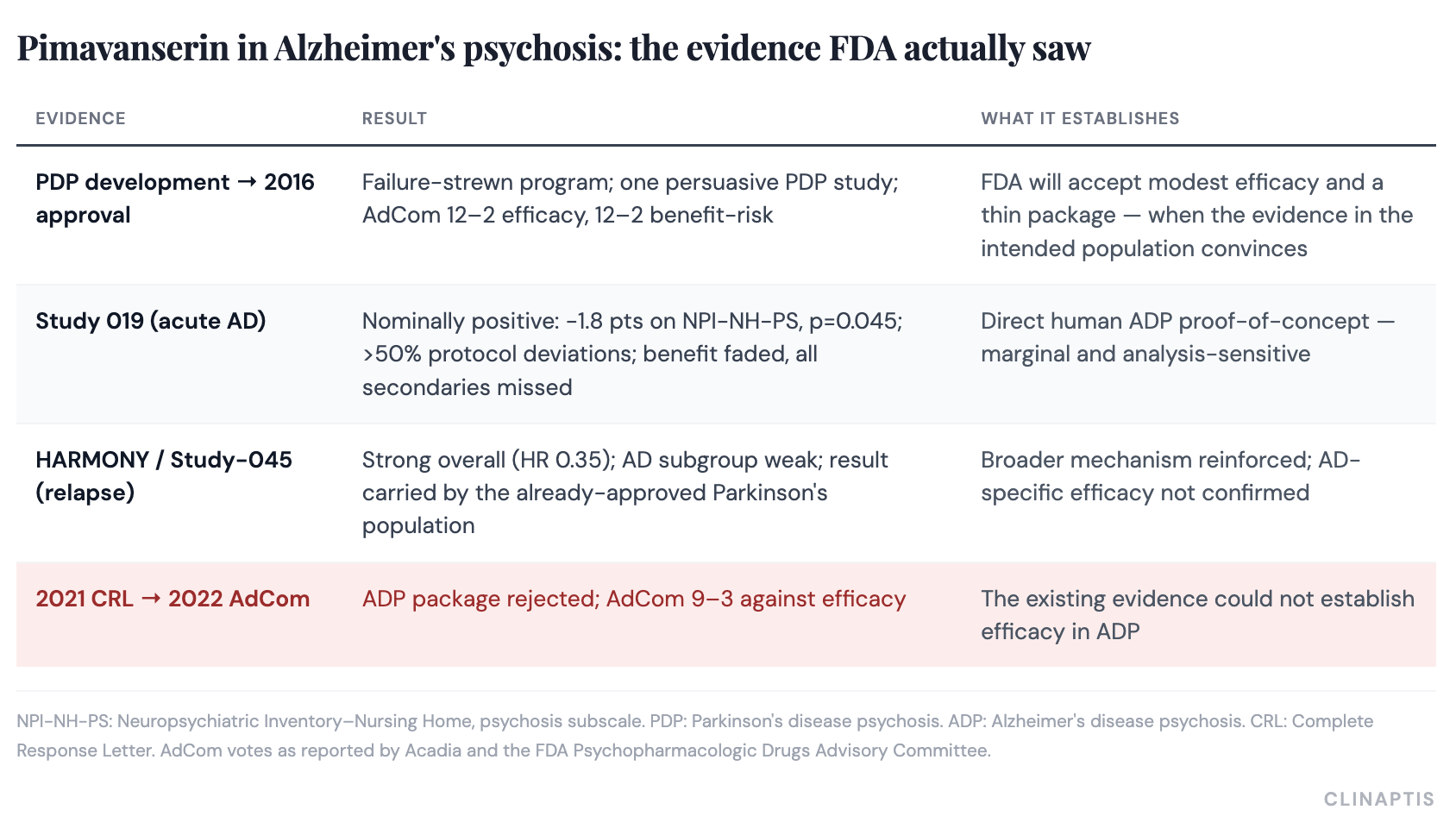
The mechanism kept generating signals strong enough to keep the program alive, and never strong enough to settle it.
Study 019 (Ph2, acute AD). Primary hit — 1.8 pts benefit on 24 point NPI-NH psychosis scale (p=0.045) — but the effect swung with the analysis set, >50% protocol deviations in both arms, every secondary missed. FDA: “not adequate and well-controlled.”
HARMONY / Study-045 (Ph3, randomized-withdrawal). Strong overall relapse HR 0.35, but FDA found it carried by the Parkinson’s-dementia subgroup, with the AD signal much weaker. Acadia blamed dopaminergic co-meds; the panel disagreed — “different illnesses, different responses.”
Two marginal studies were not enough — even by the FDA’s unusually permissive 2021 standards. The agency rejected pimavanserin’s broader dementia package in April, approved aducanumab two months later despite a negative advisory committee, then still voted 9–3 against pimavanserin’s post-hoc ADP case. The problem was not regulatory conservatism. The Alzheimer’s evidence was too weak.
Remlifanserin clearly fixes one of pimavanserin’s problems: therapeutic headroom. Against pimavanserin’s ~7.8 ms of FDA-predicted placebo-adjusted QTc prolongation at therapeutic exposure, remlifanserin held its upper confidence bound below 10 ms through 180 mg, three times RADIANT’s higher dose. That gives Acadia room to dose the molecule without running into pimavanserin’s cardiac constraint.
The bet is that efficacy will not fall short again in ADP. Pimavanserin at 34 mg already achieved ~90% persistent 5-HT2A occupancy, so inadequate target engagement is a poor explanation for its modest effect. Remlifanserin’s wider therapeutic index therefore does not, by itself, imply a wider efficacy margin. Acadia is instead pairing a cleaner molecule with a cleaner experiment: biomarker-confirmed Alzheimer’s disease, prospectively defined psychosis, two doses, and a program built from the outset to feed two independent Ph3 studies rather than recover an Alzheimer’s signal from a mixed-dementia trial.
That leaves magnitude as the unresolved question. Atypical antipsychotics provide a low bar, generally around d≈0.15–0.25 in dementia: risperidone ~0.23, olanzapine ~0.17, aripiprazole ~0.12, quetiapine roughly zero, and ~0.14 across a 38-trial pooled analysis. The scales and populations differ, so these are magnitude anchors rather than like-for-like comparisons. Pimavanserin’s ~0.32, unreliable as it is, still sits above the class it would displace. Our ~0.45 is the bet; the historical record does not establish it.
4. Reconstructing RADIANT: ~3 points of separation, d≈0.45 under our variance assumption
Neither anchor is a forecast. Reconstructed from FDA data, Study 019’s treatment-difference SE of 0.910 implies d≈0.303–0.352 depending on the variance scale used — wide enough to make 0.32 nearly uninformative as a point estimate. Acadia’s 0.40 was chosen to size a trial, not defended on evidence.
4A. Four variables, one identity
RADIANT’s standardized effect is a function of four inputs:
d = (Baseline severity × Incremental response × Transferability) ÷ Change-score SD.
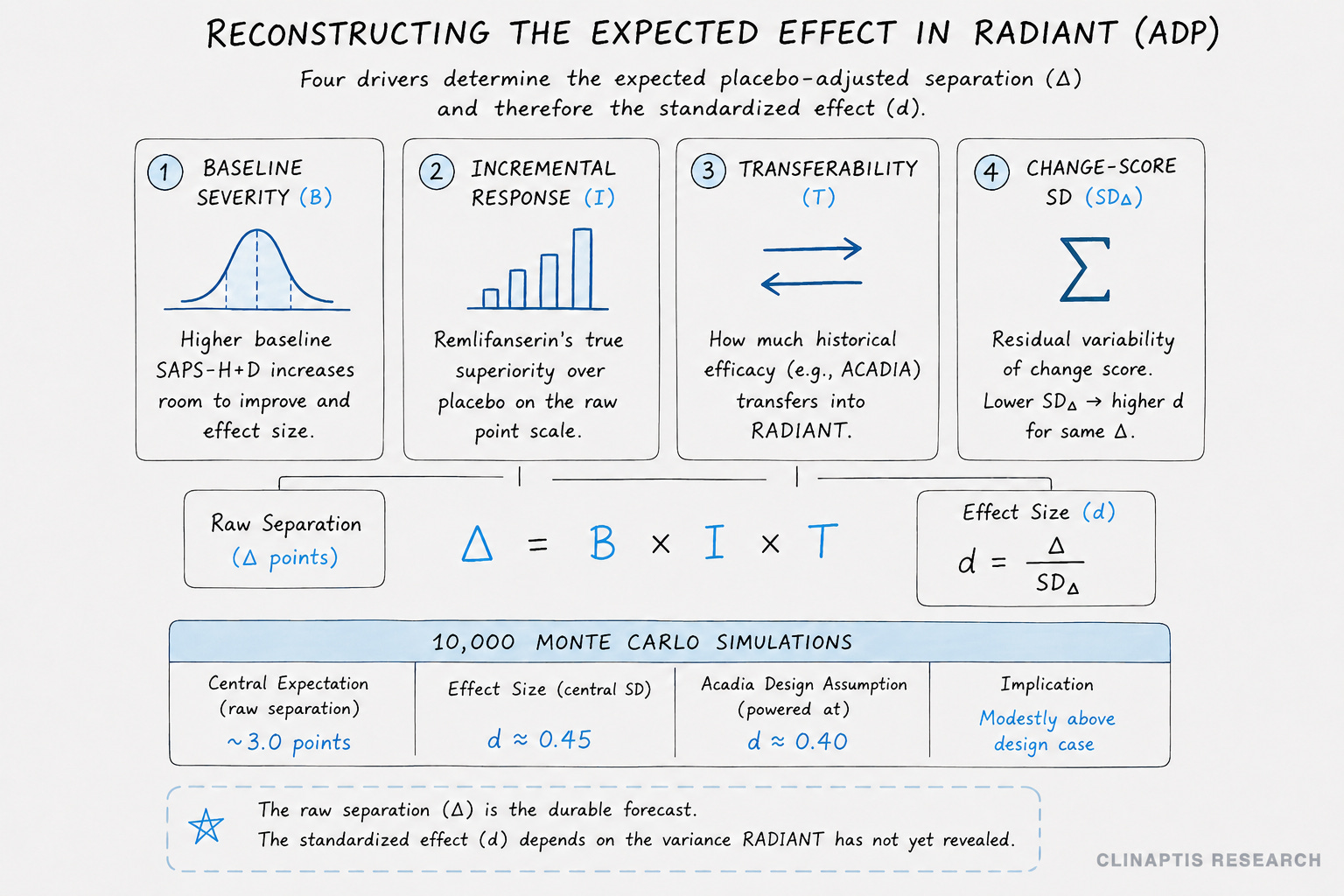
The point estimates give us historical anchors; the calibration is where the real-world forecast begins (illustrative):
Baseline SAPS-H+D: 16 ±2
Incremental response: 20% ±6.5%
Transferability: 0.95 ±0.10
Change-score SD: 6.5 ±0.8
We let these vary jointly rather than pretend efficacy is a fixed number. Incremental response drives most of the biological upside and downside; change-score SD is the key execution risk. Baseline severity and transferability matter, but neither moves the forecast on its own.
At the central assumptions, 16 × 20% × 0.95 ≈ 3 points of placebo-adjusted separation — d≈0.46 at SD 6.5. Across 10,000 simulations, median d settles near 0.45. But the ~3-point separation is the more durable forecast: at the same efficacy, d falls to ~0.41 if SD reaches 7.25 and ~0.36 at 8.3.
4B. True efficacy is a distribution, not a point estimate (Uncertainty #1)
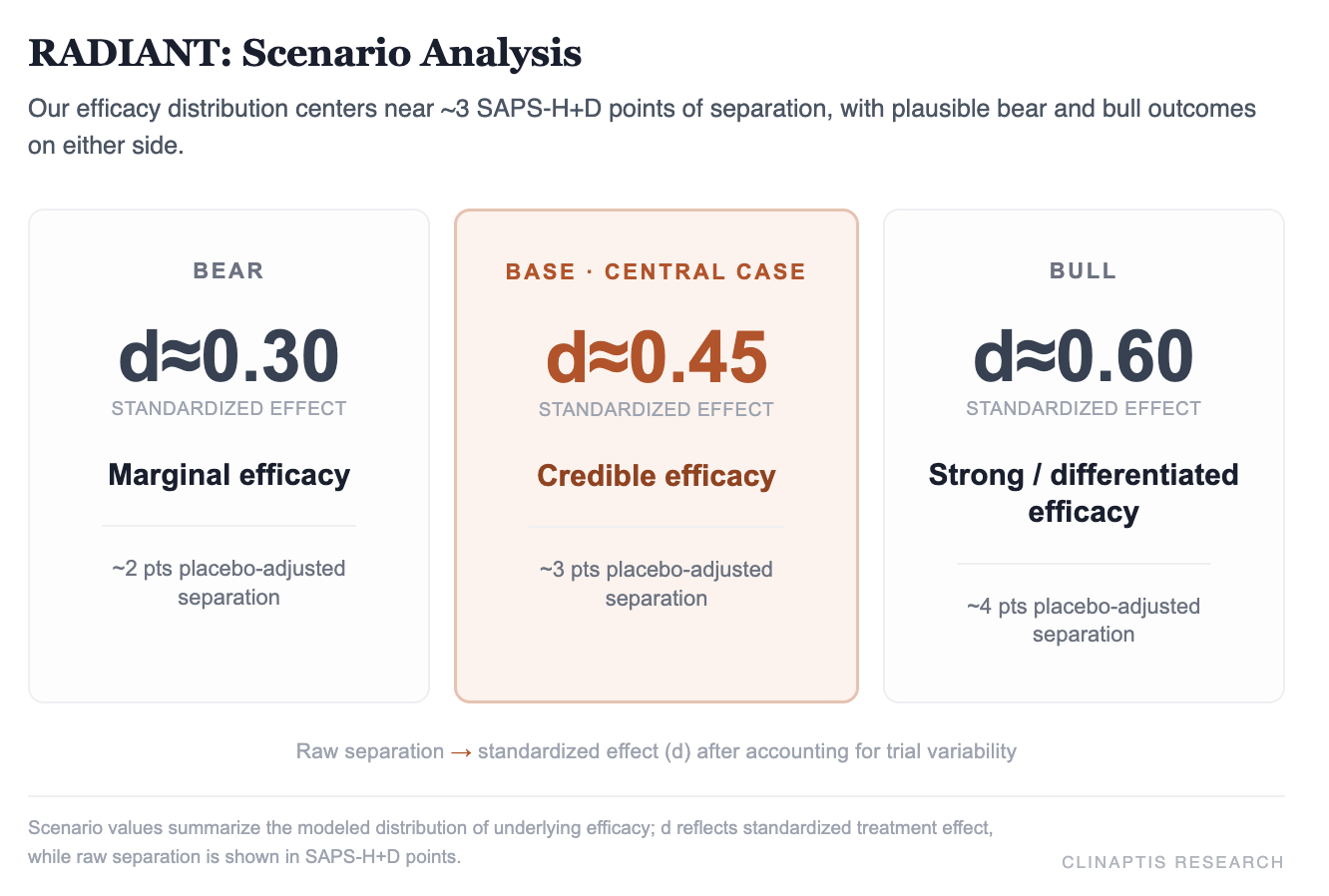
d≈0.45 is the center of our estimate, not a property of the drug. The main biological uncertainty is incremental efficacy; the main execution uncertainty is residual variance. Together, they determine whether RADIANT lands closer to the bear, base or bull case above.
The bear case is essentially pimavanserin-grade efficacy: a cleaner molecule and sharper trial bought Acadia a better experiment, but not a better effect. Our base case is roughly 3 points of Pbo-adj. endpoint separation; the bull case approaches 4 points.
The model does not tell us RADIANT is a d=0.45 drug. It tells us ~3 points is our best estimate, with plausible outcomes on either side.
4C. From efficacy uncertainty to trial PoS
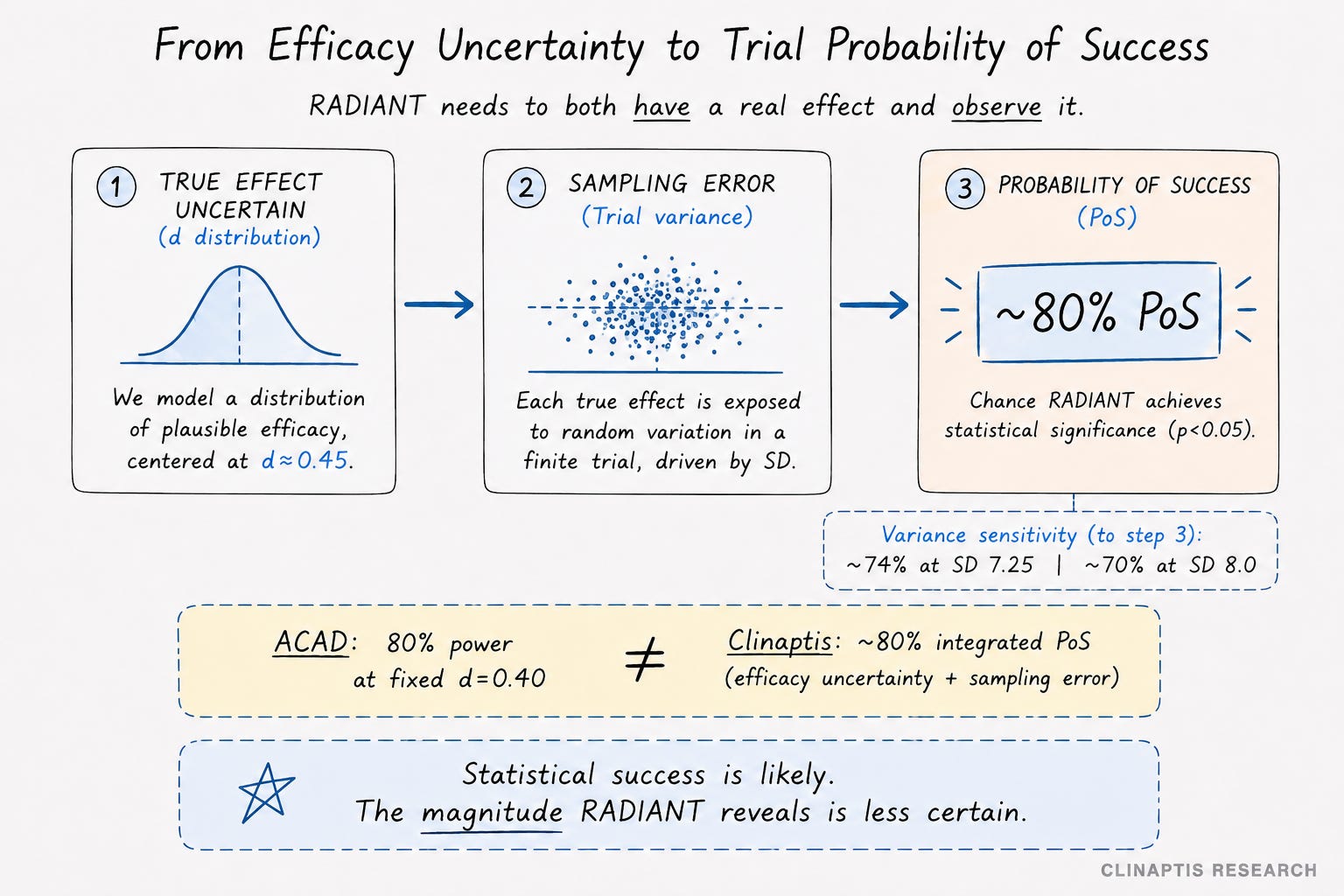
A central estimate isn’t enough; RADIANT still has to observe it. Fix true d at 0.45 and the trial has ~89% power; at 0.30, only ~55%. But efficacy itself is uncertain, and every possible effect then meets sampling error. Integrating both uncertainties puts our probability of statistical success near 80%.
Variance is the main execution sensitivity. Our base model already lets SD vary around 6.5 ±0.8; recentering that prior at 7.25 pulls PoS to 74%, and at 8.0 to 70%. We therefore frame RADIANT as a ~70–80% trial, ~80% base case.
That matches Acadia’s 80% design power, but the two numbers answer different questions. Acadia fixes d=0.40 and asks whether RADIANT can detect it; we let true efficacy vary and ask how often the trial succeeds. Statistical success is likely. The magnitude it reveals is not.
4D. Where we could be wrong
The model is only as good as what transfers into RADIANT. The largest risk is that pimavanserin’s historical incremental response overstates what remlifanserin reproduces in ADP — and a noisier-than-expected trial would compound it. Differences in population, endpoint and design add uncertainty our transferability assumption can only approximate.
Enrichment should sharpen assay sensitivity, but it could also shift placebo behavior or the severity mix in ways historical studies don’t capture. So our ~70–80% PoS can be right for the wrong reasons — and a statistically positive trial can still produce an incoherent efficacy story.
Our base case is not “d=0.45 and 80% PoS.” It is ~3 points of expected separation, wrapped in uncertainty over true efficacy, trial variance and sampling. The fall topline result resolves some of that — not all of it.
5. Observed efficacy is not true efficacy
RADIANT’s topline will answer whether the trial succeeded. The harder question is what that success says about the drug underneath. Four things — observed effect size, dose coherence, trajectory and clinical concordance — set how much to trust the headline.
5A Winner’s curse
One correction runs underneath everything below: a successful trial overstates the drug, most when the drug is weakest. A true d of 0.45 prints around 0.54 among winners; a true 0.30 prints near 0.44. Weaker drugs need more sampling luck to clear significance, so their wins are the most inflated — which is why the thresholds in 5D sit above our 0.45 forecast.
5B. Placebo response: a stress test, not a fifth driver
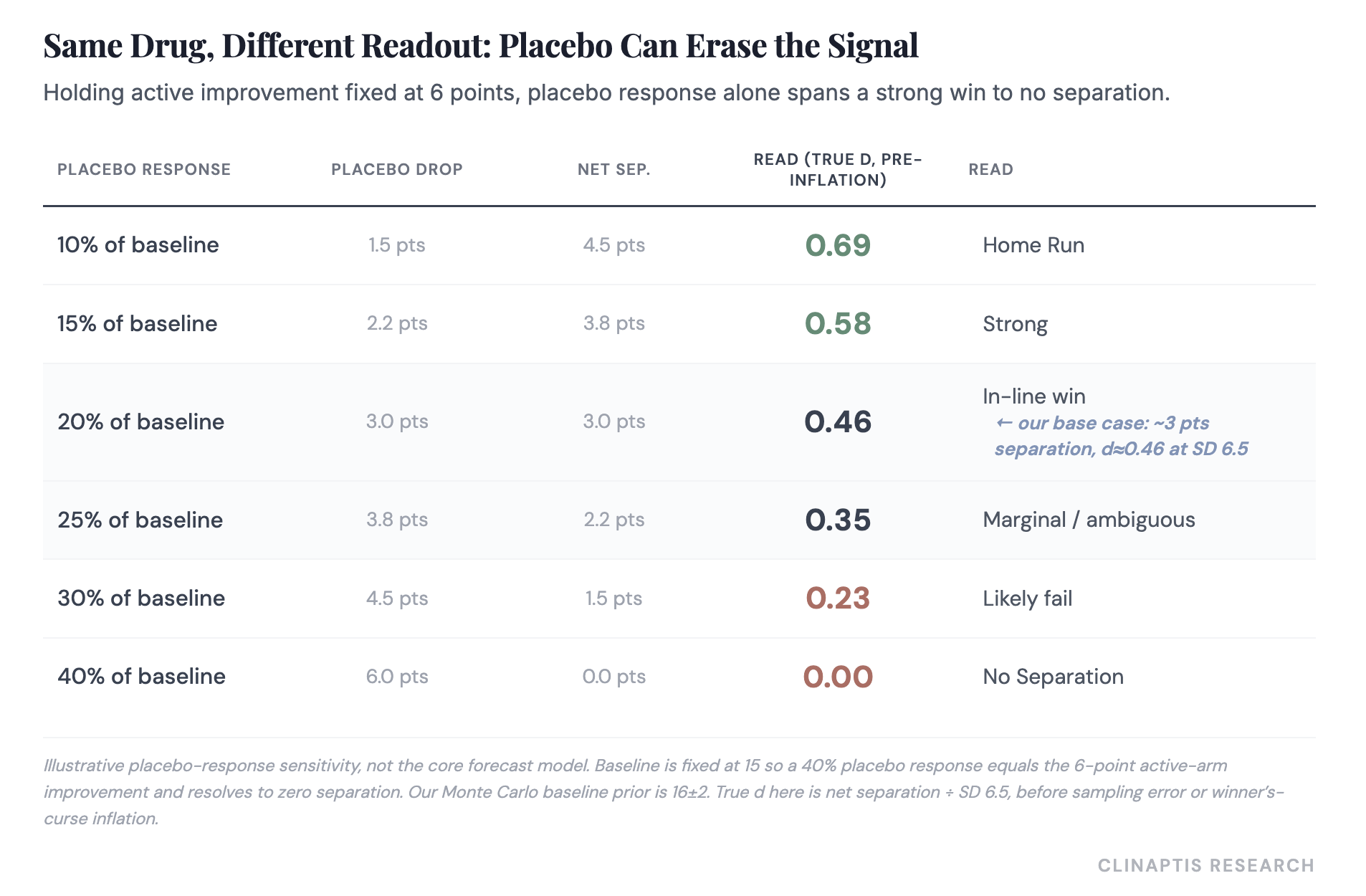
Placebo response is already inside our estimate of net separation — this isn’t another model input. The sensitivity below instead holds active-arm improvement fixed at 6 SAPS-H+D points and asks how much placebo the drug can absorb. At 10% placebo improvement the result looks exceptional; at 20% it lands on our base case; at 25% it turns ambiguous; by 30% the trial is likely failing; at 40% separation disappears. Same active response, opposite readout — which is why management calls placebo the key execution risk.
5C. Dose coherence, trajectory and CGI-S
Target engagement is de-risked; efficacy is not. Remlifanserin saturates 5-HT2A occupancy below both RADIANT doses, so 60 mg need not beat 30 mg — what matters is coherence: two doses pointing the same way beat one isolated positive. Trajectory is the next check. Separation by Weeks 2–4 that holds or widens supports a durable signal; an effect surfacing only at Week 6 recreates Study 019’s single-visit fragility. CGI-S is the clinical cross-check: a positive SAPS-H+D alongside flat global improvement would weaken the case that statistical efficacy became perceptible benefit.
5D. What to demand of the readout
These thresholds apply to observed efficacy, not the underlying effect from Section 4. Our central estimate is d≈0.45; among successful trials that prints around 0.54 on average, on selection alone. So an observed ~0.45–0.55 is broadly consistent with our base case, while ~0.55+ starts to argue efficacy is stronger than our prior. Judge the readout on more than the p-value: magnitude says whether the result moves the efficacy prior; dose coherence, trajectory and CGI-S say how much to trust that magnitude. A thin or isolated positive can advance the program without changing the thesis.
5E. What the scenarios are worth
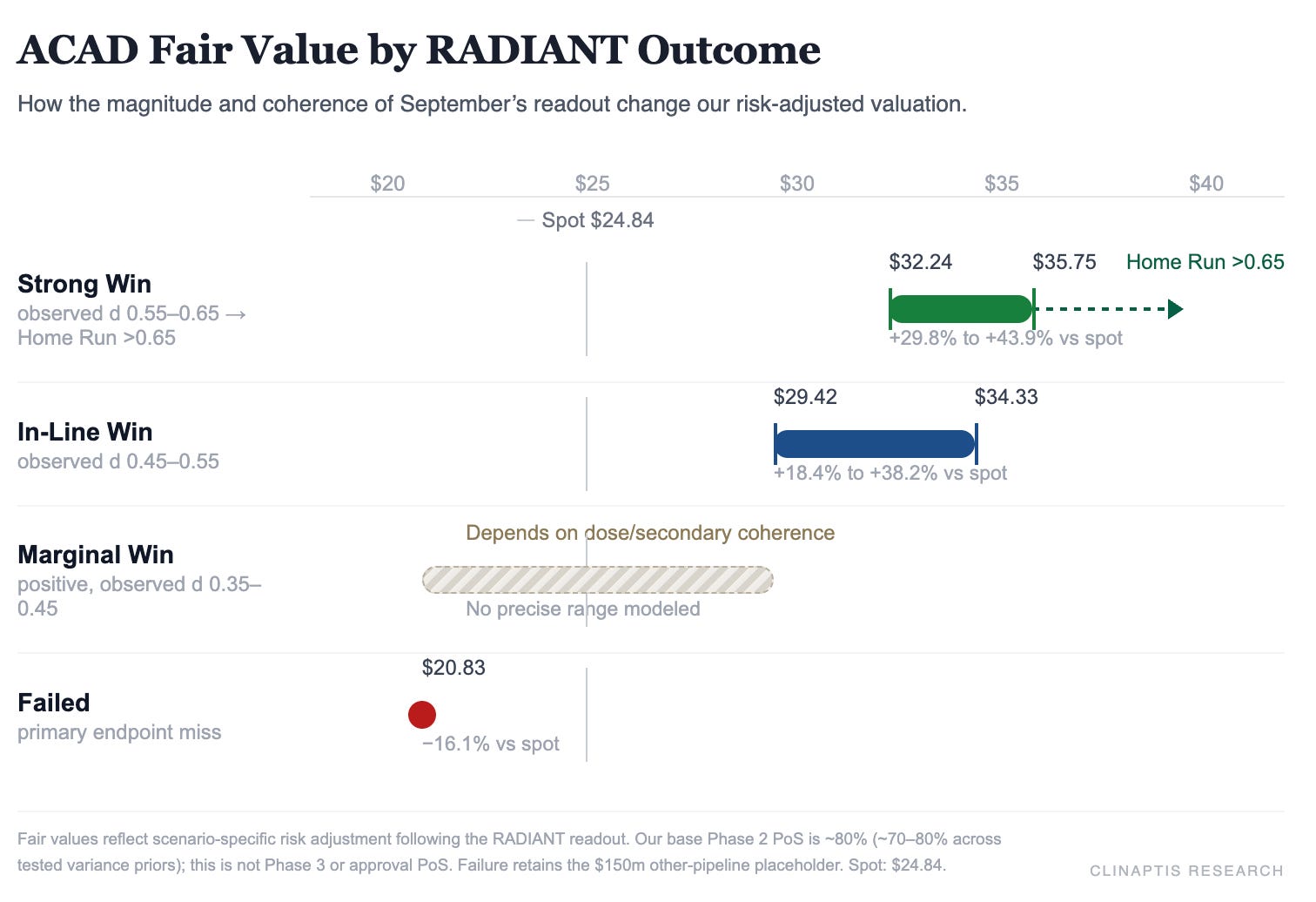
Mapping those clinical outcomes onto value gives the payoff its shape. A clean failure points to roughly $21 — about 16% below the $24.84 last close — and lower if sentiment sours on the broader program. A credible positive in our base range supports the high-$20s to mid-$30s; a strong, coherent readout (observed d well above 0.50) reaches ~$34–36, roughly 40% upside. The distribution is asymmetric: the downside is one clean number, while the upside fans across a wide band that only resolves as effect size, dose coherence and secondary data arrive.
6. Bottom line: a win may not settle much
RADIANT probably works. Our reconstruction centers on ~3 SAPS-H+D points of placebo-adjusted separation — d≈0.45 under our central variance prior — with ~80% probability of statistical success, and ~70–80% across plausible variance. But a successful trial overstates the drug: our base case prints around d≈0.54 on average, so an observed ~0.45–0.55 is consistent with our thesis rather than evidence of more. Conviction rises above ~0.55, and materially toward ~0.60+ with coherent dose, trajectory, CGI-S and responder data; below ~0.35 the thesis weakens. Because the overstatement is largest when the drug is weakest, magnitude and coherence tell us more than the p-value.
The valuation asymmetry still favors owning the catalyst. Our ~80% is Ph2 PoS, not approval probability — Ph3 replication, safety and regulatory risk remain downstream. Against the $24.84 last close, our framework puts a clean failure near $21, an in-line observed d≈0.45–0.55 win at $29–34, and a strong d≈0.55–0.65 result at $32–36.
The asymmetry is the trade. The September straddle implies a ±26% move — the market bracing for repricing without committing to direction — yet our base case makes a positive readout the likelier outcome, not a coin flip. The risk isn’t direction; it’s that the headline overshoots the fundamentals. A modal positive prints hot on the winner’s curse, invites a sharp rally, then gives ground as effect size and secondary data pull it back toward the high-$20s to low-$30s. A genuinely strong readout deserves the opposite treatment — the initial move understates it, because the market can’t yet see the dose coherence and durability that separate a durable signal from a lucky one. We would fade the first and add to the second.
RADIANT may make whether remlifanserin works the easy question. The harder one in September is how well — and whether the observed magnitude is strong and coherent enough to raise the odds of everything that still has to follow.
References & Sources
Risperidone individual-patient meta-analysis, six RCTs (n=1,721): psychosis-specific SMD −0.23. PubMed 40916051 (2025).
Meta-epidemiologic analysis, 38 placebo-controlled dementia trials: atypicals SMD −0.14. PMC6776492.
Network meta-analysis, off-label atypicals in dementia-related psychosis: NPI-NH psychosis d≈0.12 aripiprazole, 0.17 olanzapine, ~0 quetiapine. PubMed 35247186 (2022).
Risperidone AD/mixed-dementia psychosis RCT: 59% vs 26% responders. PubMed 16315159. CATIE-AD effectiveness: PubMed 17035647.
Voss, Brocht, Ravina, “Performance of the SAPS in Parkinson’s disease psychosis,” Movement Disorders 2010 (ACADIA-supported; n=54; 1 CGI category ≈ 4–5 total-SAPS points; H+D = 83% of SAPS change; 13% SAPS-improved/CGI-worse).
Pimavanserin ADP Study 019: d≈0.32, −3.76 vs −1.93 NPI-NH-PS, treatment difference −1.84 (p=0.045). PubMed 29452684. Study 020 SAPS change-score data used for incremental-response and variance calibration.
Pimavanserin severe-symptom subgroup: d≈0.73. PubMed 30569083. PDP pivotal: d≈0.50, −5.79 vs −2.73 SAPS-PD. PubMed 24183563.
FDA Briefing Document, Psychopharmacologic Drugs Advisory Committee, June 17, 2022 (Study 019 “not adequate and well-controlled”; Study-045 subgroup HRs, Table 7; PDD HR 0.054, DLB n=9). Acadia press release, AdCom 9–3, June 17, 2022.
Pimavanserin dementia-related-psychosis CRL, April 5, 2021. Aducanumab (Aduhelm) accelerated approval, June 7, 2021.
Cognition Therapeutics zervimesine (CT1812) SHIMMER Phase 2 in DLB, AD/PD 2026: NPI-12 86% slowing vs placebo (p=0.0545); hallucinations p=0.0207; delusions p=0.0609.
Appendix — Effect-size model
RADIANT efficacy is modeled from four uncertain inputs, each drawn independently, with ± denoting a one-standard-deviation prior: baseline SAPS-H+D severity (16 ±2), incremental response over placebo (20% ±6.5%), historical transferability (0.95 ±0.10, a multiplier on historical incremental response reflecting population, endpoint and design differences), and change-score SD (6.5 ±0.8). The central arithmetic gives ~3.0 points of placebo-adjusted separation and d≈0.46; across 10,000 joint simulations, median d is ~0.45.
Each simulated effect is then passed through a RADIANT-sized trial — ~100 evaluable patients per arm versus ~106 randomized, two active doses against placebo, success defined as p<0.05 on either dose under a Bonferroni-type alpha split across the two doses. This produces ~80% integrated Phase 2 PoS. Conditional-power estimates instead hold efficacy fixed; winner’s-curse estimates report observed efficacy among successful simulations only.
Sensitivity. Incremental response is the largest biological driver; change-score SD is the principal execution uncertainty. Recentering the SD prior from 6.5 to 7.25 lowers PoS to ~74%, and to 8.0 lowers it to ~70%. Transferability is the least empirically anchored input. Placebo response is embedded in net incremental efficacy and separately stressed in Section 5B.
The model estimates RADIANT statistical success, not Phase 3 success or approval, and Bear/Base/Bull scenarios represent points on a continuous efficacy distribution rather than separately assigned probabilities.
Disclaimer
Clinaptis Research is a publication of Clinaptis Advisors. Clinaptis is not a registered investment adviser, broker-dealer, or financial institution, and nothing in this note constitutes investment, legal, tax, or medical advice, or an offer or solicitation to buy or sell any security. The analysis reflects the author’s independent opinions and reconstructions from public sources believed reliable but not guaranteed accurate or complete; forward-looking statements and probability estimates are inherently uncertain and may prove wrong. Readers should conduct their own due diligence and consult a licensed professional before making any investment decision. The author may hold positions in the securities discussed and is under no obligation to update this note. © Clinaptis Advisors.