

On March 26, 2026, Kodiak reported GLOW2 topline: Zenkuda (tarcocimab tedromer) beat sham on the primary diabetic-retinopathy endpoint (62.5% vs. 3.3% achieving a ≥2-step DRSS improvement, p<0.0001), and the cataract signal that broke the prior formulation was gone (2.3% vs. 1.6% on sham; zero intraocular inflammation). The stock re-rated roughly 5x off its 52-week low ($8.29). The formulation’s safety problem now looks largely resolved. Whether the reformulation also restores enough wet-AMD efficacy to absorb a longer dosing interval is a separate question, and an unobserved one. DAYBREAK, reading out in September, is where it gets answered — and the market is trading it as one binary event: pass or fail on non-inferiority to aflibercept, the current standard of care.
That framing conflates two questions. Non-inferiority is the base case, but it is an edge rather than a near-certainty: we estimate ~63% off the molecule’s own Ph3 record (methodology in §3). The larger question is whether the pass looks like a molecule that merely clears the bar or one that has closed the durability gap against a field that has already normalized q16w dosing — and that is what decides between a franchise re-rate and a shrug.
The mispricing, if there is one, is in the quality of a pass, not the probability of one.
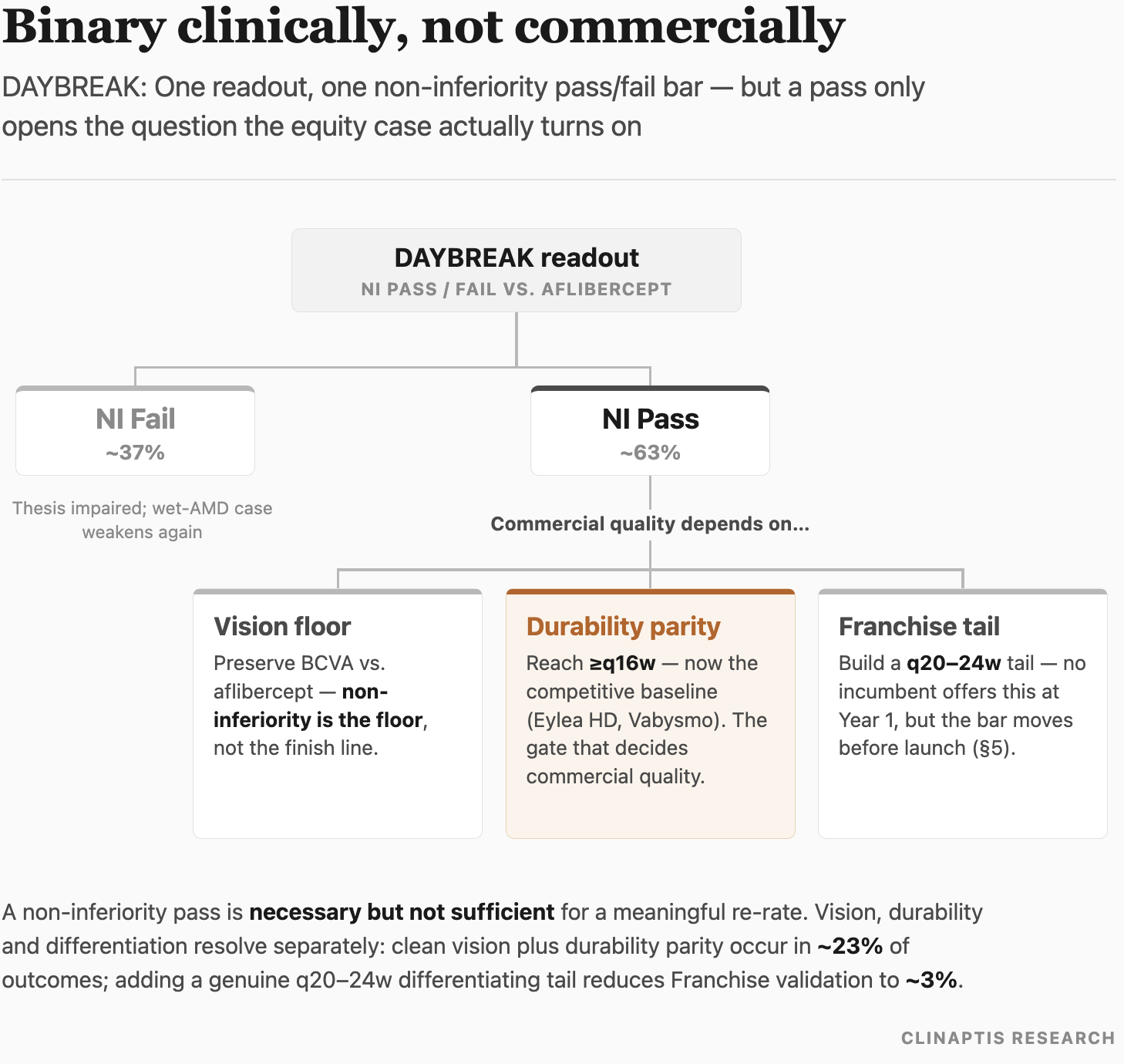
Three questions follow: what DAYBREAK is likely to show, what level of durability the 2028 field will pay for, and what each outcome is worth. Kodiak’s own trial history answers most of the first.
1. What the market is pricing
Kodiak enters the readout at $2.7B market capitalization (66.7M fully diluted shares against the $41.00 reference price — 3-day average close through Aug 18, 2026). The balance sheet is thin: $125.9M cash at 2Q26 against roughly $43M/quarter of operating burn, with a going-concern flag in the 10-Q. It is not clean net cash either. Kodiak sold Baker Bros. Advisors a top-line royalty on tarcocimab net sales in 2019 (terms in Appendix). Royalty-adjusted, we put pre-trial fair value at $40/share — in-line with $41.00 reference, not above it.
The stock has already paid for the repair. Kodiak traded at $8.29 before GLOW2, roughly 5x below the current ~$41, on formulation, manufacturing and BLA-path execution — almost all of it before any wet-AMD vision result.
What the setup is not is a probability disagreement. Even taking our own non-inferiority estimate as given, blended fair value lands within a couple of percent of spot, because enough of the positive-outcome mass falls into a commercially underweight middle. The exposure is on the shape of a pass — how often a statistically positive trial still prints thin vision, and how much credit that deserves once durability is priced separately from vision. A reader who agrees with our probability and disagrees with our shape gets a materially different answer; a reader who agrees with the shape does not need our probability to be right to the point.
The battlefield. Retinal disease carries one of the highest commercial bars in biotech, because the incumbents are exceptional. It has also repeatedly paid for durability without a vision edge. Eylea + Eylea HD did $4.4B in US net sales in FY2025; Vabysmo matched aflibercept on vision, differentiated on dosing interval, and reached $5.3B globally and over 60% of new US wet-AMD starts on that story alone. That precedent is the permission structure for the Durability-led-mixed state (§6). Large-cap pharma has paid up for validated retinal franchises too — Biogen’s $5.6B Apellis deal, Astellas’s ~$5.9B Iveric Bio purchase — though both bought a new mechanism in a previously untreatable indication, not durability inside an already-crowded anti-VEGF class.
2. The trade-off Kodiak has to solve
Kodiak is largely a single-mechanism bet. Zenkuda and KSI-501 both sit on the antibody biopolymer conjugate (ABC) platform, which extends an antibody’s residence time in the eye via an attached phosphorylcholine polymer; the thesis is that one piece of chemistry lets Kodiak treat the same diseases as the incumbents, at meaningfully longer intervals, without giving back vision. KSI-101 is the one clinical leg whose biology sits outside that mechanism — an unconjugated IL-6/VEGF bispecific — so it does not share the durability trade-off the rest of this section describes. If the durability trade-off can’t be solved, the conjugated assets don’t escape it — which is why the Fail state is worth ~$27/share rather than near zero, and why the Franchise state’s premium is a platform re-rate rather than a single-drug one: it runs through Zenkuda and KSI-501, not KSI-101.
Two of the platform’s three indications already have positive Ph3 data: GLOW2 in DR, and BEACON in RVO, which met non-inferiority on fewer injections than aflibercept with matched vision. Wet AMD — the largest and most commercially important — is the confirmation still outstanding. Management has guided to a single multi-indication BLA in 4Q26 spanning DR, RVO and wet AMD, so a DAYBREAK win completes the filing rather than standing alone.
Kodiak has run the vision-versus-interval trade-off twice already, for different reasons — a distinction the rest of this note depends on. DAZZLE, in wet AMD, stretched the dosing interval and lost the vision comparison: a genuine durability-versus-efficacy trade-off, and the objection every specialist reader brings to this note. DAYLIGHT then held the interval at monthly dosing and cleared non-inferiority — but at −2.1 letters, and with Zenkuda dosed q4w against aflibercept q8w. That comparison matters more than it has been given credit for, and §4 returns to it.
GLEAM/GLIMMER, in diabetic macular edema, stretched the interval again in 2023 and missed non-inferiority by roughly 4.3 letters — but decomposition (§4) attributes most of that miss to cataract rather than to durability repeating itself. GLOW2 then closed that failure mode: the cataract signal gone, zero vasculitis, and every patient reaching six-month dosing.
What GLOW2 settled, and what it didn’t. GLOW2 removed the safety objection to the redesigned formulation and showed a large anatomic effect on six-month dosing, including an 85% reduction in sight-threatening complications (2.4% vs 15.8%). It says almost nothing about how far dosing can be stretched in active neovascular disease while holding vision. DR is the indication where durability only has to change prescribing behavior; wet AMD is where it has to survive a head-to-head against the best drug in the class. DAYBREAK is the first trial to hold both halves of the trade-off at once — four loading doses and fluid-driven retreatment to protect vision, atop the formulation change that removed the cataract signal.
3. Non-inferiority is the base case
DAYBREAK randomizes ~675 treatment-naïve wet-AMD patients across three arms: Zenkuda on individualized 4-to-24-week dosing after four monthly loads, KSI-501 on an 8-week floor with individualized monthly rescue, and aflibercept 2mg per label. The primary endpoint is non-inferiority in mean BCVA change to the average of Weeks 40, 44 and 48. The NI margin is not disclosed, but Kodiak has used 4.5 letters in every comparable Ph3 — DAYLIGHT, BEACON, GLEAM, GLIMMER — so we model 4.5 and treat it as inference, not fact.
The two Kodiak arms test different hypotheses, not two versions of the same bet. Zenkuda is pursuing durability non-inferiority — matching aflibercept’s vision, then stretching the interval. KSI-501 is pursuing efficacy superiority against aflibercept monotherapy on an 8-week floor that generates no long-interval durability data — a different, harder hypothesis that DAYBREAK’s design does not ask Zenkuda to clear, and whose efficacy result (win or miss) does not touch the Zenkuda thesis. The exception is safety: a KSI-501 safety signal reads through to Zenkuda via the shared ABC platform (§7). KSI-501’s own registrational path is separate (Appendix).
The statistical hurdle is forgiving, and it is anchored to the molecule’s own record. We benchmark the expected precision against Kodiak’s own runs of this exact endpoint — a late-window BCVA average against an aflibercept control — in DAYLIGHT, GLEAM and GLIMMER, and against aflibercept 8mg in PULSAR for the class. Each trial’s realized treatment-difference precision points to an effective standard error near 1.1 letters for DAYBREAK’s ~225 patients per arm. Against a 4.5-letter margin, that means the trial passes as long as the observed deficit is no worse than about −2.4 letters.
Add in an evidence-based prior for the true Zenkuda-versus-aflibercept effect — a central estimate near −1.8 to −1.9 letters, with deliberately wide, downside-skewed uncertainty (predictive SD ~1.5 letters once sampling error and prior uncertainty are combined) — and the probability of meeting non-inferiority is ~63%. That is an edge, not a resolved question.
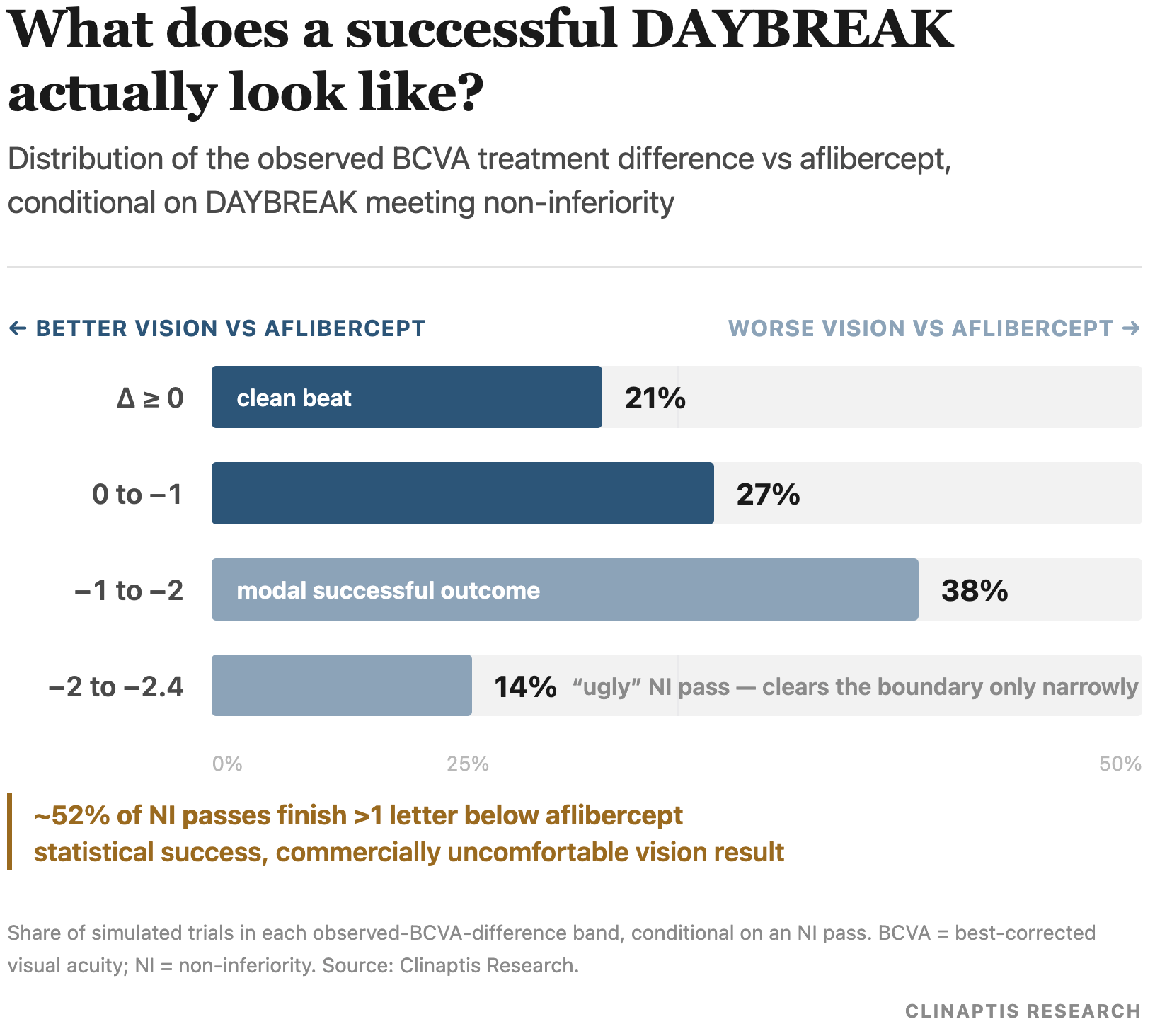
The prior mean is the largest model sensitivity, and the note’s probability is only ever as good as it. At μ≈−1.5, NI probability is ~71%; at our central −1.85 it is ~63%; at DAYLIGHT’s own −2.1 it is 56%; at the NI boundary (−2.34) it is a coin flip. Each tenth of a letter is worth roughly 2.5 points of pass probability. Earlier drafts of this note carried −1.5. We have moved the centre because the credit required to sustain it is larger than the evidence supports (§4). Where the efficacy distribution lands conditional on success carries more information than the pass rate itself.
Management’s own framing argues against reading DAYBREAK’s design as a stretch: “We tried to design a clinical trial in DAYBREAK that’s very conservative. So we’re not trying to throw the Hail Mary. We’re doing four loading doses… then we’re allowing the patients to be treated every month or as infrequently as every six months, depending on whether or not the disease is reactivating.” The fourth loading dose and fluid-driven retreatment are deliberate protections on efficacy, not incidental design choices.
4. Why 2023 does not anchor the downside
The bear case leans on GLEAM/GLIMMER: the same molecule missed non-inferiority in diabetic macular edema by ~4–5 letters in 2023. If extended dosing costs that much vision, DAYBREAK should worry. That interpretation misses the decomposition of the failure.
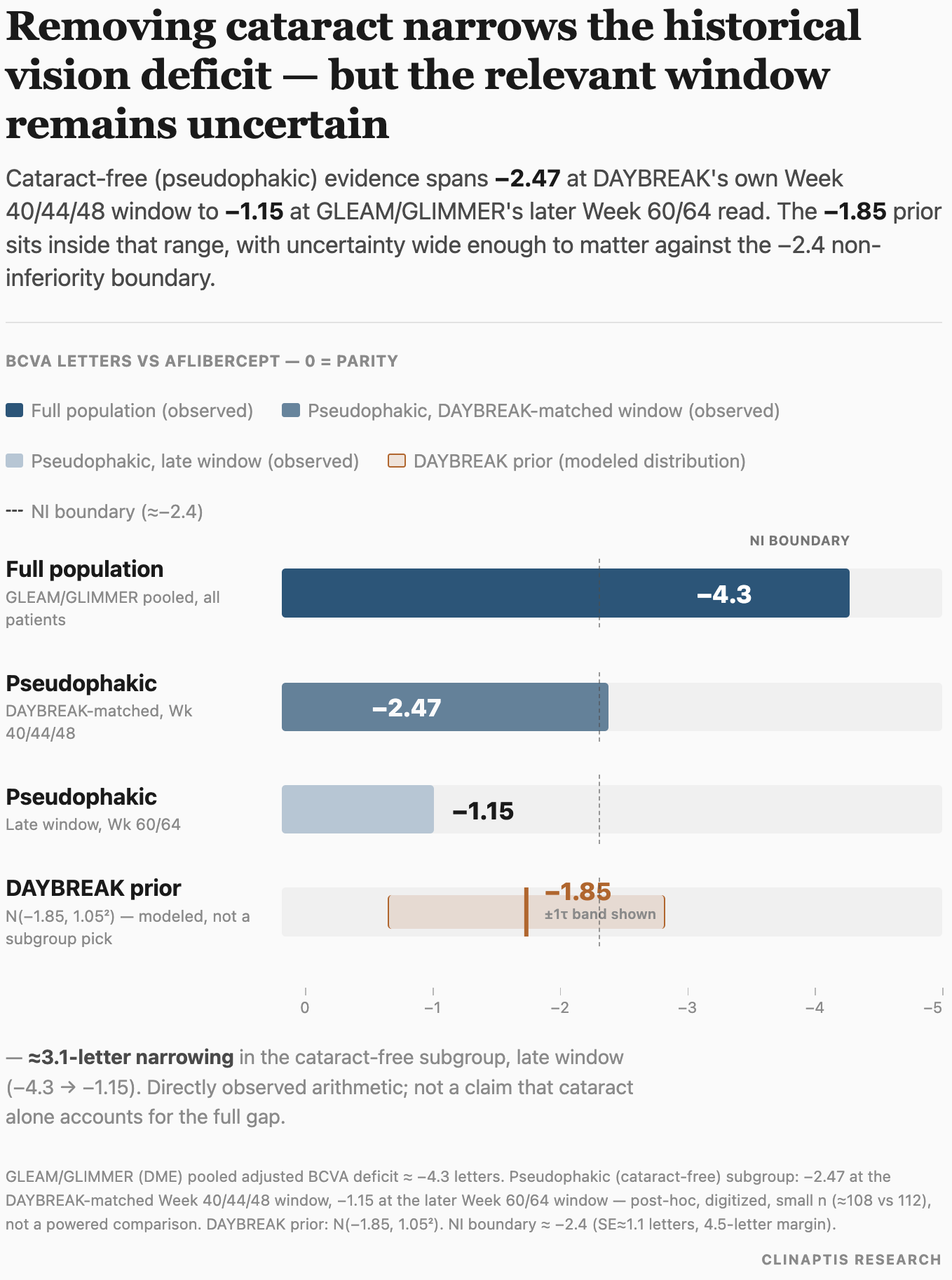
Decompose the ~4.3-letter pooled deficit rather than importing it whole. In the pseudophakic subgroup — patients who cannot develop the cataracts that drove the 2023 failure — the baseline-adjusted BCVA gap at the primary window was only about −1.15 letters, despite half those patients reaching q24w dosing. The anatomic penalty was real (tarcocimab ran ~28µm thicker on OCT) but it barely translated into lost letters. The deficit narrows by ~3.1 letters in the pseudophakic subgroup (−4.3 → −1.15), consistent with cataract accounting for a substantial portion of the historical miss — directly observed arithmetic, not a claim that cataract alone accounts for the full gap.
Management corroborates the mechanism: “In a small minority of patients — is it ten percent or maybe twenty percent — having that large conjugate only meant that in early dosing… we were maybe weak in terms of the speed or the immediacy of that efficacy.” That is why Zenkuda’s enhanced formulation splits its 5mg dose into 1mg unconjugated, fast-acting antibody plus 4mg conjugated, durable antibody — a real, targeted change, though silent on magnitude: no wAMD vision number is attached to the fix, which is why our prior keeps its uncertainty wide rather than tightening toward the bull case.
The −1.15-letter pseudophakic figure is measured at GLEAM/GLIMMER’s own Week 60/64 primary window. But DAYBREAK reads at Weeks 40/44/48, and at that earlier window the same pseudophakic series is −2.47 letters — tarcocimab caught up only late (pseudophakic BCVA rose from ~72.8 at Week 48 to ~74.2 by Week 60). So the honest read is a bracket, not a point: the extension-plus-loading penalty in cataract-free eyes sits somewhere between about −1.15 (late window) and −2.47 (DAYBREAK-matched window), not “capped at one letter.” Two design changes push DAYBREAK toward the favorable end of that bracket — a fourth loading dose (versus three in GLEAM/GLIMMER) and a stricter fluid-driven treat-to-dryness rule, both of which front-load disease control and should lift the early-window result the −2.47 reflects. Add the usual subgroup caveats — small n (≈108 vs 112), a baseline imbalance, post-hoc and digitized — and the DME series alone would support a centre somewhere in the −1.5 to −2.0 range. It is deliberately not −1.15. But the DME series is not the only anchor, and it is not the most relevant one.
The DAYLIGHT bridge — the harder direction. The decomposition above runs from GLEAM/GLIMMER, where cataract does most of the explanatory work. Run it from the other anchor and it gets less comfortable. DAYLIGHT is the only controlled wet-AMD BCVA comparison Zenkuda has: −2.1 letters, with Zenkuda dosed q4w against aflibercept q8w. DAYBREAK then asks the molecule to move from q4w to individualized q4–24w against the same comparator. The fourth loading dose and the fluid-driven rule are real improvements against GLEAM/GLIMMER’s three loads, but they add close to nothing against a trial that already dosed monthly. So against this anchor, formulation credit has to cover the interval-extension debit on its own.
The counterargument is genuine and we weight it: aflibercept q8w sits near its own efficacy ceiling, so q4w-versus-q8w is not a twofold exposure advantage in effect terms, and DAYLIGHT met its endpoint. But two independent cataract-free estimates — −2.47 in DME at the DAYBREAK-matched window and −2.1 in wet AMD at maximal dosing — converge on a −2.1 to −2.5 range that the −1.15 late-window figure does not touch. Against that range, the enhanced formulation and the earlier disease control it targets argue for some positive credit; the interval extension itself argues the other way; and the net cannot be directly estimated, because no controlled enhanced-formulation wet-AMD BCVA dataset exists. Management’s framing supplies one illustrative bound on the credit, not a measured effect: if the immediacy problem affected “ten percent or maybe twenty percent” of patients, then — assuming, as our own bounding assumption rather than a management-quantified figure, a three-letter per-patient repair — the arithmetic implies roughly +0.4 letters to the mean. Treat that as a bounding exercise, not evidence. −1.8 to −1.9 is therefore where we underwrite: between the −2.1 to −2.5 anchors and the −1.5 we previously carried, reflecting credit we believe is directionally real but cannot size empirically. Sustaining −1.5 would require close to a full letter of unobserved improvement — more than management has quantified, and more than the illustrative bound above supports.
Intrinsic relative potency is therefore the strongest unresolved bear hypothesis in this name, and this note does not resolve it: DAYLIGHT passed, populations differ, and comparator variance is real. It is not why we would be short. It is why the prior sits below −1.5 and the uncertainty around it stays wide.
5. The durability bar has moved
Assuming DAYBREAK clears the efficacy hurdle, durability becomes the variable that separates a statistical success from a commercial success. The field has already shown durability is achievable; what remains open is whether Zenkuda extends intervals enough, without sacrificing vision, to change prescribing behavior. Two distributions determine the answer — the vision result, centred at −1.8 to −1.9 letters with wide, downside-skewed uncertainty, and the achieved-interval distribution against a parity bar the field has already raised — and crossing them produces the five states in §6. Two bars matter, and they are not the same bar.
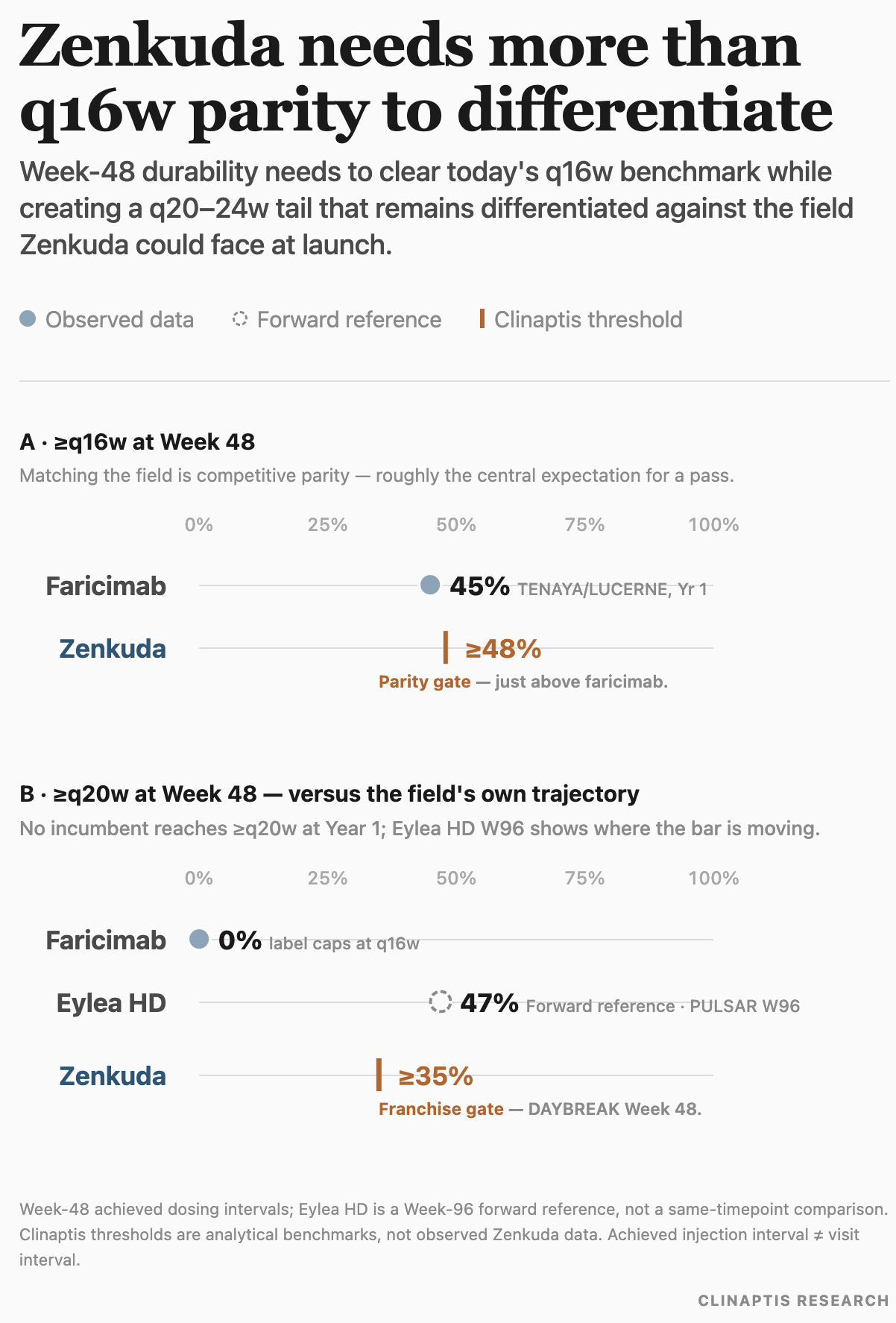
Layer 1 — clinical differentiation, Sep 2026. This is what the readout prints and what the tape trades. The relevant benchmark is contemporary Week-48 achieved interval on an individualized design: faricimab puts ~45% of wet-AMD patients at ≥q16w at one year (its label caps there). That is observed data. Many patients extended past q8w” is therefore no longer differentiating — it is table stakes. We classify ~48% ≥q16w as parity and a ≥q20w cohort of ~35%+ as clinical differentiation (the Franchise gate in Figure 4); both of those are analyst-defined thresholds, not observed Zenkuda outcomes and not regulatory bars. Parity keeps Kodiak in the game; only the tail re-rates the platform.
The biology permits a tail; it does not establish one. Ocular sampling in ~50 patients gives Kodiak’s conjugate a mean ~20-day half-life against ~7.5 days for other antibody-sized eye medicines, with over 80% of patients above 11 days versus ~10% for faricimab. That ~2.7x advantage is the mechanistic reason a q20–24w tail is achievable at all. It is also PK, not achieved dosing interval — DAZZLE carried the same chemistry and still lost the vision comparison. Treat it as permission to underwrite the Franchise state, not as evidence for it.
Layer 2 — commercial differentiation, ~2028. Zenkuda launches into a field that will have moved. Eylea HD’s Week-96 PULSAR data already show 47% of patients ≥q20w, so what reads as a differentiated tail on a Week-48 print may be Year-2 parity by the time it is prescribed. Long-acting implants and TKI depots aimed at the same durability claim are in late development, and biosimilar aflibercept will reshape price underneath all of it. DAYBREAK’s own design adds a discount: disease activity is assessed every four weeks with sham dosing when the algorithm withholds drug, so a q20–24w achieved injection interval does not translate into a q20–24w reduction in clinic visits — that depends on a post-approval monitoring paradigm the trial does not test.
The two layers can disagree, and that is the Durability-led state’s real risk. A Week-48 result can clear Layer 1 — parity or better against faricimab’s contemporary numbers — and still fail Layer 2 by the time it competes. Our peak-share assumptions (6.5% / 9.5% / 13.5% / 22.5%) are Layer-2 judgments struck against a field that will move again before any of them is tested. The tape trades Layer 1; the fair value depends on Layer 2.
LUGANO: durability alone is insufficient. EyePoint’s DURAVYU missed the primary NI endpoint in Ph3 LUGANO on 17 Aug 2026, despite a genuine durability edge (42% reduction in injection burden), and EYPT fell roughly 60%+ to a 52-week low. LUGANO is good evidence for one proposition — the market will not pay for durability when vision fails — and weak evidence for the magnitude of a KOD drawdown, because EyePoint had no approved-indication optionality behind the asset and Kodiak does. We use it for the former and calibrate the Fail tape off Kodiak’s own residual value and trading history instead (§7).
One inference from ALTO, carefully bounded. Kodiak began a 910-patient second registrational KSI-501 study on 10 August, with DAYBREAK still blinded. That is weak evidence that no development-stopping safety signal — vasculitis, occlusive events — has surfaced at the DSMB level on the same platform. It says nothing about efficacy, and “no DSMB halt” is a long way from “clean safety.” It matters only for the composition of the Fail state: a miss is more likely to be an efficacy disappointment than a safety event, which is a materially cheaper failure.
6. The quality of the pass determines the stock outcome
DAYBREAK is not a binary event. A non-inferiority pass can produce materially different equity outcomes depending on the combination of vision and durability delivered. We separate the old “mixed” bucket into two states: a low-differentiation pass where Zenkuda clears the bar but lacks a commercial edge, and a durability-led mixed outcome where thinner vision is offset by competitive durability — a scenario with precedent in Vabysmo but a lower ceiling than a clean re-rate.
Each state is carried through the valuation with Kodiak’s other clinical assets held constant (financing mechanics in §7).
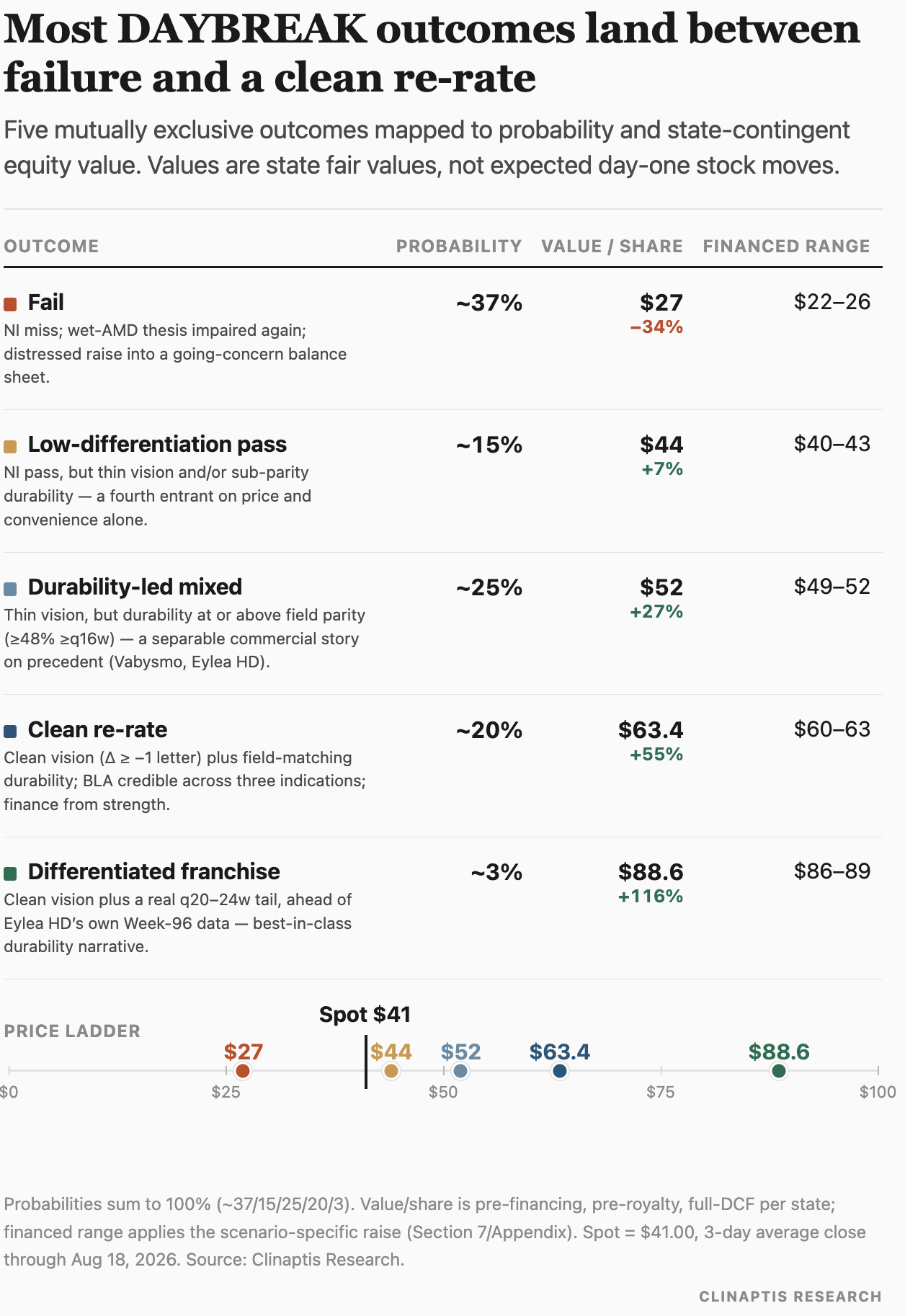
Positive but non-differentiated outcomes carry ~40% of the distribution, against ~23% for re-rate quality and ~3% for franchise validation.
What the crossing assumes. The five states come from crossing the vision distribution with the achieved-interval distribution, and the engine treats the two as approximately independent: the model’s implied probability of clearing the parity gate is ~76% whether vision prints clean or thin. That is a simplification, and two mechanisms push against it in opposite directions. Biologically, a molecule with better ocular residence should deliver both better vision and longer intervals — positive correlation, and the platform thesis assumes exactly that. Mechanically, DAYBREAK’s fluid-driven rescue converts weak disease control into earlier retreatment rather than lost letters — the algorithm trades interval to protect vision, which is negative correlation.
Durability-led mixed is the state most exposed, because it is the off-diagonal outcome: thin vision with good durability. Under moderate positive correlation it falls toward ~21% and re-rate quality rises toward ~26%; under the algorithm-dominant case it rises toward ~29% and re-rate quality falls toward ~20%. The ordering survives every regime we tested and the middling block stays the largest at 37–43%, but individual state probabilities are less precise than two significant figures imply. Read them to the nearest five points.
7. Fundamental value versus the post-readout tape
Kodiak’s going-concern flag doesn’t change the fundamental ranking of outcomes, but it does change the path from readout to stock price. With under a year of cash, Kodiak likely raises after anything short of a clean pass — largest and most-discounted in Fail, smallest and cheapest in Franchise (terms in Appendix) — which compresses the modal outcome toward spot rather than through it.
The distribution in §6 is the conclusion; what follows is the lowest-confidence layer in the note, a calibration of how the tape might express it.
Fundamental impairment and tape overshoot are different objects, and the Fail state is where they diverge most. A clean NI miss does not erase DR, RVO, KSI-501 or KSI-101; on our own build it impairs the equity by roughly a third, to $27/share. But a going-concern name that has just lost its anchor indication, facing a discounted raise, should be expected to trade through fundamental value before settling. We centre the Fail tape at −45% ($22/share, inside the post-financing range) and treat −60% as a tail requiring something worse than an ordinary efficacy miss: severe vision failure, a safety signal with platform read-through, or a disorderly financing.
We do not apply the same compression to the upside. A genuinely clean, differentiated print simultaneously revises wet-AMD economics, three-indication BLA credibility, platform validation, peak-share expectations and financing terms — and it is hard to parse quickly. Complex readouts that resolve several questions at once tend to overshoot on the way up, and we have left the upper states wide rather than trimming them toward a narrower consensus band.
Illustrative post-readout reaction (analyst calibration, not a valuation output):
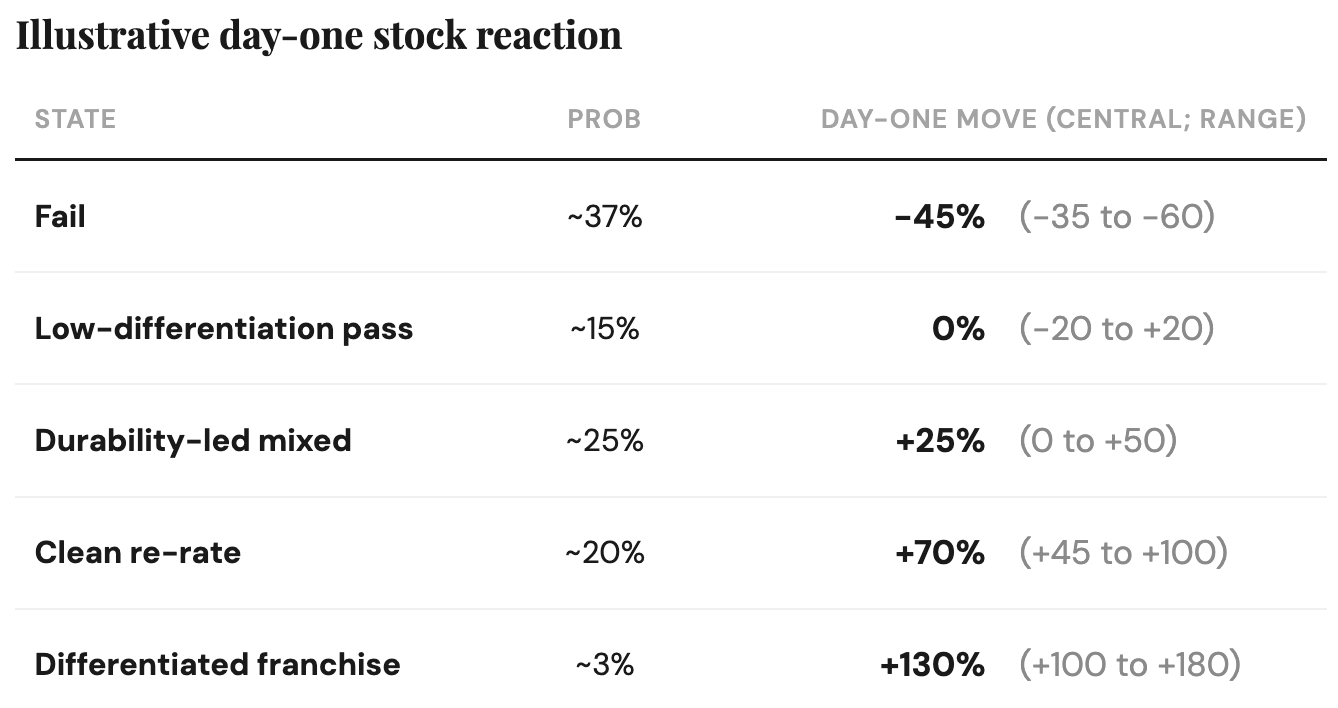
Probability-weighted, that is roughly +7%, barbelled rather than symmetric: a −16.7pp drag from Fail against a +17.9pp lift from Clean re-rate and Franchise, with the two middle states contributing ~+6pp. The weighted number is the least robust output in the note — it swings from about +2% to +11% across the Fail-tape range alone, without any change to the underlying clinical view. Treat the spread as the finding and the point estimate as a summary of it.
KSI-501 modifies the tape without moving the fundamentals. DAYBREAK reports three arms at once, and the five states above are a Zenkuda framework. KSI-501 carries only ~$117M of rNPV — about 4% of equity value — so its fundamental contribution is small in every state. Its narrative contribution is not, and it is asymmetric: a clear superiority result would cushion a Fail or Low-differentiation tape most — those are the states with no other story available — and add little to a clean re-rate that is already happening. A KSI-501 miss matters little either way. A KSI-501 safety signal is the exception that cuts across all five states, because KSI-501 sits on the same ABC platform — that is a platform read-through, and it is the kind of event the −60% Fail tail contemplates.
8. Bottom line
The consensus question — whether DAYBREAK achieves non-inferiority — is probably answered yes, at ~63%. That is an edge, not a resolved question, and it is lower than it looks at first pass because the only controlled wet-AMD anchor Zenkuda has was struck at q4w against a q8w comparator. The investment question is whether a pass differentiates, and the distribution says probably not cleanly: positive-but-undifferentiated outcomes carry ~40%, re-rate quality ~23%, franchise validation ~3%.
That gap is the trade: Kodiak is roughly twice as likely to pass without differentiating as to pass and re-rate, on a stock that has already moved 5x and still needs to finance across most of the distribution. Royalty-adjusted pre-trial fair value of ~$40/share sits marginally below spot. This is not an upside call.
DAYBREAK does not decide the whole valuation. DR, RVO and the two KSI programs contribute roughly 60% of pipeline rNPV and leave residual value even under a weak wet-AMD result (build in Appendix). That value is not fully diversifying: DR and RVO are the same molecule as wAMD, sharing one multi-indication BLA, and KSI-501 shares the ABC platform. Only KSI-101 is mechanistically independent — though it still carries company-level risk (financing, management execution, the shared regulatory package, CMC) with the rest of the portfolio.
The variant perception is about shape, not probability. A reader can accept our ~63% and still reach a different answer by disagreeing about what a pass is worth — which is the point. A stock priced at or slightly through fair value on a blended basis, against a near-term distribution spanning roughly −45% to +130%, is a position-sizing problem before it is a directional one. Our highest-confidence claim is the shape of that distribution; our lowest is the single number it averages to.
DAYBREAK is more likely than not a technical success. Whether it is an investment depends on a durability bar the field has raised twice while Kodiak was fixing its formulation — and on whether the bar that matters is the one the market sees in September or the one Zenkuda has to clear in 2028.
What would change our mind
Efficacy prior / formulation credit. μ at −1.85 gives ~63% NI pass probability; at −1.5 it rises to ~71%; at DAYLIGHT’s −2.1 it falls to ~56%; at ~−2.34 it is a coin flip. Roughly 2.5 points of probability per tenth of a letter — the single most consequential number in the note, and the one most exposed to an unobserved formulation credit.
Fail-tape calibration. At −45% the weighted near-term move is ~+7%; at −60% it is ~+2%; at −35% it is ~+11%. The tape assumption moves the headline as much as the clinical prior does, and it is a weaker judgment.
Durability parity threshold. At faricimab’s ~45% ≥q16w, re-rate quality is ~23% unconditionally; at an aspirational 55%, it falls to roughly 14%.
Efficacy–durability dependence. The engine treats the two as independent. Moderate positive correlation moves Durability-led mixed to ~21% and re-rate quality to ~26%; the algorithm-dominant case moves them to ~29% and ~20%. Ordering holds; precision does not.
Market treatment of Durability-led mixed. If a thin-vision-but-durable pass trades like Low-differentiation rather than earning credit for the durability data (the LUGANO risk), the weighted near-term move compresses from ~+7% toward ~+1%, and the fundamental case for that state weakens correspondingly.
The Durability-led peak-share assumption (9.5%). Analyst judgment, not simulation output — directionally precedented by Vabysmo/Eylea HD but not primary-sourced to a Zenkuda-specific analog, and the largest unmodeled lever on fair value after the wAMD active-treated base.
DR penetration and pricing. The 9%→18% penetration doubling is a behavioral bet with no direct precedent — durability alone did not move DR uptake for Eylea HD — and gross-to-net pricing remains a live assumption (full build in Appendix).
Appendix — Valuation methodology
The build behind the numbers in the body.
What DAYBREAK does not decide. DR, RVO, and the two KSI programs carry additional value this readout doesn’t decide: ~$1.68B risked value against ~$1.09B for wAMD, or ~60% of pipeline rNPV. This is why Fail lands at ~$27 rather than near zero, and why Low-differentiation-pass (§6) stays near spot despite a weak wAMD outcome. That value is not fully diversifying: wAMD, DR and RVO are the same molecule sharing one multi-indication BLA, and KSI-501 shares the ABC platform. KSI-101 is the exception — an unconjugated IL-6/VEGF bispecific, mechanistically independent of the conjugation/durability platform — though it still carries company-level risk (financing, execution, the shared regulatory package, CMC) alongside the other legs.
Architecture. wAMD regulatory PoS (56.7% = 63% NI-pass probability × ~90% filing/review conditional) is kept strictly to approval risk. Commercial-quality risk lives entirely in peak share, blended across the four non-Fail states — Low-differentiation pass, Durability-led mixed, re-rate and franchise peak shares (6.5%/9.5%/13.5%/22.5%) — weighted by probability conditional on approval, so risk is never charged twice. At the revised state weights the blend falls slightly, from ~10.9% to ~10.7%, as mass shifts from re-rate quality toward the durability-led middle. Durability-led mixed’s ~25% probability comes from the same simulation engine as every other state (thin vision, Δ < −1L but passing NI, plus durability at or above the Layer-1 parity gate) — not an analyst overlay — though it assumes efficacy and durability are approximately independent (§6). Its 9.5% peak share is judgment, anchored to Vabysmo’s durability-only precedent but discounted for how far the Layer-2 bar has since moved.
Prior construction. The efficacy engine combines a prior on the true Zenkuda-versus-aflibercept effect (central −1.85 letters, SD ~1.05) with sampling error (effective SE ~1.1 letters at ~225/arm), giving a predictive SD of ~1.5 letters against a derived pass boundary of ~−2.34 observed letters. Prior mean and SD are both analyst judgment; the SE is estimated from Kodiak’s own realized Ph3 precision. The prior mean moved from −1.5 in prior drafts after re-weighting DAYLIGHT (§4).
wAMD. The anchor asset, the only leg on a full 17-year DCF. Demand is bottom-up from an active-treated base (~1.2M currently; peak-year 1.15M/1.25M/1.35M Bear/Base/Bull), not a prevalence funnel. The ~1.2M base is derived from the FY2025 anti-VEGF wet-AMD treated population implied by Eylea/Eylea HD and Vabysmo US net sales at reported injection intensity and net price, cross-referenced to retina-claims analyses of actively treated patients; it is a treated-patient count, not the ~1.5M+ diagnosed-prevalence pool. Pricing: gross price/injection ($2,000/$2,100/$2,200) × gross-to-net (72%/75%/78%) = net $1,440/$1,575/$1,716, at 5.0–6.0 injections/year. That gives US net peak sales of $0.62B/$1.62B/$3.47B. For context, Eylea plus Eylea HD did $4.385B US net sales in FY2025 at ~41% share — a Base-case Zenkuda at ~37% of that isn’t a heroic ask for a differentiated entrant.
DR. Sized off a primary-source VTDR pool of 1.84M (CDC VEHSS / JAMA Ophthalmology 2023, 95% UI 1.41–2.40M) — not the 9.6M any-DR figure, an unusable commercial denominator. The CDC VTDR definition spans severe NPDR, PDR and DME; because DME is separately addressed by anti-VEGF today, the incremental DR-driven opportunity sits in the NPDR/PDR-without-DME slice, and 1.84M is therefore an upper bound on the commercially relevant pool rather than a conservative one. Current anti-VEGF penetration of VTDR is only ~9% (Roche epidemiology), historically lower still — Medicare claims show just 7.4% of VTDR-without-DME patients treated in 2018.
We model peak penetration rising to ~18% (12%/18%/27%), Zenkuda capturing ~35% (20%/35%/45%) of the treated pool at 2 injections/year — $3,150/patient-year at $1,575 net/injection. US peak sales: $120M/$365M/$765M, or $155M/$475M/$995M worldwide at 0.30× ex-US.
Approval probability 82.5% (72.5%/90% bear/bull): GLOW’s clinical support is strong (~90–95%), but the single multi-indication BLA (DR+RVO+wAMD) means the DR revenue stream clears only on the joint of clinical success and an acceptable integrated package — formulation bridge, CMC, a safety database complicated by the GLEAM/GLIMMER and DAZZLE misses. We do not model DR × RVO × wAMD as an independent three-trial tree, since FDA can approve indications selectively — this is correlated package risk, not all-or-nothing.
RVO. BEACON is genuine Ph3 evidence — randomized, active-controlled (n=568), NI in BRVO and overall RVO on fewer injections than aflibercept with matched vision — earning a 75% approval probability (below DR: BEACON used the original formulation, a residual bridging risk). It doesn’t earn peak sales sized off management’s $3–3.5B TAM narrative; we size bottom-up: ~750K US treatable ceiling, 30–50% actively treated, 7.5–20% Zenkuda share — cross-checked against a 2025 retina-database analysis (n=40,429 treated eyes) showing injection intensity falling ~7/year to ~3.8/year by year five. Global peak sales $100M/$300M/$750M.
KSI-101. Carries a near-term catalyst of its own: the initial 300-patient PEAK cohort has completed enrolment with a first pivotal readout guided to December 2026, roughly three months after DAYBREAK. That matters for the Fail state — a company financing into a live catalyst raises on different terms than one without. Often confused with KSI-501: KSI-101 is an unconjugated IL-6/VEGF bispecific testing whether that biology works, independent of the durability platform; KSI-501 is the second ABC-platform candidate, testing whether conjugation extends beyond one molecule. Sized on Kodiak’s disclosed >150K initial-addressable pool (steroid-contraindicated, multiply-treated/refractory ME-with-inflammation, PEAK/PINNACLE Ph3) at 10–35% peak penetration. Approval probability 52.5%, weighing the Ph1b APEX proof-of-concept against its small, uncontrolled design. Global peak sales $140M/$380M/$900M.
KSI-501 / ALTO. Valued at $117M rNPV against the DAYBREAK arm alone (§3) — ~4% of equity value, which is why §7 treats it as a tape modifier rather than a valuation driver. ALTO — the global Ph3 in DME, first patients enrolled 10 August 2026, superiority design vs. aflibercept, ~910 patients, primary endpoint Weeks 48–52 — isn’t yet in this figure; it is strategic optionality carrying no valuation weight pending its own diligence pass. Its initiation date carries the weak safety inference discussed in §5.
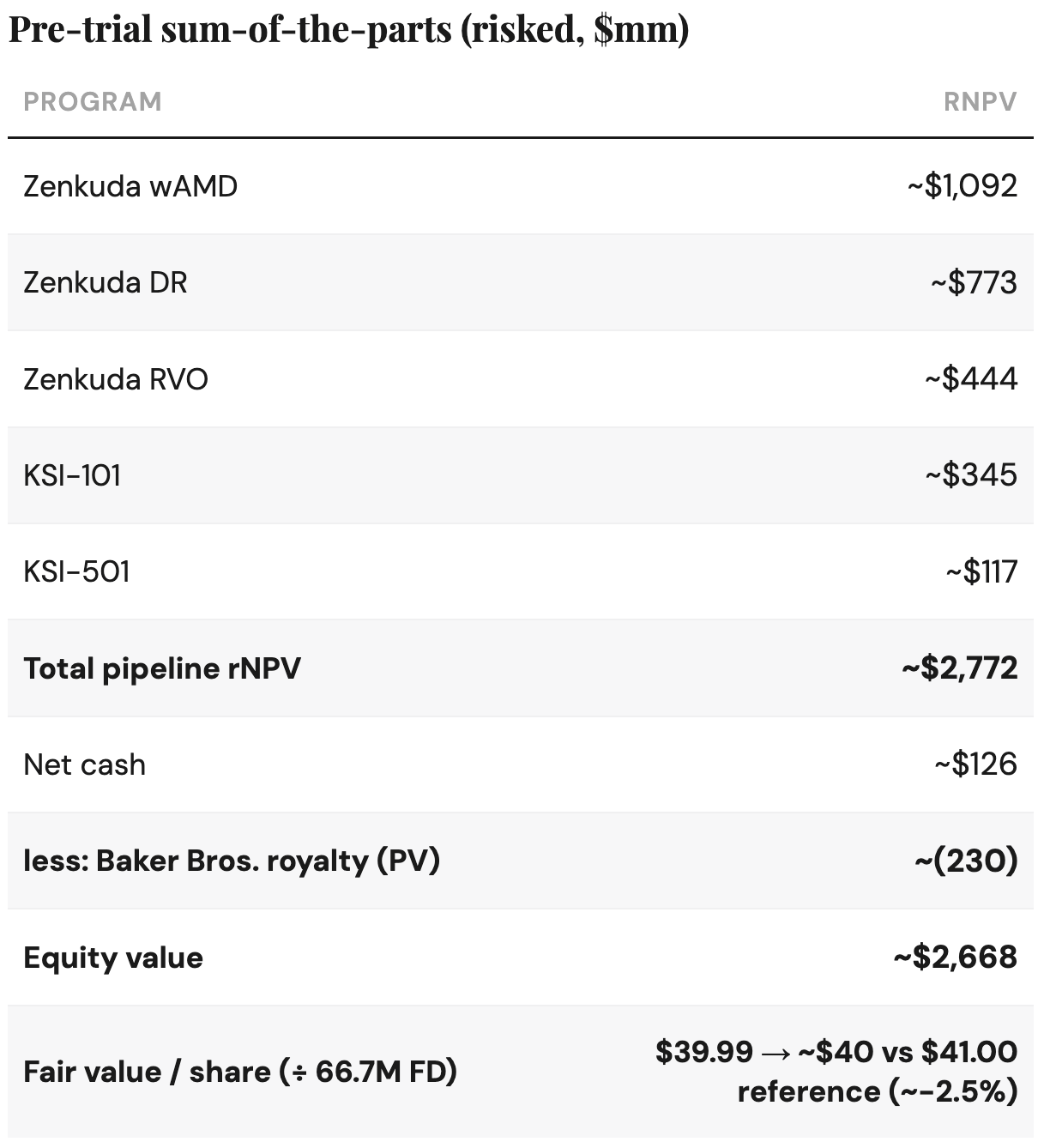
Baker Bros. royalty. Per the 2019 funding agreement (2022 10-K), Kodiak sold BBA a 4.5% royalty on global tarcocimab net sales for $100M funded ($125M further tranche declined in 2021), terminating once BBA receives 4.5× funded — $450M cumulative; combination products (KSI-501) carry a reduced 1.5–2.25% toward the same cap. No repayment obligation; Kodiak holds a repurchase option at 4.5× funded less amounts paid. This is not a $100M debt deduction — it is a capped, long-duration top-line royalty on Zenkuda net sales. For the pre-trial SOTP we retain a $230M ($39.99 unrounded model output) legacy royalty-PV overlay, applied once at the portfolio level, which moves pre-trial fair value from a pre-royalty $43.4 to $40.0. The post-readout state DCFs (§6) are shown pre-royalty to isolate DAYBREAK outcomes; the royalty lowers each state price by a state-dependent amount, larger in higher-revenue states. The precise long-duration royalty PV is sensitive to revenue-timing assumptions well beyond this readout and is not central to this catalyst analysis; it is carried here for SOTP consistency rather than independently re-underwritten in this cycle.
Post-readout state prices derive from a full per-state 17-year DCF using each state’s own peak share and approval probability: ~$27 (Fail), ~$44 (Low-differentiation pass), ~$52 (Durability-led mixed), ~$63 (Clean re-rate), ~$89 (Franchise), pre-financing and pre-royalty. (The royalty lowers each price by a state-dependent amount, larger in higher-revenue states; the barbell shape holds.) These per-state DCFs and the pre-trial blended SOTP are different estimands — five independent DCFs vs. one blended-PoS DCF — so the gap between the $40.0 pre-trial figure and the probability-weighted post-readout average ($44.95 pre-financing) is expected, not an error. We do not publish a market-implied probability of success: reverse-solving the price against these state values is under-identified, because the state values bundle approval probability, commercial quality and the non-DAYBREAK legs. The thesis does not require it.
Financing overlay. A standalone layer applies a scenario-specific raise on the full-DCF state prices — largest/most-discounted in Fail ($325M at 25%), smallest/cheapest in Franchise ($150M at 5%), with Low-differentiation pass ($250M/15%) and Durability-led mixed ($225M/11%, interpolated) between. Two treatments bracket the range: proceeds retained as cash (dilution only) versus consumed by ongoing burn (more conservative, used for Fail and the two non-differentiated-positive states). Probability-weighted across ~37/15/25/20/3, expected drag on fair value is roughly −1.6% (retained) to −9.2% (consumed). Read-only; doesn’t feed back into the pre-trial DCF. Post-financing (pre-royalty, per Figure 5): Low-differentiation pass ~$40–43/share, Durability-led mixed ~$49–52/share.
Post-readout tape math (§7). Probability-weighted across ~37/15/25/20/3, the reaction table works out to roughly +7% — barbelled: a −16.7pp drag from Fail against a +17.9pp lift from Clean re-rate/Franchise, the two middle states contributing +6pp. The Fail tape is centred at −45%, between fundamental impairment (−34%) and the −60% tail; across the −35%/−60% range the weighted figure moves from ~+11% to ~+2%, which is why §7 presents the spread rather than the point. The Durability-led-mixed assumption (+25%) is precedented by Vabysmo’s trading history and is the one LUGANO pressures. Provisional analyst calibrations, not model outputs.
Key sensitivities and sourcing. The PK series behind the durability hypothesis (§5) is ocular sampling in ~50 patients and is not achieved-dosing-interval data; it supports the plausibility of a q20–24w tail without evidencing one. The DR leg is primary-sourced (CDC VEHSS/JAMA Ophthalmology 2023, Roche epidemiology, 2024 Vestrum, 2022 Medicare claims); its residual risk is the 9%→18% penetration bet, not the epidemiology. RVO and KSI-101 are built bottom-up from named sources. The wAMD active-treated base and gross-to-net pricing remain the largest levers on the anchor leg. Durability-led mixed’s 9.5% peak share is judgment, not simulation output — directionally precedented by Vabysmo/Eylea HD but not Zenkuda-specific — the second-largest lever on fair value after the wAMD base. ALTO (KSI-501, Ph3 DME, superiority design) is disclosed but carries no valuation weight. The Franchise state carries the monitoring-burden discount described in §5. The $41.00 reference price is confirmed arithmetic: the 3-day average close through Aug 18, 2026 (Aug 14 $41.35 / Aug 17 $40.98 / Aug 18 $40.65) averages to $40.99, rounding to $41.00. Note that the ~$43M/quarter figure used in §1 is cash operating burn and will not tie to reported GAAP operating expense, which runs materially higher on stock-based compensation — the two should not be compared directly.
Disclaimer. This note is provided for informational purposes only and does not constitute investment advice, a recommendation, or an offer or solicitation to buy or sell any security. It reflects Clinaptis Research’s independent analysis, built from publicly available information and management commentary believed to be reliable but not independently verified in every instance; the estimates, probabilities, and valuation ranges throughout are analyst judgment, not guarantees, and may prove wrong. Clinaptis Research and its principals may hold positions in the securities discussed and may transact in those positions at any time without notice. Past performance is not indicative of future results, and forward-looking statements about clinical, regulatory, or commercial outcomes are inherently uncertain. This note is not intended for redistribution. Readers should conduct their own diligence and consult a qualified financial advisor before making any investment decision.