
Lean Mass: Selectivity Is the Trap
Selectivity makes apitegromab's lean-mass result (1.9 kg preserved vs. placebo) the cleanest in obesity — and the why exactly why it hasn't proven mass becomes function.

The market prices apitegromab as the clean answer to what GLP-1s cost patients. Rapid weight loss on a GLP-1 anti-obesity medicines (AOM) strips lean mass alongside fat, and apitegromab’s pitch is efficacy against that loss — weight loss without the muscle loss, and without the off-target burden that dogs broader ActRII blockers. That claim is real, and it shows up in the tape: roughly 15–25% of Scholar Rock’s (SRRK) ~$6.0B enterprise value (EV) sits on the obesity opportunity, priced on the lean-mass efficacy claim as much as on tolerability, with sell-side probability-adjusted peak sales generally clustering around $1.0 Bn (vs. SMA $1.6-$1.8Bn). The lean-mass result earns that starting point. The dispute begins one inference later.
That inference is a chain the valuation quietly embeds: preserved lean mass on a DXA (dual-energy X-ray absorptiometry) scan becomes preserved skeletal muscle, becomes physical function, becomes something a physician can measure and a payer will underwrite. Muscle preservation has been sold as the fix for GLP-1 muscle loss since the category’s Ph2 data began reading out, and the shelf keeps growing — Even as the class’s translation problem accumulates, new capital keeps entering — iBio’s IBIO-600 dosed its first patient in June 2026. Across several years of that pitch, no asset has yet produced a patient who is demonstrably stronger, not merely leaner on a scan. That is the specific claim this note tests.
Three programs have now run muscle preservation on a GLP-1 backbone or as monotherapy: apitegromab (EMBRAZE), bimagrumab (BELIEVE), trevogrumab (COURAGE). Read together, they say selectivity buys a clean proxy, not a functional claim — and the class has already run the mass-to-function experiment in patients who actually carried the deficit, without it translating. Selectivity is therefore both apitegromab’s strength and its possible trap: the cleanest body-composition result in obesity, attached to the thinnest evidence that clean body composition is what this market ultimately rewards. SMA is not the subject here; that franchise and the safety profile are real. The narrower question is the one to sit with — is the market paying for a demonstrated obesity attribute, or for the belief that a tidy biomarker becomes one?
I. Apitegromab’s Weight-Loss Identity Closes on the Scale
Start with what the bear case has to survive: the objection that EMBRAZE is a noisy trial and the lean-mass signal is an artifact. It isn’t, and saying so is this section’s first job. Total body weight is an accounting identity — lean mass plus fat mass plus everything else — and the fastest test of whether a body-composition pitch is honest is whether its own numbers reconcile to the scale. EMBRAZE’s do. That matters, because it means what follows can’t be waved away as bad data. Apitegromab’s problem isn’t that the result is soft. It’s that the result is clean, and clean is not the same as valuable.
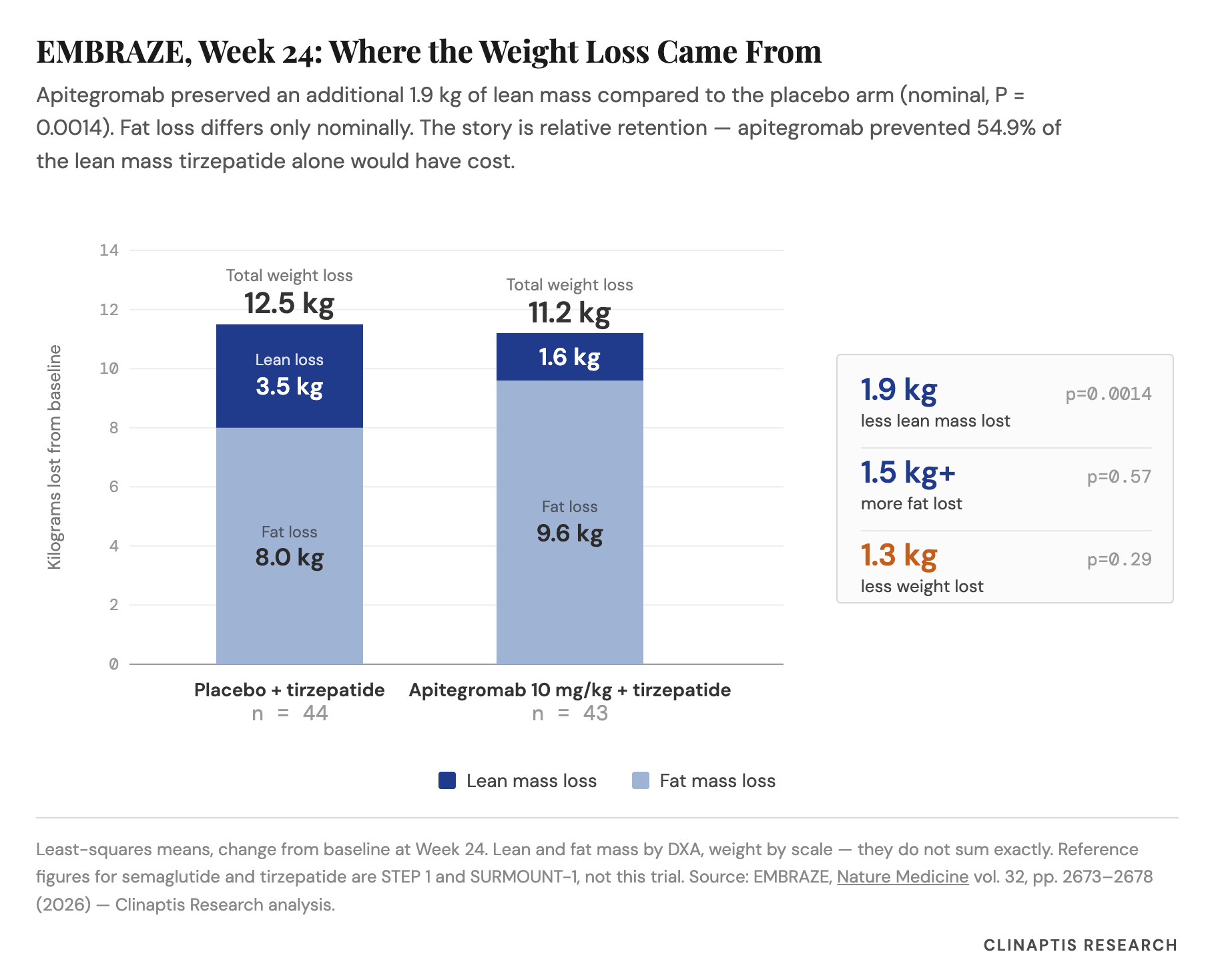
The identity closes — which is the point. Apitegromab preserved 1.9 kg more lean mass than placebo (p=0.0014) while losing ~0.5 kg more fat (p=0.5744 — noise). Net the two rather than sum them, and the expected weight difference is 1.4 kg; the measured difference was 1.3 kg (p=0.288). A 0.1 kg residual is what “the identity closes” is supposed to look like, and here it does. The non-significant fat delta kills a second bull story before it starts: there’s no hidden fat-loss edge buried in the total. Visceral adipose tissue, measured directly, is a cleaner null still — 0.0 kg difference (80% CI −0.1 to 0.0, p=0.5255), with VAT’s share of total adipose moving 0.1 points (p=0.8946). The cardiometabolic fallback has no data to stand on. The number exists, and it’s flat (Exhibit 1).
Now price the trade. The useful question isn’t whether lean mass was preserved — it was — but what preserving it cost on the scale. Divide the weight delta by the lean delta and you get a forfeiture ratio: kilograms of weight loss surrendered per kilogram of lean mass preserved. Apitegromab’s is 1.3 ÷ 1.9 = +0.68, roughly a two-thirds tax. That figure only turns damning next to the alternative. Bimagrumab, engaging the receptor far more broadly, runs −1.38 — more lean preserved and more weight lost, both significant (p<0.001, p=0.039). Trevogrumab’s own dose ladder (200 mg and 400 mg subcutaneous, monthly) bends the same way as it grows more promiscuous: +0.50 at Trevo 200, −0.29 at Trevo 400, −1.13 for the triplet — each computed against its own same-backbone comparator, one formula throughout.
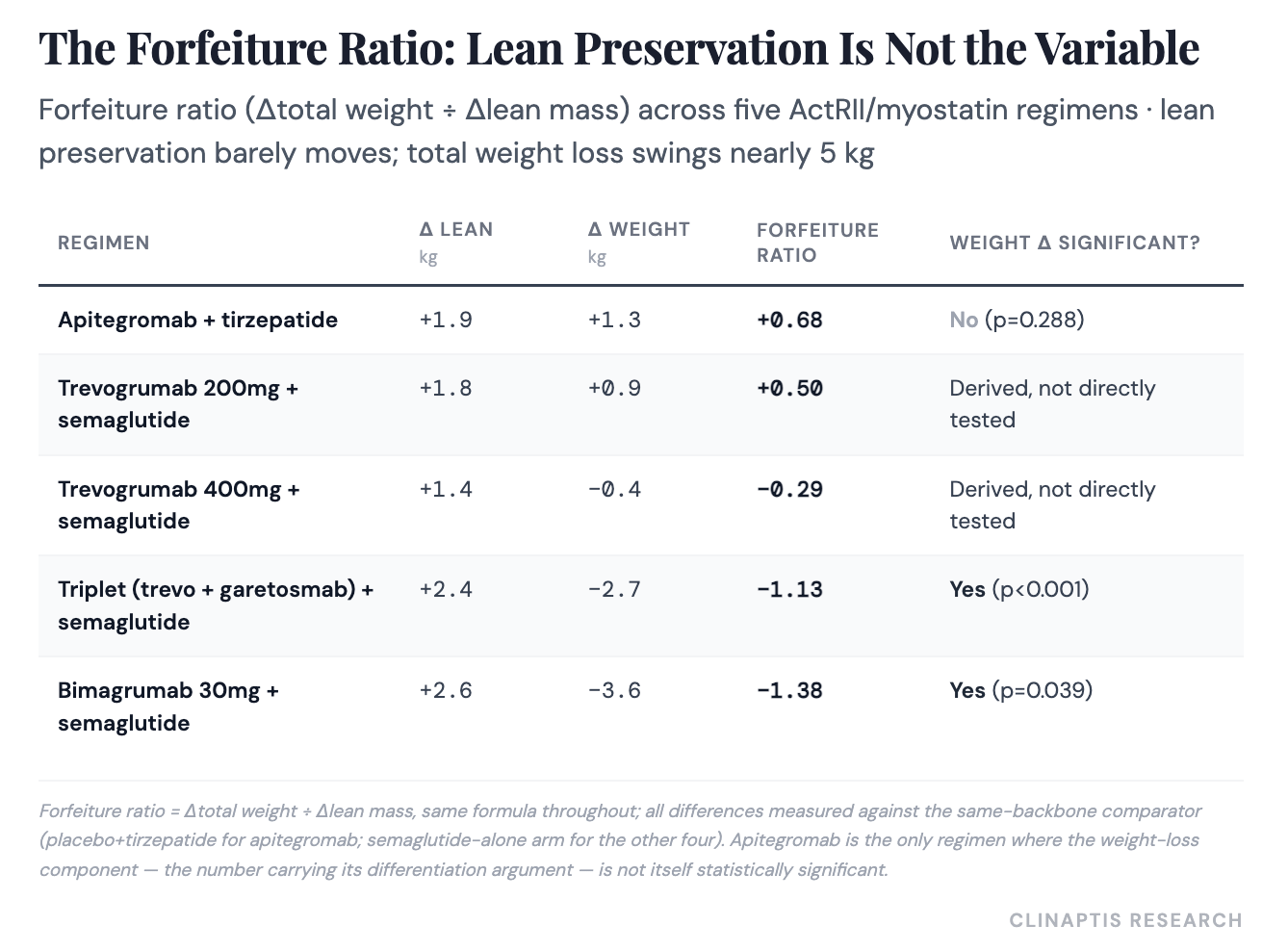
Deltas vs the same-backbone comparator (placebo + tirzepatide for apitegromab; semaglutide monotherapy for the rest). Ratio = Δ total weight ÷ Δ lean mass; positive = weight loss forfeited, negative = weight loss enhanced.
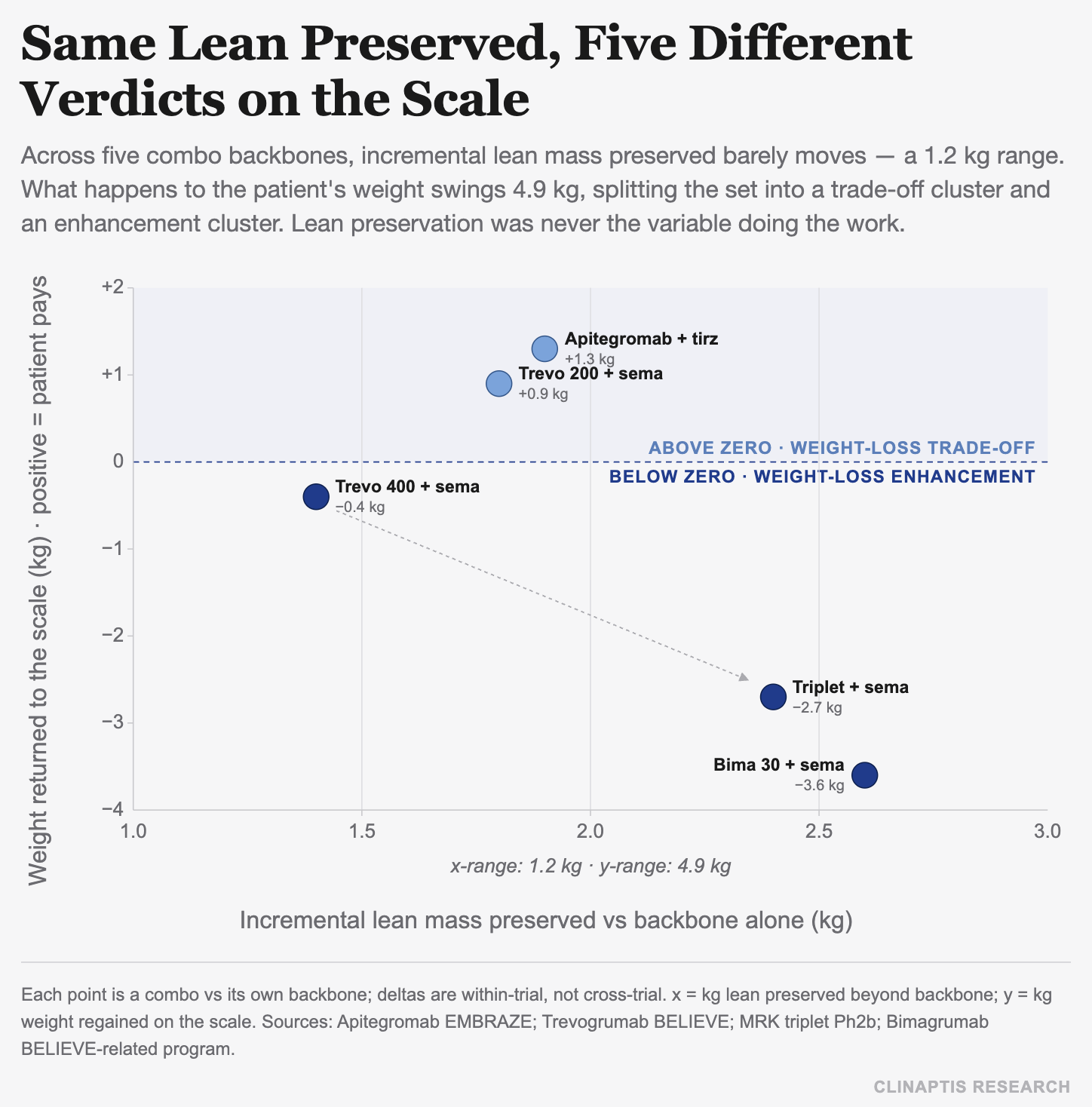
Plotted, the five regimens don’t trace a gradient — they split into two clusters on either side of zero (Exhibit 2). Lean preservation barely moves across the set, a 1.2 kg spread, while total weight loss swings 4.9 kg. Lean preservation was never the variable doing the work. Receptor promiscuity was.
And the number carrying SRRK’s differentiation is the weakest one on the board. Line the ratios up and one fact sits under the entire obesity thesis: of the regimens whose weight delta was actually powered and tested, apitegromab’s is the only one that came back non-significant — and the two that cleared significance are the two most promiscuous. Selectivity doesn’t merely fail to help the weight-loss arithmetic. The one place it’s supposed to win, it wins on a number the trial couldn’t tell apart from zero.
II. Is COURAGE Actually an Activin A Test?
COURAGE isn’t an obesity readout — it’s a controlled experiment the market is reading as one. Randomize a dose ladder of one molecule, add Activin A binding only in the triplet arm, hold the semaglutide backbone and the population fixed, and you’ve isolated the single variable every cross-trial comparison confounds. Apitegromab-trial-versus-bimagrumab-trial can’t tell you what Activin A engagement costs; it imports three eras of GLP-1 dosing and two patient populations along with the answer. COURAGE strips those out by construction. That’s why it, and not EMBRAZE, is where the obesity thesis is actually adjudicated.
And what it adjudicates is a sign flip that runs directly against selectivity. Trevogrumab alone — no Activin A binding — sits near zero on the forfeiture ratio, apitegromab’s own neighborhood at +0.68. Bind Activin A and the ratio turns solidly negative: more lean preserved and more weight lost, the trade eliminated rather than softened. The clean molecule pays a tax on the scale; the dirty one gets paid. Scholar Rock’s 10-K confirms apitegromab binds neither GDF11 nor Activin A — the selectivity is deliberate, and COURAGE is the invoice for it.
The invoice is steep, which is the point — the debate isn’t biology anymore, it’s price. The triplet arm ran a 28.3% discontinuation rate and ~10% severe TEAEs, with two deaths: one undetermined in a patient carrying multiple cardiovascular risk factors, one cardiac arrest with prior CV disease. Regeneron reports no identified causal link, and that qualifier stands — weigh it as a signal, not a verdict. But notice what it does to the question. COURAGE never asked whether promiscuity works; the ratios settle that. It asks whether the tolerability bill is worth paying, and for which patients — a commercial judgment the market has quietly folded into the clean efficacy read it’s already rewarding.
II.B — What the Sponsors Have Revealed
Apitegromab’s safety is the real thing being inherited — and it’s being mistaken for efficacy. No honest note disputes the profile: EMBRAZE logged AEs in 76% of apitegromab participants versus 71% on placebo, with no serious AEs, no discontinuations, no attributed hypersensitivity, no deaths; 6% developed transient low-titer ADAs with no safety signal. That’s what selectivity bought, and it’s exactly what SMA demanded — a molecule you can give a child every four weeks for life. The obesity valuation inherited that cleanliness and priced it as though efficacy came attached. It didn’t. Safety and efficacy are separately measured, and only one of them is in dispute.
The class hasn’t yet run the trial that would end the argument. Taldefgrobep — broad ActRII blockade, monotherapy, against placebo, topline 2H26 — is the clean test of whether promiscuity alone buys the fat-loss premium, with no muscle-preservation story to hide behind. Until it reads out, the strongest evidence sits with the sponsor that already has the data.
Which is Lilly — and Lilly keeps powering on the scale. Through Versanis and bimagrumab, Lilly owns the deepest muscle-preservation dataset in obesity, and every trial choice points away from muscle as the endpoint that matters. BELIEVE’s primary moved off waist circumference to total body weight on FDA feedback. Appendicular lean mass — the DXA measure most specific to skeletal muscle — entered only as a secondary. The follow-on, NCT06643728 (bimagrumab ± tirzepatide, Ph2, ~70 weeks), carries one primary: change in body weight. The sponsor with the most to gain from making lean mass the endpoint declined to — and that’s a revealed preference no bull can dismiss as SRRK-specific.
III. Has This Class Already Run the Function Experiment — and Failed?
Apitegromab’s best number is a solved-problem statistic that hasn’t solved the problem. It cuts lean mass from 30.2% of total weight loss on tirzepatide alone to 14.6% with apitegromab added (p<0.0001) — the “quality of weight loss” figure the industry has promised since GLP-1s took off. But that number certifies only the first of two claims the market is treating as one. Claim one: apitegromab preserves lean mass. True — the identity closes. Claim two: preserved lean mass becomes preserved function, the thing a patient feels, a physician measures, a payer underwrites. Claim two has never cleared significance — not in EMBRAZE, not in any trial that has tried. The chain runs lean mass → muscle → function → payer → valuation, and it breaks at the second link, well before the fifth.
The signal is diluted before it ever reaches muscle. DXA lean mass counts organs, fluid, and connective tissue, not just skeletal muscle. Stress-test the transfer and roughly 275 g of the 1.9 kg preserved shows up as contractile tissue even under generous assumptions — a several-fold haircut on a result that was statistically clean to begin with. The biomarker is real. What it hands to function is a fraction.
And EMBRAZE measured function directly, and found none. Sit-to-stand improved 1.1 reps over placebo at Week 32 — a trend, not a result (p≈0.09). Grip strength moved nothing at either timepoint (p>0.5). The paper’s own verdict: no notable differences in physical function. This is the trial built to show the translation, reporting that it didn’t.
The headline lean result is also thinner than the topline implies. A sex-stratified sensitivity analysis shows the male subgroup — seven on drug, eight on placebo — carrying a 4.8 kg effect (p=0.0092), three times the 1.6 kg in the far larger female cohort (36/36, p=0.0170). Both directionally consistent, as the paper notes — but the pooled number leans on fifteen patients, which “directionally consistent” quietly obscures.
Widen the lens and the failure isn’t apitegromab’s — it’s the class’s. Run the test on every anti-myostatin or ActRII program tested in a real deficit population rather than an obesity trial selecting for headroom, and the result repeats — most damningly within one molecule. Bimagrumab added 6.0% lean body mass in sarcopenic elders (p<0.001) and moved neither SPPB (p=0.134) nor gait speed (p=0.161); tested again in inclusion-body myositis, it missed six-minute-walk at every dose (p>0.1), with decline across all arms in extension. Domagrozumab in Duchenne and landogrozumab in cachexia complete the set — a near-zero stair-climb delta and a program halted early on safety, respectively (scorecard below).
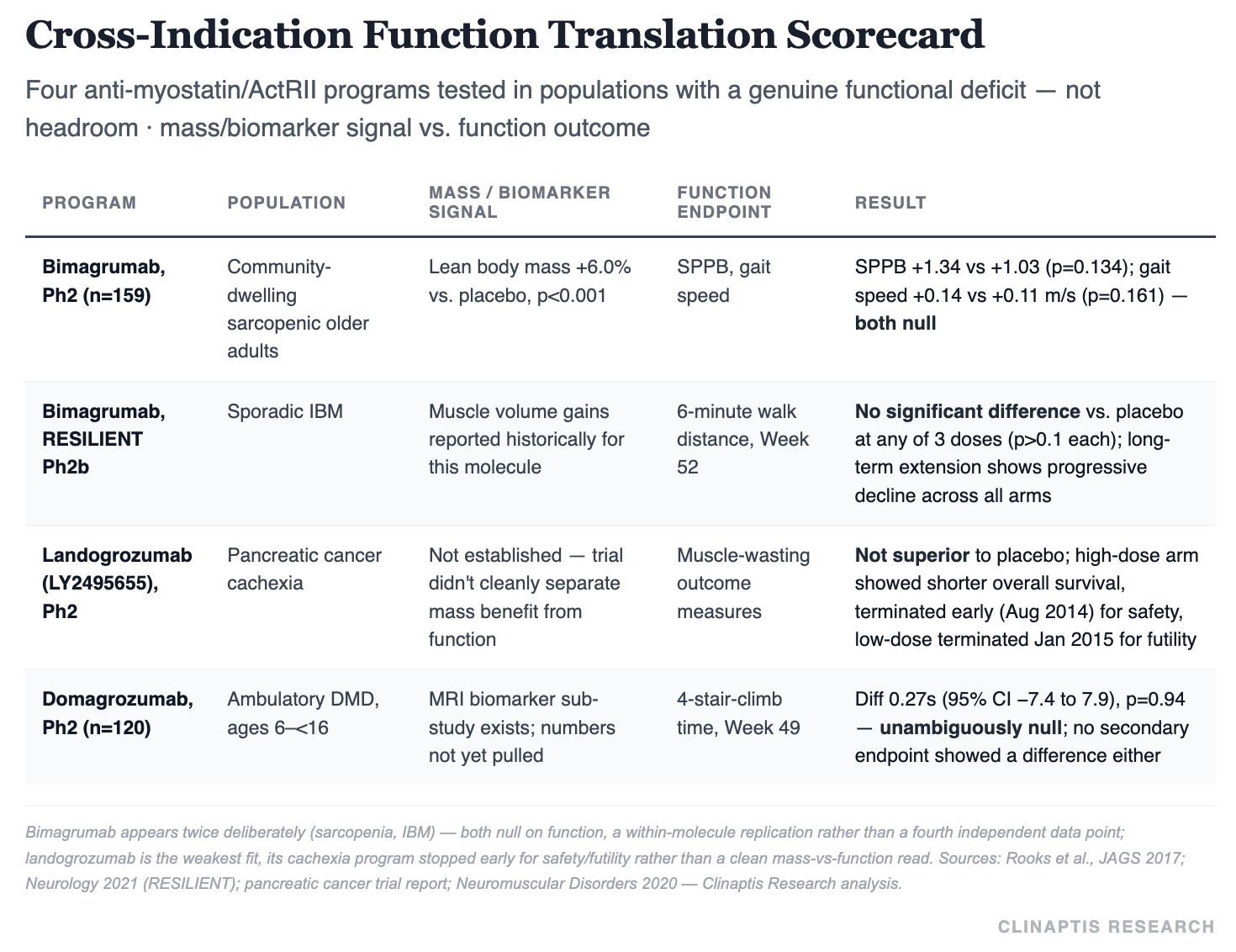
None of these four is apitegromab. All four are what apitegromab’s thesis assumes goes differently this time. Four trials, three molecules, one pattern: preserving mass has not once produced measurable function where this class has tested it head-on. The obesity opportunity isn’t priced on a flawed molecule — it’s priced on a translation the entire class has attempted and never delivered.
Even granting function, there’s no harm number for a payer to price against. SELECT ran 17,604 CV-disease patients on semaglutide and has surfaced no frailty or sarcopenia sub-analysis, despite a population old enough for it to matter. The category has a numerator — 25–40% of GLP-1 weight loss reported as lean tissue — and no denominator showing that becomes a harm patients experience at scale. ICER’s December 2025 obesity report assessed semaglutide and tirzepatide and didn’t assess muscle-preservation adjuncts at all, because none needs one yet. That absence is the signal, not a gap to backfill.
And the comparator is already free. Resistance training and adequate protein — a gym membership, not a second biologic — preserve functional lean mass in GLP-1 patients who stay consistent, and it’s the frontline guidance most obesity physicians already give. A biologic add-on doesn’t clear its bar by beating placebo on lean mass; it clears it by doing what that guidance can’t. On every molecule’s function data so far, none has.
IV. What Would Settle the Function Question, What’s on the Calendar, and Why SMA Isn’t the Question.
The trial that would answer this can’t look like EMBRAZE — and none of Scholar Rock’s trials do. Settling the function claim requires a population selected for deficit, not headroom: sarcopenic obesity, 65-plus, DXA-confirmed low lean mass at baseline — patients with function to recover, not patients whose decline hasn’t happened yet. EMBRAZE, SAPPHIRE, and the FSHD Ph2 each selected for the opposite: room to lose weight, not a deficit to reverse. That’s the correct design for a weight-loss trial and the wrong one for the question the obesity multiple depends on. The trial that would test the thesis is not the trial the company has been running.
Size that trial and the math turns against a clean answer. Sit-to-stand, powered on EMBRAZE’s own variance, needs ~110 patients per arm — feasible, near a real Ph3. Grip strength needs ~1,000 per arm, pushing enrollment toward 2,000 for a single secondary. Nobody powers a Ph3 that way, so the realistic study runs 500–600 patients over roughly a year on sit-to-stand, with grip demoted to exploratory. The consequence is quiet but decisive: grip strength likely never gets a clean read — not in this trial, not the next. The one endpoint most legible to a payer is the one the economics won’t let you power.
What Actually Tests the Thesis. Whether that trial ever gets run is a separate question from whether it should be. Four catalysts sit ahead, and not one is built to test the claim.
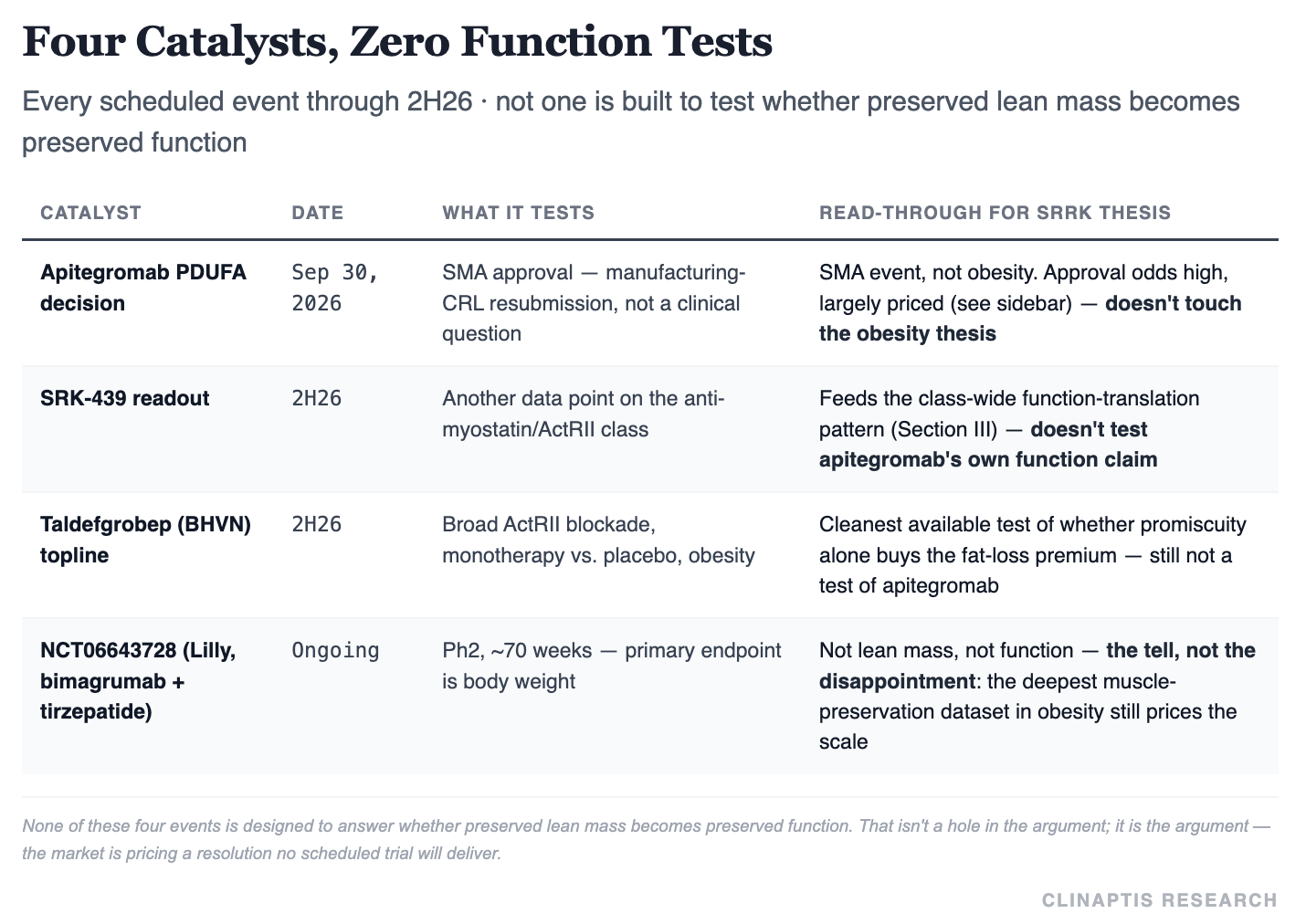
Nothing currently on the calendar, across any molecule in this class, is actually designed to answer the function question. That’s not a gap in this note’s argument; it’s the argument — the market is pricing a resolution no scheduled trial will deliver.
That leaves apitegromab’s obesity slice priced on a translation none of these programs delivered.
SMA is real — and it’s not where the disagreement lives. Apitegromab is likely approved September 30. The Sep 2025 CRL traced solely to FDA inspection findings at Catalent’s Indiana fill-finish site — not clinical, not apitegromab-specific — and the resubmission added a second qualified site to the BLA. SAPPHIRE cleared its HFMSE primary at 1.8 points versus placebo across combined doses (p=0.0192; 10mg/kg alone 2.2 points, p=0.0121, n=188). The franchise is genuine, with peak WW sales converging near $1.6-$1.8 Bn. Two structural caveats for anyone rebuilding the model: peak penetration is an identity — capture ÷ (capture + discontinuation) — and the reimbursable pool shrinks as gene-therapy-exposed birth cohorts age into the eligible band. Neither moves the question that matters. SMA is real. The obesity multiple is the disagreement, and it rests on a translation nothing scheduled will confirm.
Bottom Line
Mass is not muscle, muscle is not function, and function is not what the obesity market pays for. Patients feel it, physicians measure it, payers underwrite it — none of the three has been shown a number yet, and four years of GLP-1 outcomes data across ~17,600 SELECT patients have not surfaced the harm to price against. SRRK is priced on the resolved half of that chain: apitegromab preserves lean mass, cleanly. It is not priced on the unresolved half, because that half has never been shown — not by this molecule, not by the four class programs that tested it directly. This is the ezetimibe setup before ENHANCE: a clean biomarker, priced as though the biomarker were the outcome, ahead of the trial that would test whether it is one.
This category keeps generating hype without proof for a reason. A 10% improvement on an already-validated pathway is a safer venture bet than new biology from scratch, and a small biotech with cleaner tolerability or a better body-composition scan becomes an acquisition target whether or not it has shown function. That’s the statin me-too pattern — its endpoint was Vytorin, engineered to win on incremental LDL, which then struggled in ENHANCE to show the LDL mattered. Muscle preservation is running the same playbook on a different backbone: the hype is the fast-follower strategy, and the missing functional proof, several years in, is the cost of running it. The sponsor with the deepest dataset in the category has already voted with its endpoint — Lilly’s follow-on is powered on the scale, not the muscle.
So the number to sit with: roughly $0.8–1.4B of Scholar Rock’s enterprise value — 15–25% of the ~$5.5B — rests on the half of the chain the class has never closed. The clean data is real. The price assumes the translation.
Disclaimer
This publication has been prepared by Clinaptis Research, the research publication of Clinaptis Advisors, for informational and educational purposes only. It does not constitute investment advice, investment research, an offer or solicitation to buy or sell any security, or a recommendation regarding any investment strategy or financial instrument. The views expressed are those of the author as of the publication date and may change without notice.
Clinaptis Advisors is not a registered investment adviser, broker-dealer, or licensed financial professional. Readers should conduct their own independent due diligence and consult qualified financial, legal, tax, and other professional advisers before making any investment decision. Investing in publicly traded securities involves risk, including the possible loss of principal.
Unless otherwise stated, factual information is derived from publicly available sources, including company filings, earnings calls, regulatory documents, clinical trial registries, scientific publications, and other materials believed to be reliable. While reasonable care has been taken in preparing this publication, no representation or warranty, express or implied, is made regarding the accuracy, completeness, or timeliness of the information presented. Estimates, projections, scenario analyses, valuation models, statistical reconstructions, and other forward-looking statements reflect the author’s independent analytical judgment and are inherently uncertain.
Copyright © Clinaptis Advisors. All rights reserved. This publication, including its analytical frameworks, methodologies, valuation models, graphics, figures, tables, visualizations, written content, and other original research, is the intellectual property of Clinaptis Advisors and may not be reproduced, redistributed, republished, or incorporated into derivative works without prior written permission, except for brief quotations with appropriate attribution.
-----
Footnote: Grip-strength sizing: EMBRAZE’s grip signal was null at both timepoints (p=0.47 at Week 24, p=0.57 at Week 32), so no treatment effect is assumed. The ~1,000/arm figure is illustrative — it reflects the sample needed to power the trial’s own observed grip delta (~1 kg point estimate) against its reported SD at 80% power, two-sided α=0.05, and rises steeply as the assumed effect shrinks toward the observed near-zero. The point is not a precise N but the order of magnitude: grip’s effect-to-variance ratio in this trial is roughly an order of magnitude worse than sit-to-stand’s, which is why any feasibly sized Ph3 powers on the latter and relegates grip to exploratory. Sit-to-stand’s ~110/arm assumes the Week-32 point estimate (~1.1 reps) holds — itself optimistic, given p≈ 0.09.