
Praxis: Odds Favor Ulixacaltamide Approval in ET, but...
Approval is not as de-risked as the market implies — the black box remains. Beyond the FDA decision, tolerability, persistence and commercial uptake determine whether PRAX can justify a $10B valuation

A year ago, Praxis Precision Medicines (PRAX) was still valued like a development-stage biotech. After a ~700% share-price rerating, it is now a ~$10.2B equity — with another ~15% added after favorable regulatory progress across both lead programs in the Q2 2026 update. Much of that transformation runs through ulixacaltamide, the oral T-type calcium-channel modulator that became the first drug to deliver a positive Phase 3 in essential tremor (ET) after a decade of failures across the field. The question is no longer whether the market recognizes the asset. It is how much success the current valuation already assumes.
ET is an unusually attractive market that has proved unusually hard to drug. It is prevalent, chronic, undertreated, and still anchored to generics approved in the 1960s — and yet Neurocrine, Jazz and Sage/Biogen all failed in it, with experienced development teams and different mechanisms. The disease leaves little room for a weak link: biology, Phase 1 translation, endpoint choice, Phase 2 proof-of-concept, dose selection and statistical design all have to line up before the FDA sees the package. Praxis did not get there cleanly either. Essential1 missed its primary endpoint (p=0.126) before the program was rebuilt around the functional signal that carried Essential3.
The ~700% rerating says the market now believes PRAX has cracked most of that problem — two positive pivotals, a clean mid-cycle, no advisory committee, and closed BIMO inspections have carried approval odds from ~65% toward 75-80%. That is a conventional reading of favorable procedural signals, and FDA review remains partly a black box, so we did not accept it at face value: we went back through the development history — the Ph2 miss, the endpoint reconstruction, the SAP amendment, the missing-data and estimand questions — looking for a hidden regulatory failure mode the headline result might be masking. We mostly did not find one, which is a finding, not an assumption. Published price targets still span roughly 15x, but that dispersion is about what the drug is worth once approved, not whether it gets there.
Once that regulatory stress test survives, the underwriting question migrates downstream: whether the clinical profile justifies what the valuation now requires commercially — specialty-tier pricing, durable persistence, and enough differentiation from cheap generics. Peak sales reduce to reachable patients times net price, and both are contested — the patient count by ~30x, net price by ~3-4x between primary-care and specialty economics. We think the clinical record, not the epidemiology, decides which end of each the drug reaches.
Three conclusions carry different weight, and the note keeps them separate. Replicated efficacy and high approval probability survive the stress test below — not a starting assumption, but where the adversarial read of the trial history lands. The Day-56-to-84 contraction is real but mixed-mechanism, bounded rather than resolved. What remains only partly underwritten is commercial value: whether ulixacaltamide can generate enough durable, specialty-priced patient-years from a finite reachable pool to support today’s valuation.
Stock Call: PRAX is not yet a clean directional thesis. At ~$10B equity value, the stock is rich even against bullish ET assumptions. We remain sidelined, leaning toward a small structural long pending further diligence on the non-ET assets.
The more interesting trade is tactical: short ~60 days before the PDUFA window and exit ~15 days before the first decision. The market appears to underprice regulatory delay or renewed FDA scrutiny of the evidence package. This is a pre-PDUFA risk-repricing trade, not an explicit CRL bet — deliberately avoiding the binaries.
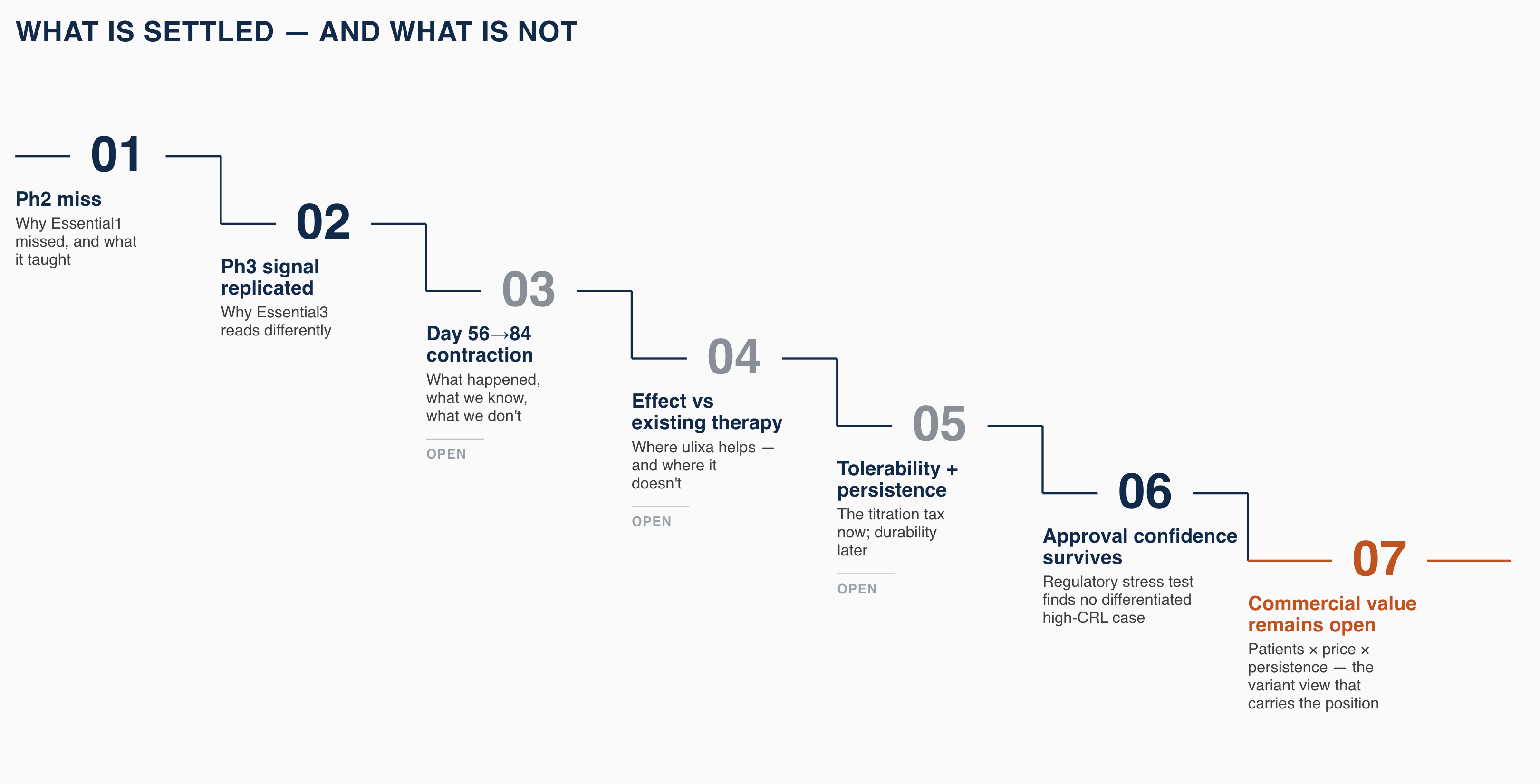
Ph2 Essential1 Study Missed. Here’s What It Revealed.
The Ph2 Essential1 study missed on a composite that diluted the functional signal. The 2023 Ph2 failed its primary — change to Day 56 on the modified TETRAS-ADL (mADL) — at p=0.126, but hit p=0.042 once the clinician-rated performance subscale was stripped out. In March 2023 the FDA recommended exactly that construction: TETRAS-ADL items 1-11, patient-reported, dropping the performance and social-impact items. That became mADL11, the Ph3 primary. We read this as a program-specific fix responsive to Essential1’s failure pattern, not a general FDA preference for patient-reported ET endpoints — a distinction that matters, and one the coverage gets wrong below.
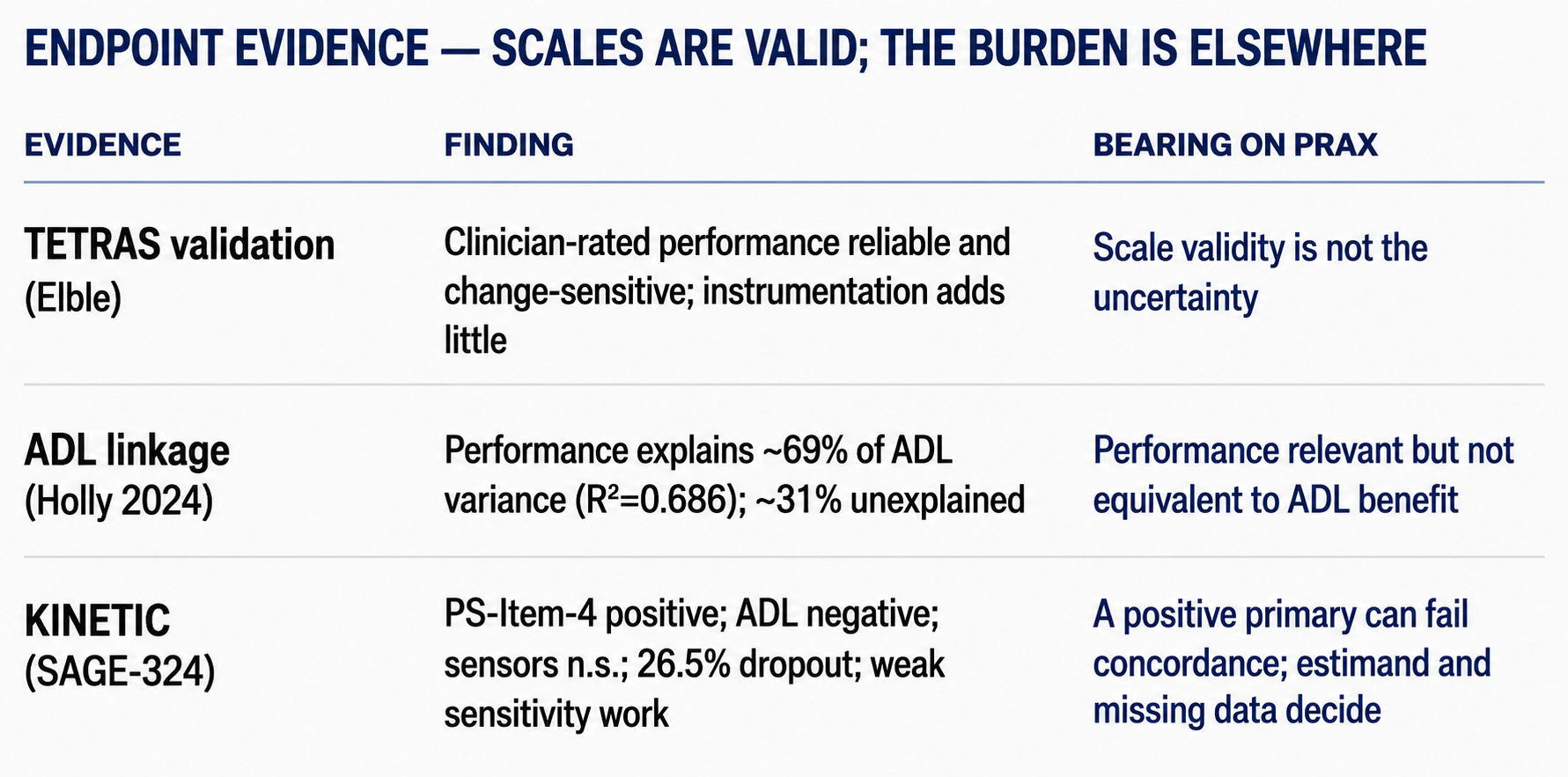
The miss was about which axis moved, not about a broken scale. The ET graveyard is not a measurement failure — the scales work. Elble’s TETRAS review documents high inter- and intra-rater reliability, strong correlation with ADL and transducer measures, and sensitivity to change comparable to accelerometry and gyroscopy, because spontaneous tremor variability caps the practical advantage of instrumented measurement. Clinician-rated performance is a legitimate, treatment-sensitive endpoint. Essential1’s miss localized the signal axis: ulixacaltamide moved patient-reported daily function more than it moved the clinician-rated tremor amplitude that dominated the original composite. The recent failures cluster on that same axis, not on scale noise — Neurocrine dropped a candidate in 2022, Essential1 missed in 2023, Jazz’s suvecaltamide and Sage/Biogen’s SAGE-324 both failed in 2024, the latter two on performance-rated primaries through unrelated mechanisms. Ulixacaltamide separated on a patient-reported ADL construct, the endpoint the FDA itself asked for. So scale validity is not the question. Effect size, functional concordance, estimand robustness, and missing-data sensitivity are.
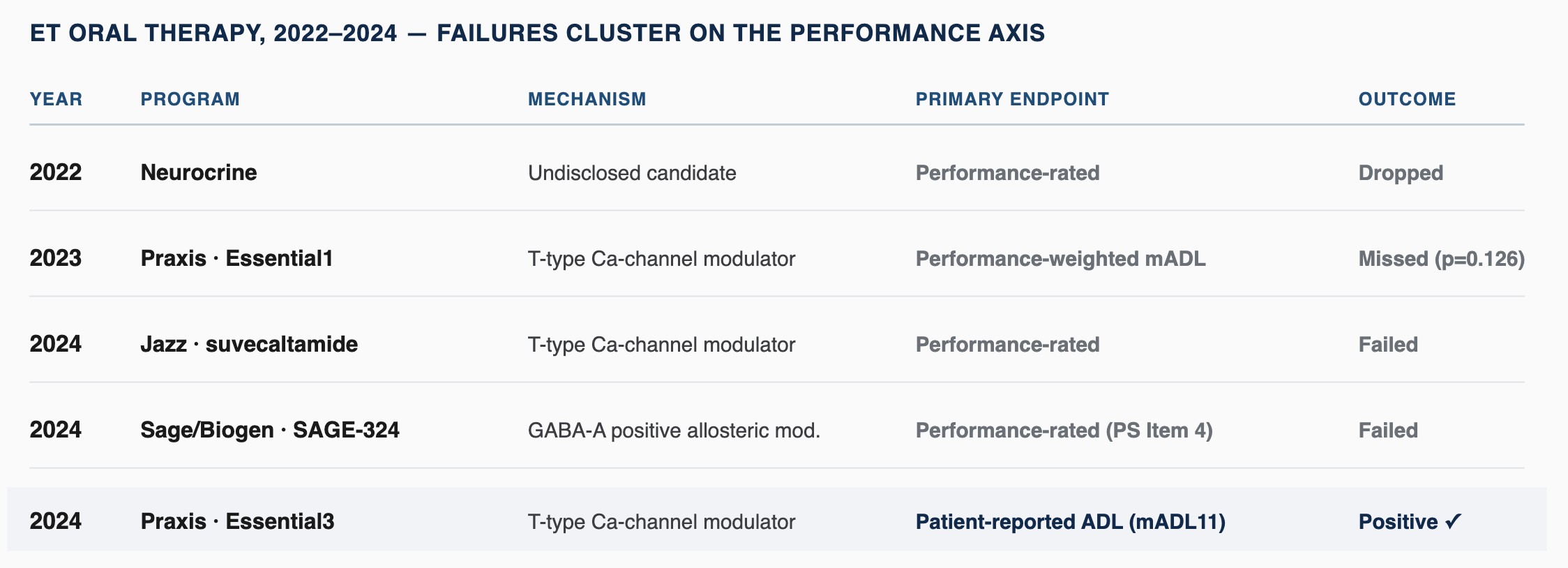
Coverage that calls mADL11 “the FDA-preferred ET endpoint” is overreaching, and the closest comparator shows why. Jazz’s FDA-reviewed suvecaltamide-in-ET primary (Parkinsonism & Related Disorders, 2026) kept a performance-rated component — modified TETRAS-ADL items 1-11 plus performance items 6 and 7 (spiral drawing, handwriting) — a construction the paper says was “selected based on regulatory guidance after FDA review of the study plan.” Same agency, same disease, same window, different endpoint. FDA guidance in ET has been program-specific, tailored to each sponsor’s failed-endpoint history, not a fixed doctrine — so mADL11 is the endpoint Praxis earned, not one the FDA hands out.
The Ph3 program was engineered around the axis where the drug is strongest, with regulatory cover. That improves the odds of the label. It also means the headline effect measures patient-reported function, not tremor suppression — which is what payers will scrutinize when the premium has to be justified.
The bridge from the miss to the win is mostly power and measurement, not a new drug effect. The jump from p=0.126 to p<0.00001 decomposes into more precision and a modestly larger effect — and over half of the effect gain is the endpoint refinement, not new pharmacology. Stripping the clinician-rated performance subscale had already lifted the Ph2 signal to significance; Essential3 mainly added the sample size to detect it cleanly. The Ph2 effect was also consistent across dose regimens and related ADL constructs and distributed across the response curve rather than driven by an exceptional-responder tail.
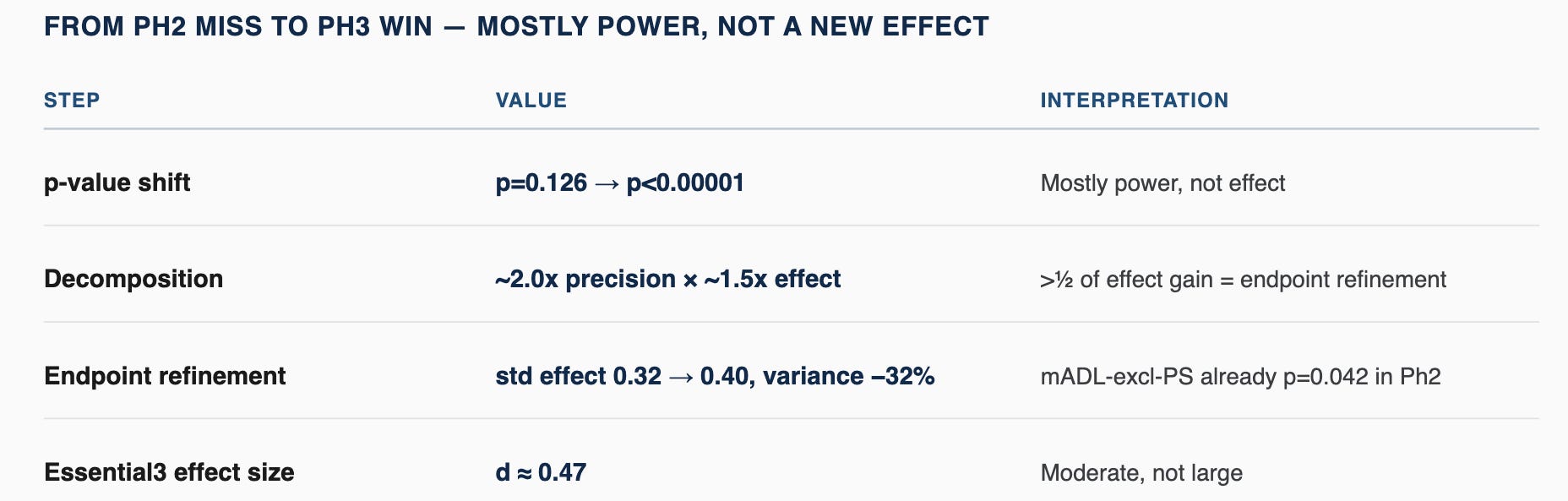
The efficacy signal was already visible in Essential1; Essential3 confirmed it in a much larger study (−2.57-point placebo-adjusted mADL11). The very low p-value reflects that larger sample as much as the effect itself — the relevant question is whether the placebo-adjusted effect is clinically meaningful, not how small the p-value is.
Performance and functional endpoints measure overlapping but non-equivalent aspects of treatment response. Hollý et al. (2024) found TETRAS-Performance explains ~69% of TETRAS-ADL variance (R²=0.686), with accelerometry, spiral scoring and water-pouring adding nothing. So improvement in tremor performance should translate into functional benefit to a meaningful degree. But ~31% of ADL variance remains unexplained: the two endpoints move together, not one-for-one. mADL11 therefore captures treatment effect on daily function that cannot be inferred from performance scores alone.
SAGE-324’s KINETIC trial is the cautionary case. It hit its Day-29 performance primary (TETRAS-PS Item 4, placebo-adjusted ~−1.07; P=0.0491), but Day-29 ADL was negative and the Kinesia sensors were not significant — performance moved, function and instrumentation did not follow. The severe subgroup (baseline ≥12) did better (~−1.70; P=0.0066), which tells you dynamic range drives the assay. And the missing data were structural: 26.5% TEAE-related discontinuation and 61.8% dose reduction on the active arm, run through an MMRM whose assumptions break when dropout tracks tolerability, with no reference-based, tipping-point or treatment-policy sensitivity disclosed.[^kinetic] This is why the Essential3 estimand and post-discontinuation questions matter: a positive performance primary can still fail on concordance and missing-data handling.
[^kinetic]: Evaluable patients near Day 29 were 21 of 33 on active drug against 33 of 34 on placebo. The nominal 60 mg arm was in practice a heterogeneous exposure — among completers, 8 stayed at 60 mg, 5 finished at 45 mg, 8 at 30 mg — so the estimand had to reflect a treatment strategy tolerability was continuously reshaping.
The endpoint change is not the main issue. The endpoint is clinically valid, the effect size is moderate but real, and the signal survives the obvious sensitivity checks. Performance improvement is functionally relevant but not equivalent to ADL benefit; meaningfulness depends on magnitude, not the p-value; baseline severity drives assay sensitivity; and when discontinuation is asymmetric, estimand choice decides the answer. On that last point Essential3 splits: the Day-56 result looks robust to missing data, and Day 84 does not.
The Ph3: is the win a signal or a construction?
Essential3 replicated the signal across two independent designs, which is worth more than either point estimate on its own. Both ran 12 weeks under one protocol (NCT06087276): a parallel-group study (−2.57-point mADL11 separation at Day 56; p=0.0000014) and a randomized-withdrawal study (55% of stable responders held on drug vs 33% on placebo; p=0.037), positive on a different logic.
Two features of the design still need scrutiny:
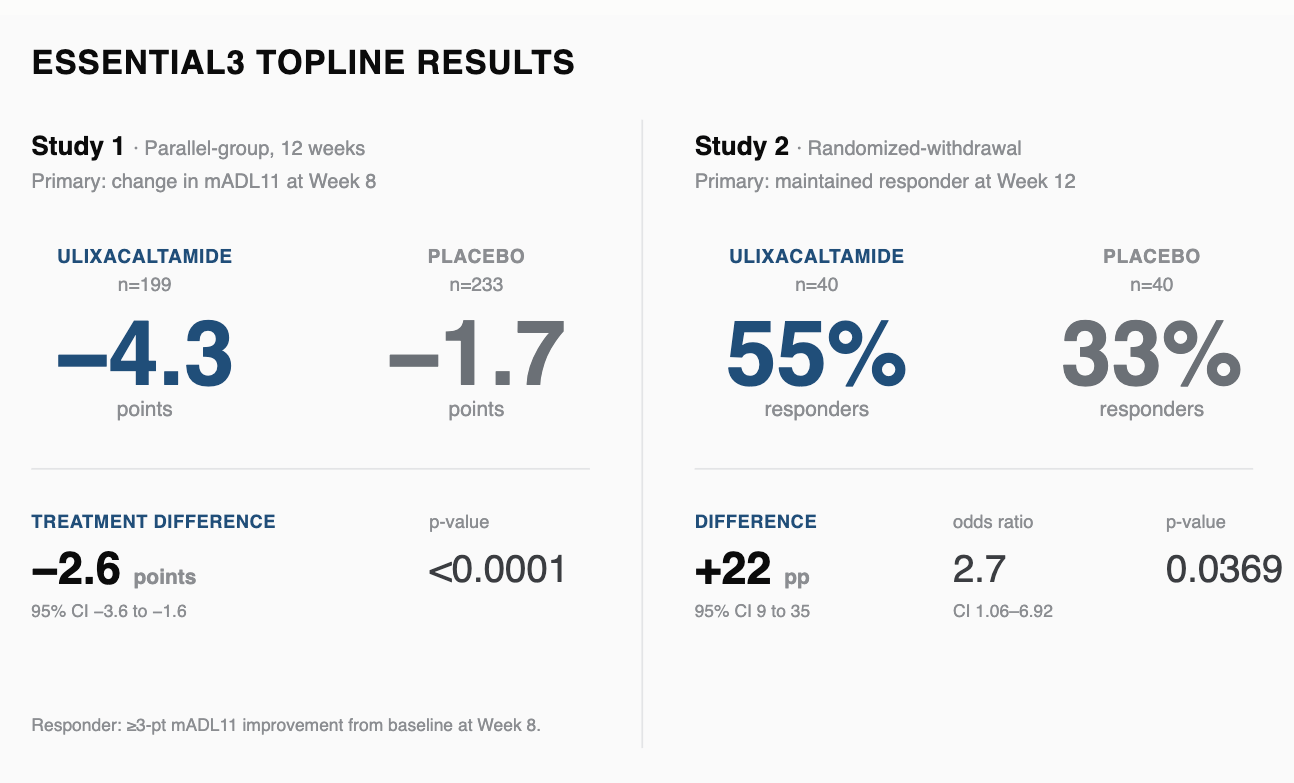
1. Primary timepoint moved to the point of maximum effect, one month before unblinding. The Study 1 primary moved from Day 84 to Day 56 in a Sep 2025 SAP amendment — after a Feb 2025 IDMC futility recommendation that Praxis overrode. Day 56 is where the effect peaks: mADL11 separation runs ~2.1x MCID at Day 56 and erodes toward ~1.3x by Day 84. This is the most aggressive methodological choice in the program. The IDMC had judged Study 1 “unlikely to meet the primary efficacy endpoint under the parameters set by the statistical model,” while noting that model assumptions might have influenced the result and encouraging alternative analyses. That the IDMC itself flagged those assumptions supports the rationale for re-analysis; but the pre-specified primary was tracking toward futility, and the timepoint that governed the label was chosen after that signal.
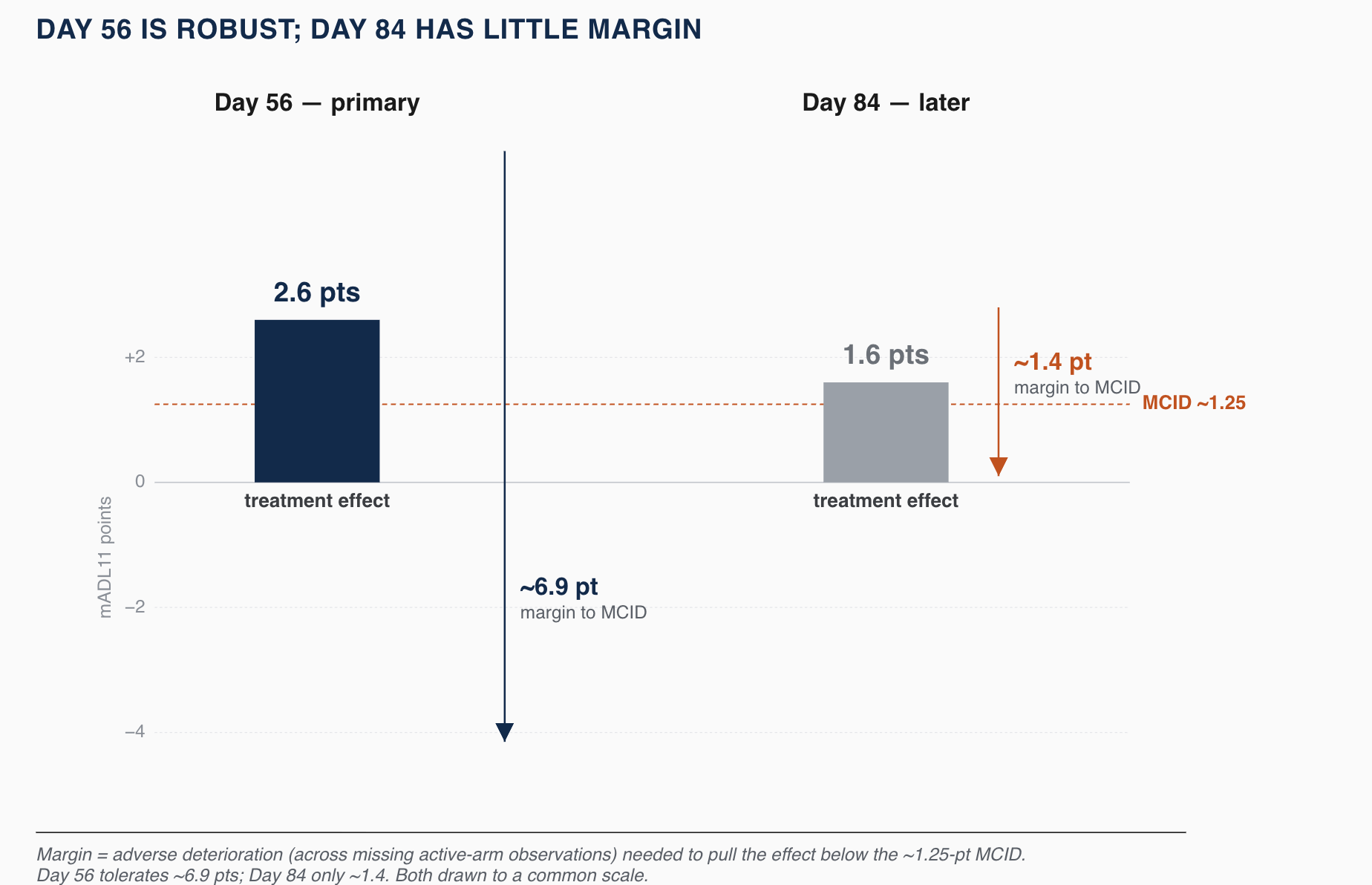
The result holds even if you discount the timepoint choice. The pre-specified delta-adjusted tipping analysis stayed significant at a 2.5-point penalty (p=0.0026), and our population-level stress needs ~6.9 points of deterioration across missing active-arm observations to break the effect — a coarser check than the sponsor’s MMRM, but directionally concordant. The primary is a genuine signal, measured at its most flattering moment.
2. Fade to Day 84 carries far less robustness margin than the primary, and its cause is not identifiable from the public data. At Day 84 the treatment difference narrows to ~1.6 points with more active-arm observations missing, so only ~1.4 points of adverse delta — versus ~6.9 at Day 56 — would breach the ~1.25-point threshold. Day 56 is robust efficacy evidence; Day 84 is a durability question.
The modified ITT set includes 199/236 randomized patients on drug (84.3%) versus 233/237 on placebo (98.3%); the ~16% of drug-arm patients with no post-baseline assessment are excluded, creating potential upward bias at Day 56 if missingness tracks poor tolerability or response.
A disclosed SAP from Jazz’s JZP385-202 — another tremor program using a TETRAS-family instrument — used a treatment-policy estimand with MAR-MMRM, plus control-based imputation and delta-adjusted tipping-point sensitivities. Under that approach, post-discontinuation data are retained in the primary analysis.
That does not establish Essential3’s estimand, but it provides a relevant regulatory precedent. If Essential3 similarly retained post-discontinuation observations, ulixacaltamide’s 27% early discontinuation could mechanically pull later means toward baseline without implying waning among continuers. The randomized-withdrawal study argues against simple waning: responders maintained benefit through Day 84. But dropout cannot explain the contraction cleanly. Preferential loss of weak responders enriches the remaining treatment population and biases observed efficacy upward; the direction is identifiable, the magnitude is not without responder-by-discontinuation data.
The contraction therefore likely mixes missing-data/intercurrent-event effects with genuine attenuation. The aggregate data cannot identify the split, and Phase 2 PGI-C and CGI-S also softened from Day 56 to 84. Day 84 cannot be read as pharmacologic waning alone.
Does the effect matter against what ET patients already have?
The missing-data analysis tells us how hard the result is to overturn; it does not tell us whether the observed benefit matters clinically. At −2.57, the placebo-adjusted effect runs ~2.1x the mADL11 MCID (~1.25 points, anchor-based) against a baseline burden of 18.5 of 33. Long-term-extension responders improve a mean ~8.9 points and hold benefit toward two years, which argues against obvious tolerance among continuers/responders.
Against existing therapy, the case is thinner than the trial — and this is where payers will push. First-line ET treatment is generic: propranolol (approved 1967) and primidone, worth roughly two points on 10-to-15-point tremor scales and leaving ~30% of patients unhelped. Ulixacaltamide was never tested against them, mADL11 is a different scale, and no head-to-head exists. So the premium over a $4 generic has to be argued on tolerability and daily function, not demonstrated superiority. That is defensible but unproven, and the gap is exactly where the payer negotiation will live.
What does the safety profile cost?
The safety cost is a titration tax, not organ toxicity. TEAEs ran 94.9% on drug vs 75.6% on placebo, while severe events barely separated (6.0% vs 4.3%) and serious events were lower on drug (0.9% vs 3.4%). Drug-related discontinuations were 27.0% in Study 1 and 28.1% in Study 2 versus 1.7% on placebo, driven largely by dizziness and brain fog, with most occurring during titration.
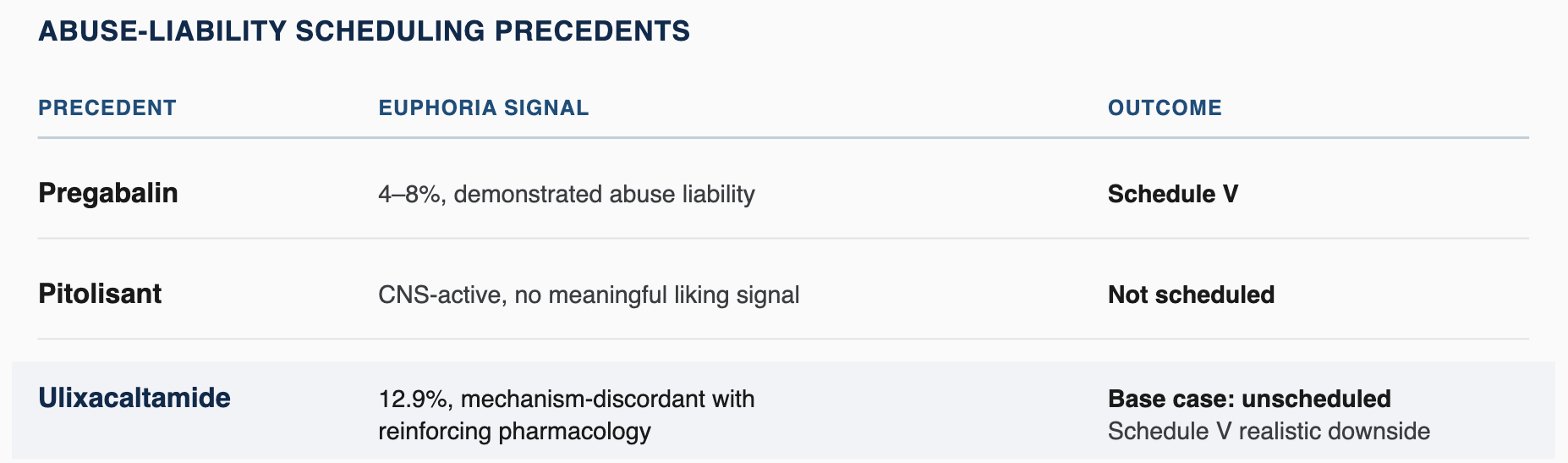
Two questions matter: abuse liability and what happens after patients clear titration. Euphoric mood occurred in 12.9%, enough to keep abuse potential in the regulatory discussion but not to determine scheduling. The decisive evidence — human abuse-potential testing, drug liking, dependence or misuse — is not public. T-type calcium-channel modulation lacks the obvious reinforcing pharmacology of benzodiazepines, opioids or stimulants, which lowers the prior on substantial abuse liability. Even Schedule V, the pregabalin precedent, would add limited prescribing friction. For now this is a tail risk, not the central commercial constraint.
The second question moves the valuation, and “persistence” hides three different quantities.
Titration tax — 27% is a one-time loss of initiators, not an annual hazard.
Maintenance persistence — the ongoing hazard after patients clear titration. Undisclosed.
Annual replenishment — new starts required to maintain the active base. Undisclosed, but bounded by the reachable pool.
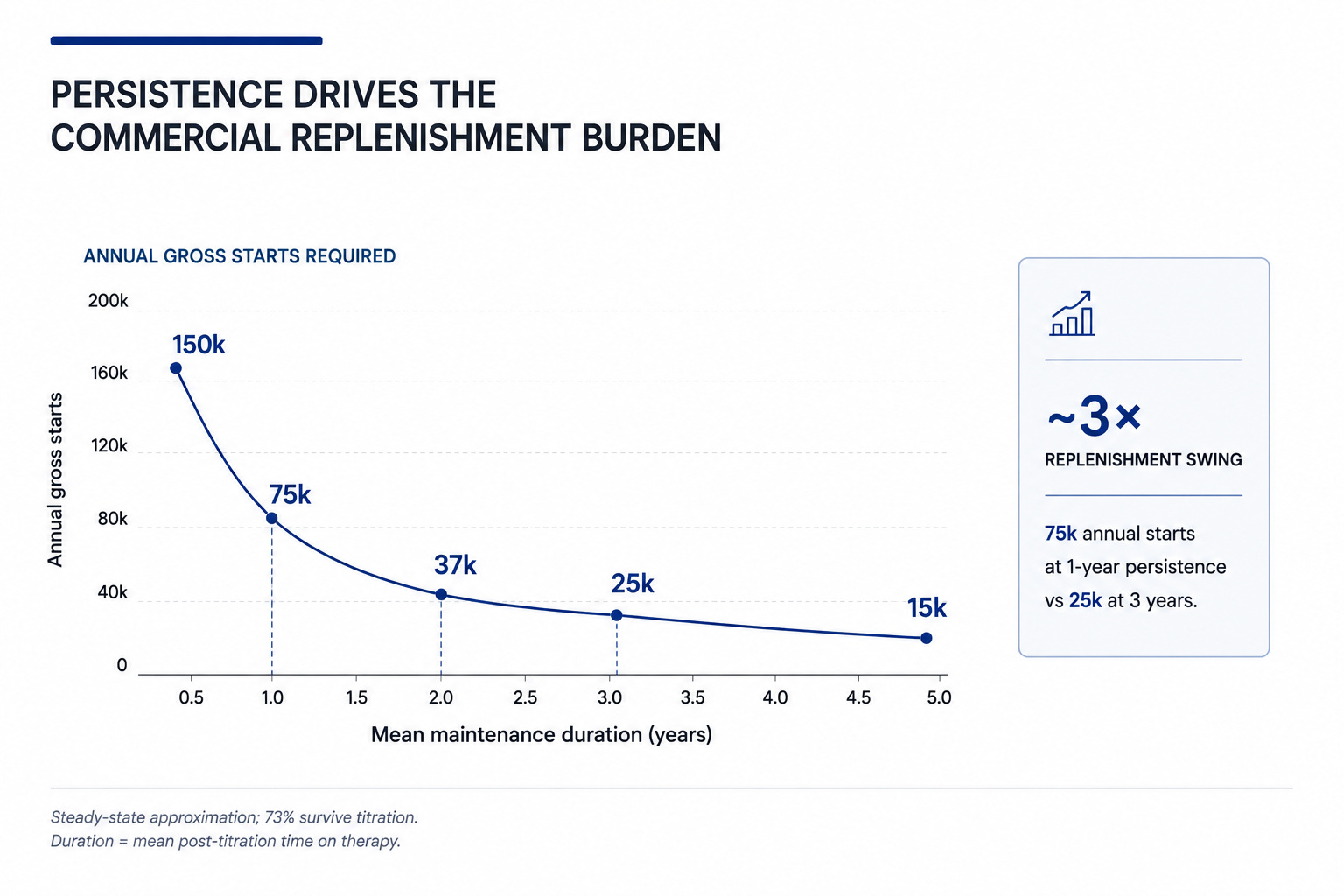
A peak-sales estimate fixes the active-patient count but says nothing about how that population is sustained. The same active base can come from many short-duration starts or fewer long-duration ones, with required annual replenishment swinging ~3x across plausible maintenance curves for identical revenue. The sponsor’s time-to-discontinuation KM curve would resolve most of this: it would estimate maintenance duration and bound replenishment against the ~240k reachable pool. Until then, persistence remains open.
Do we agree with the FDA’s implicit benefit-risk?
This is where the adversarial read above resolves. We can infer the FDA’s direction only from procedure; the review itself remains sealed until after action. Two positive pivotals, a clean mid-cycle, no advisory committee, closed BIMO inspections, a December-2025 Breakthrough Therapy Designation, and a pre-NDA meeting Praxis describes as aligned on NDA content are consistent with a review progressing toward a favorable benefit-risk conclusion, not proof of one. The reading below therefore rests on disclosed regulatory interactions and the clinical record, not the review itself.
On approvability, we agree with the inferred FDA read — and we started from the opposite presumption. We went looking for a regulatory vulnerability beneath the positive headline: the Ph2 miss, post-IDMC timepoint switch, asymmetric missingness, unresolved estimand and abuse-potential question. Each is a legitimate soft spot. None, on the available evidence, amounts to a differentiated high-CRL case. Efficacy is replicated across two designs, on the endpoint the agency recommended, with ~2.1x MCID separation at the primary timepoint. The residual approval tail increasingly sits outside what the public clinical record can resolve — including CMC/facility review and sponsor-undisclosed abuse-liability evidence.
The post-2Q management-credibility discount is aimed at the wrong evidence. We weight management interpretations lightly — including its explanations of Day 84 and the Δ2.5 sensitivity — but externally generated regulatory evidence differently. Closed BIMO inspections covering the statistical and interim analyses, Breakthrough Therapy Designation, the pre-NDA interaction and no planned advisory committee deserve more weight than sponsor characterization of ambiguous data.
Where we stop following the FDA is where its mandate stops. Benefit-risk determines approvability, not peak sales. The FDA can accept the Day-56 timepoint, estimand and missing-data treatment without answering whether the resulting clinical profile supports durable commercial use. The same is true of the 27% titration discontinuation: it can be acceptable for the label while remaining decisive for persistence and replenishment. The agency can clear these issues regulatorily while leaving them unresolved economically.
Approvability and durability are different judgments, decided on different evidence. The FDA’s process increasingly supports the first; it tells us little about whether the clinical profile supports the commercial value already embedded in the stock.
How large is the reachable market, really?
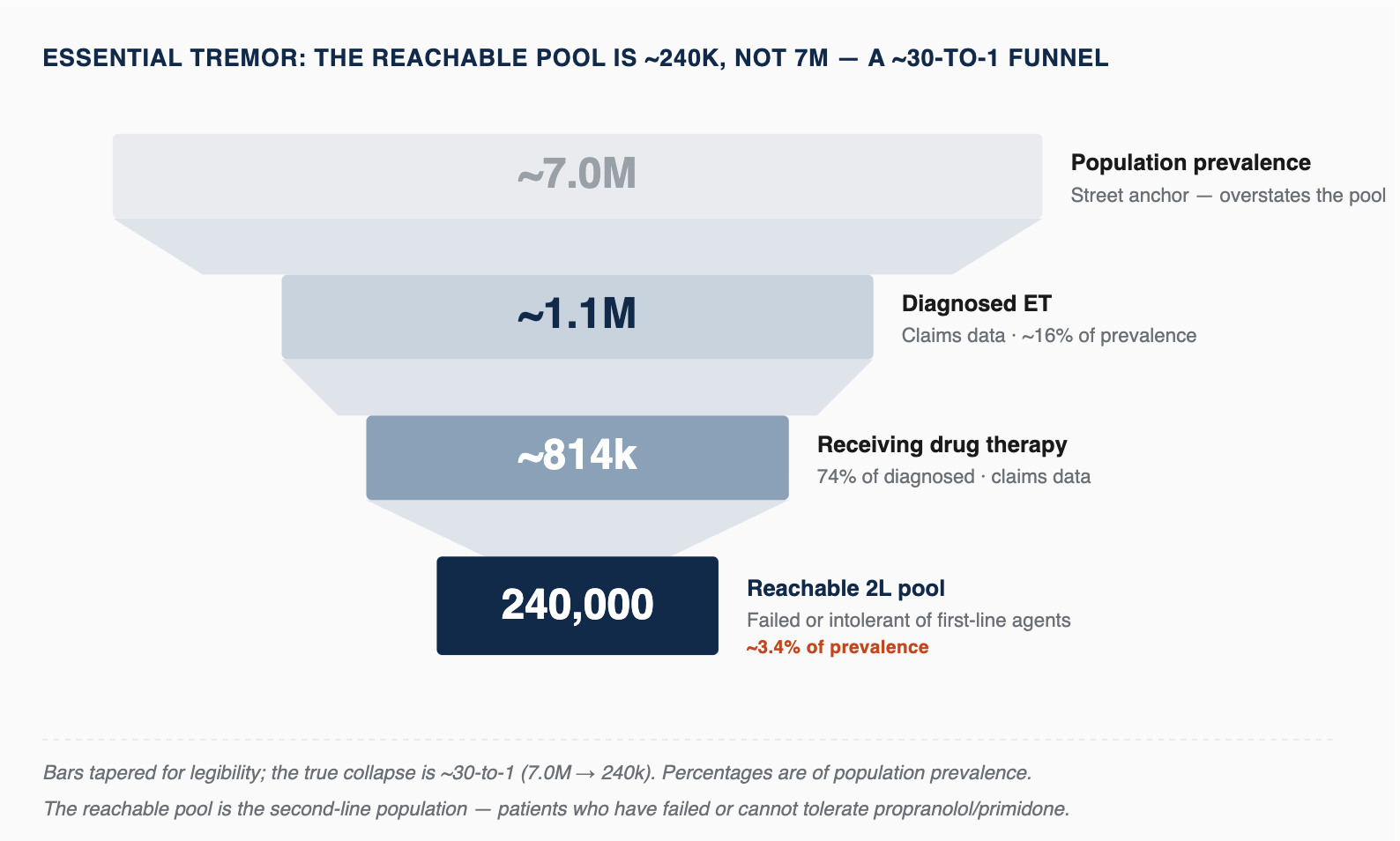
The reachable pool is ~240,000, not the ~7 million prevalence figure most models anchor on — a ~30-to-1 funnel to a treatable second-line population.
The second term is net price, and the better comparator is specialty movement disorders, not primary care. Ingrezza realizes ~$82k per treated patient and Austedo ~$70k, both well below >$120k list prices. ET has the same specialist channel, but weaker pricing fundamentals:
Larger pool: more absolute payer spend at equivalent penetration.
Generic anchor: propranolol and primidone give payers obvious step-therapy and rebate leverage.
Limited branded competition: ulixacaltamide could be the only branded oral in 2L; the oral pipeline behind it is thin.
Those forces point to realized net below the strongest VMAT2 economics (~$70–80k) rather than primary-care pricing. Our working range is $60–70k net, base $65k.
The bigger uncertainty is what happens after patients enter that 240,000-person funnel. Tolerability, maintenance persistence and differentiation determine how many durable patient-years ulixacaltamide can generate — and how much payers will pay for them. The remaining diligence is therefore more clinical than epidemiological.
Devices constrain the ceiling, not the center. MR-guided focused ultrasound and DBS compete for the medication-refractory severe tail; available adoption patterns do not suggest they are broadly displacing drug-treated patients.
What does today’s price already assume?
Today’s valuation already requires a substantial ulixacaltamide franchise. PRAX trades at ~$10.24B market cap and ~$8.87B EV (10-Aug-2026 close). We retain ~72% of EV to ulixacaltamide as our central illustrative case — an attribution assumption, not an observable market fact — and divide by an ~88% approval probability to imply ~$7.26B of unrisked ET value. The remaining ~28% is the seizure and rare-epilepsy pipeline, which we do not underwrite here.
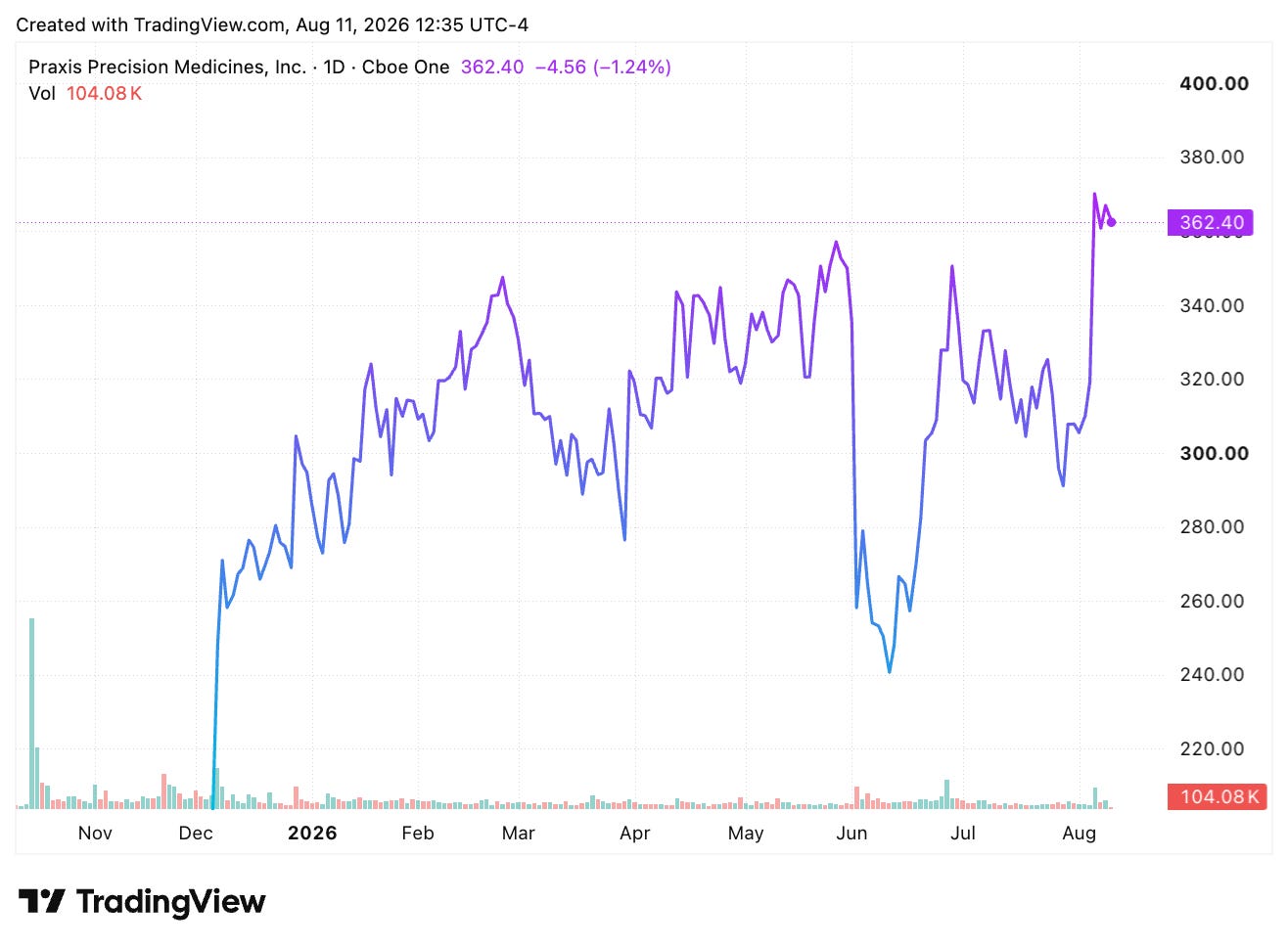
Our term structure translates that value into roughly $5.2B of required peak sales, assuming ~2039 effective genericization and a ~1.4x peak-sales multiple. These are modeling assumptions, not market facts; changing asset attribution, approval probability or duration changes the required peak. At 60%/65%/70% attribution instead of 72%, unrisked ET value falls to ~$6.05B/$6.55B/$7.06B and required peak sales to ~$4.32B/$4.68B/$5.04B.
Management has cited a broad $50–100k annual price range; specialty movement-disorder analogs realize roughly $70–$80k net. We underwrite $60–$70k realized net revenue per treated patient (base $65k) — a discount to the strongest VMAT2 economics that reflects ET’s generic first line and larger managed population. Against our ~240,000 reachable-patient estimate, the remaining question is how much penetration that ~$5.2B franchise requires:
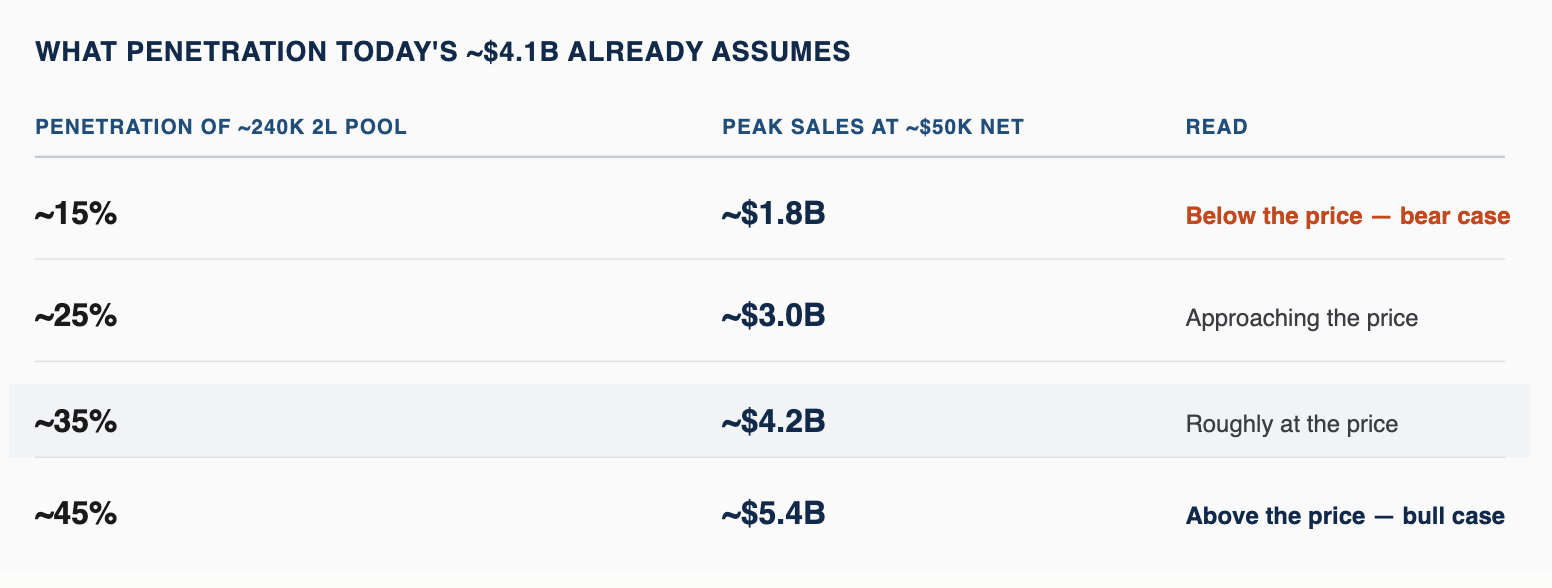
Today’s valuation requires both specialty-tier pricing and meaningful penetration. At $60k/$65k/$70k net, ~$5.2B peak sales requires roughly 86k/80k/74k active patients — ~36%/33%/31% of our 240,000-patient pool. At the $65k base case, that is plausible for the only branded oral in second line, but not trivial: roughly one-third of the entire working reachable pool must be active at peak, above our independently-built 25% base-case penetration and closer to our 35% bull case. Penetration cannot be assessed independently of persistence. With ~27% lost during titration and maintenance persistence undisclosed, sustaining ~75–85k active patients could require materially more than 75–85k annual starts, depending on the maintenance curve.
Management has framed peak US potential above $10B, citing an HCP survey representing >43,000 ET patients. Our central reverse valuation requires ~$5.2B — roughly half that framing. We do not anchor to management’s figure; the gap is evidence that today’s valuation still sits below the company’s own opportunity case, not a forecast in itself.
The open underwriting question is therefore not approval alone, nor price alone, nor reach alone. It is whether ulixacaltamide can sustain roughly 75–85k specialty-priced active patients without exhausting or placing implausible replenishment demands on the reachable second-line pool. The 27% titration discontinuation, undisclosed maintenance-persistence curve and generic first line all bear directly on that question. Abuse liability remains a tail risk.
The commercial underwriting ultimately reduces to three linked variables: patients × price × persistence. Price determines revenue per active patient; persistence determines how many starts are required to sustain that active base; and the reachable pool limits how long that replenishment can continue. With ~27% lost during titration and the maintenance curve undisclosed, the same peak revenue can imply very different demands on the patient pool. Until that curve is known, the commercial case is plausible but not fully underwritten.
The Bottom Line
Essential tremor’s trial graveyard was partly a measurement problem, not only a pharmacology one. Ulixacaltamide’s first positive Phase 3 shows that a functional endpoint can capture treatment benefit that performance measures may not fully reflect. That conclusion survives our adversarial read of the development history — and is largely priced.
We began by asking whether the market had become too comfortable with approval. On the available evidence, that confidence largely survives scrutiny. The Phase 2 miss, post-IDMC timepoint change, asymmetric missingness, unresolved estimand and Day-56-to-84 contraction each create legitimate vulnerabilities, but none currently supports a differentiated high-CRL case. The contraction remains real and mixed-mechanism; public data can bound it, not explain it. Further parsing of the efficacy topline is unlikely to change the regulatory conclusion.
The remaining underwriting question is commercial. Today’s higher valuation (~$8.87B EV, up from ~$7.15B) now requires both specialty-tier pricing and meaningful reach: at our $65k base case, roughly one-third of the ~240,000-patient reachable pool must be active at peak. That is not through any single assumption — it requires enough reachable patients, at a sufficiently high net price, remaining on therapy long enough to generate the patient-years embedded in the valuation. The ~27% titration loss, undisclosed maintenance-persistence curve and generic first line therefore matter more from here than another efficacy sensitivity.
The key missing disclosure is the time-to-discontinuation curve: it would constrain maintenance duration and the replenishment burden against the ~240,000-patient working pool. Human abuse-potential data remain relevant, but unless unexpectedly unfavorable, they are a secondary risk rather than the core commercial variable.
That leaves the investment thesis deliberately incomplete rather than negative. Approval looks increasingly underwritten; the commercial value does not yet. The next meaningful evidence should determine whether ulixacaltamide can generate enough durable specialty-priced patient-years to justify what PRAX already discounts — not whether a positive Phase 3 was statistically real.
Would value your feedback — especially where you disagree with the analysis or think we’ve missed something. Leave a comment below.
Resources
Praxis Precision Medicines: 8-K filings, Q2 2026 corporate update, Essential1/Essential3 topline and poster disclosures, NDA acceptance and Breakthrough Therapy Designation announcements
ClinicalTrials.gov: NCT06087276 (Essential3); Jazz JZP385-202 protocol and statistical analysis plan
FDA: March 2023 endpoint correspondence (Essential1), PDUFA action date (29-Jan-2027)
Peer-reviewed literature: Jazz suvecaltamide-in-ET primary results, Parkinsonism & Related Disorders (2026); Elble, TETRAS validation review (reliability, ADL/transducer correlation, sensitivity to change); Hollý et al. (2024), TETRAS-Performance vs TETRAS-ADL variance decomposition; SAGE-324 KINETIC trial results (TETRAS-PS Item 4, ADL, Kinesia, dropout and dose-modification data)
Trade press: FierceBiotech coverage of the ET competitive-failure sequence
Commercial comparators: Ingrezza (NBIX) and Austedo (TEVA) FY25 net pricing and treated-patient disclosures
Figures and full model in the accompanying diligence workbook. All estimates are Clinaptis’s own unless attributed.
Disclaimer
This publication is provided for informational and research purposes only and does not constitute investment advice or a recommendation to buy, sell, or hold any security. All estimates, projections, probabilities, and valuation assumptions herein are uncertain, based on incomplete public information, and may change without notice. Clinical, regulatory, and commercial outcomes may differ materially from the expectations described. Readers should conduct their own due diligence and consult a qualified financial advisor before making investment decisions. Clinaptis Research, its principals, or affiliates may hold positions in securities discussed in this publication, consistent with the publication’s disclosure policy.