
XBI: What Survived July's Short Retreat
XBI Short Interest Monitor · $1–5B cohort · July 31, 2026 settlement

The biotech (XBI) short book retreated in July, but 22 of the 56 names still added to shorts. Across the clean $1–5B cohort, the share of names adding to shorts fell from 76% in June to 39% in July, and the median position flipped from a build to a cover. Seven clean names bucked the broader reversal more decisively, increasing shares short more than 5% in both months: VERA, STOK, TNGX, VRDN, IRON, SVRA and DNLI. The seven are not equally informative — VERA, VRDN, STOK and TNGX separate once positioning is read against price action, standing crowding and catalyst context.
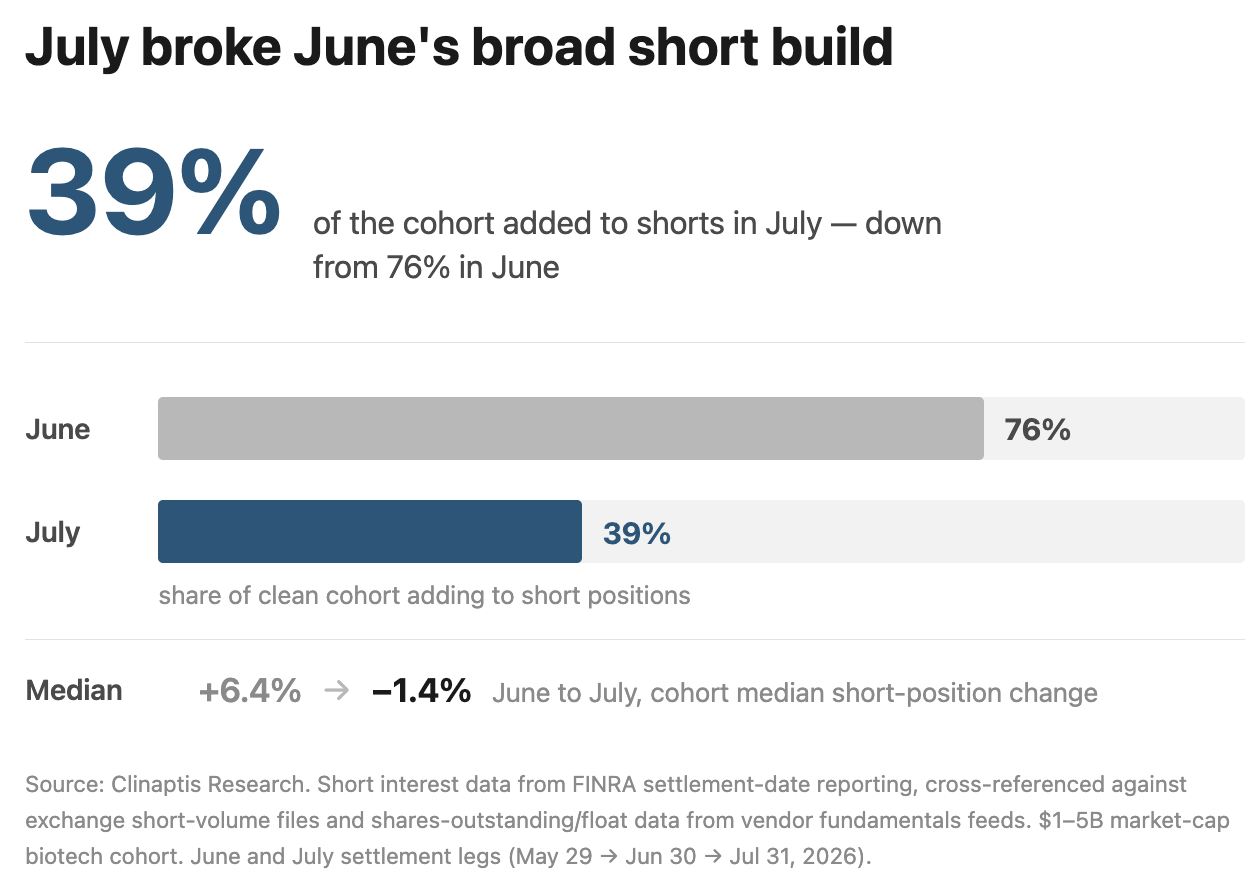
A single settlement can’t tell a persistent build from a round-trip. TYRA’s June build reversed almost exactly in July, closing back near its May level. BCRX’s cover ran further, past its starting point, consistent with a genuine de-risk rather than a wash. REPL covered in June and rebuilt in July, and did so while outperforming XBI by 8.3 points — a re-entry against relative strength. Reading June and July together is what makes these three distinguishable; either settlement alone would obscure those different trajectories.
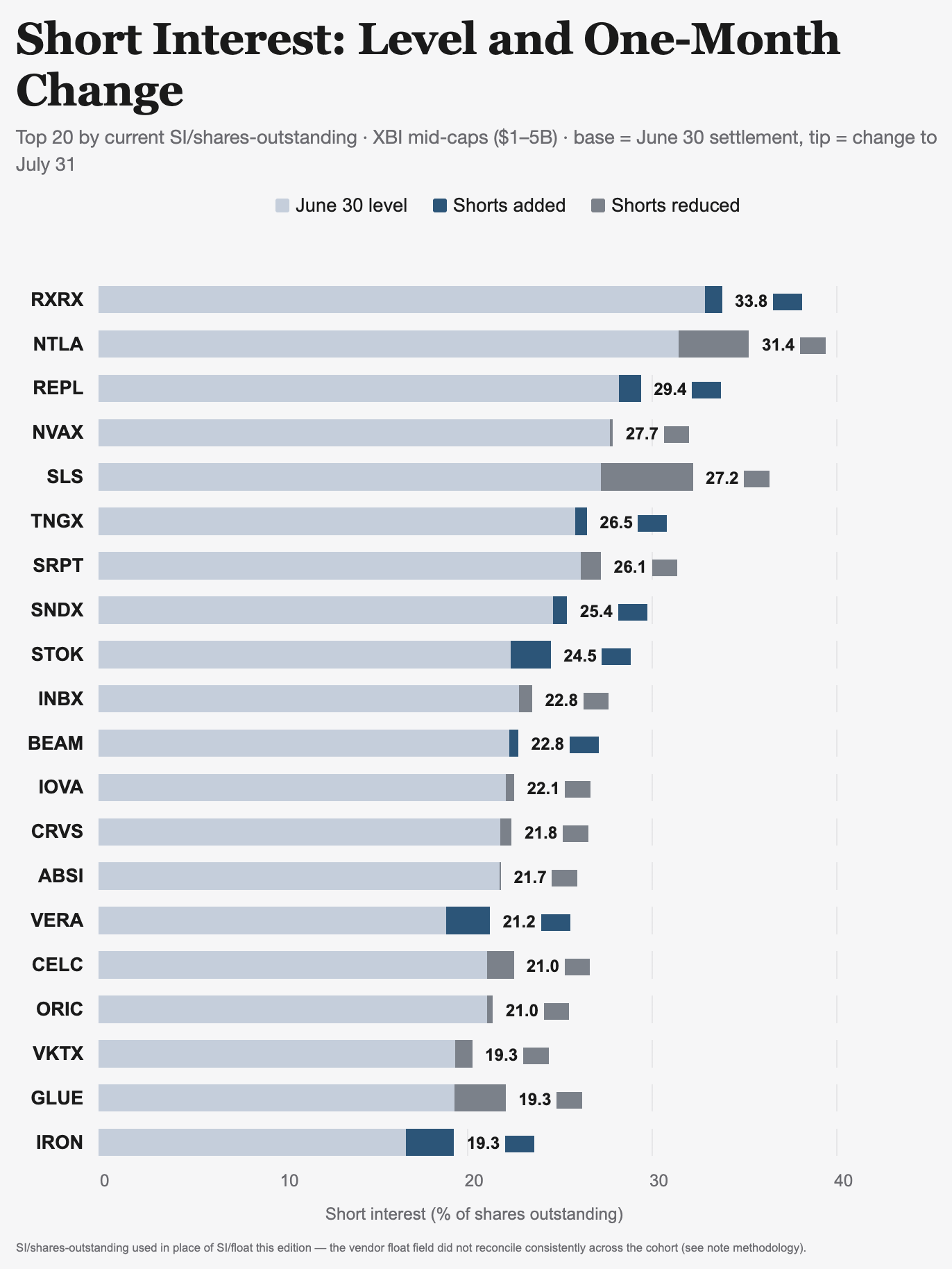
RXRX (33.8% SI/SO) and NTLA (31.4%) remain the most crowded names in the cohort, but neither saw a material July build: RXRX added only ~5%, while NTLA continued to cover.
July’s information sits in the positions that resisted the retreat, not simply in the names with the highest standing short interest.
1. Which June Short Builds Persisted?
A large one-month move can disappear completely once the prior settlement is included. Reading June and July together, against explicit thresholds, separates persistent positioning from reversals and re-entry:
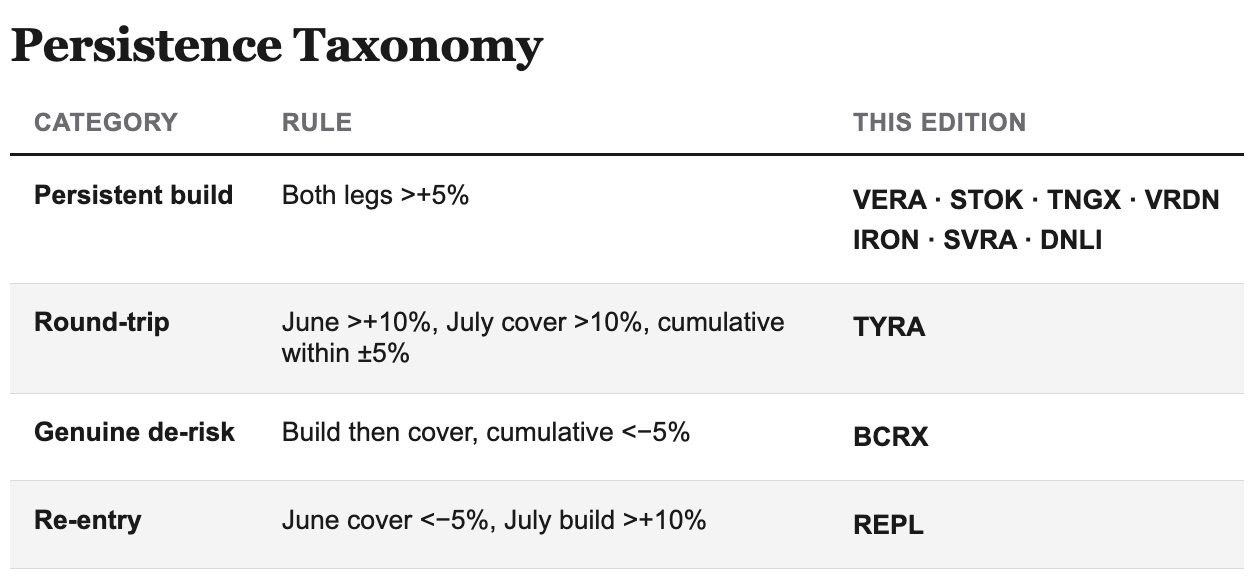
July did not simply produce fewer builds than June — it separated positions that looked alike in June into distinct trajectories. After one settlement, TYRA, BCRX, STOK, VERA and TNGX all looked like variations on the same short-build trade. STOK, VERA and TNGX kept building, TYRA erased its June move, BCRX covered through its May starting point, and REPL reversed direction a second time.
TYRA’s July cover (−22%) looks like de-risking in isolation. Against June’s build (+28%), it nets to −0.4% cumulative (9.28M→9.25M shares) — essentially flat to May. SURF302 data slipping from August to September removes the near-term catalyst that would have tested the position either way. The July cover largely neutralised the June signal, so TYRA no longer reads as a meaningful cumulative build heading into that catalyst — the question has shifted from why shorts built to whether positioning reappears as SURF302 approaches.
BCRX follows the same build→cover path as TYRA, but ends below its May starting point. June’s build (+32.8%) and July’s cover (−32.6%) each exceed TYRA’s, and this time they don’t cancel: the position lands at −10.5% (May→July). That is a different outcome than TYRA’s round-trip: the absolute short position by July 31 sits below where it stood before June’s build even started, the cohort’s cleanest example of net de-risking. The net cover coincides with restructuring, resolution of the ORLADEYO manufacturing overhang and improving cash generation — but positioning data don’t prove why funds covered.
June’s builds split apart in July
Shares short are indexed to May 29 = 100:
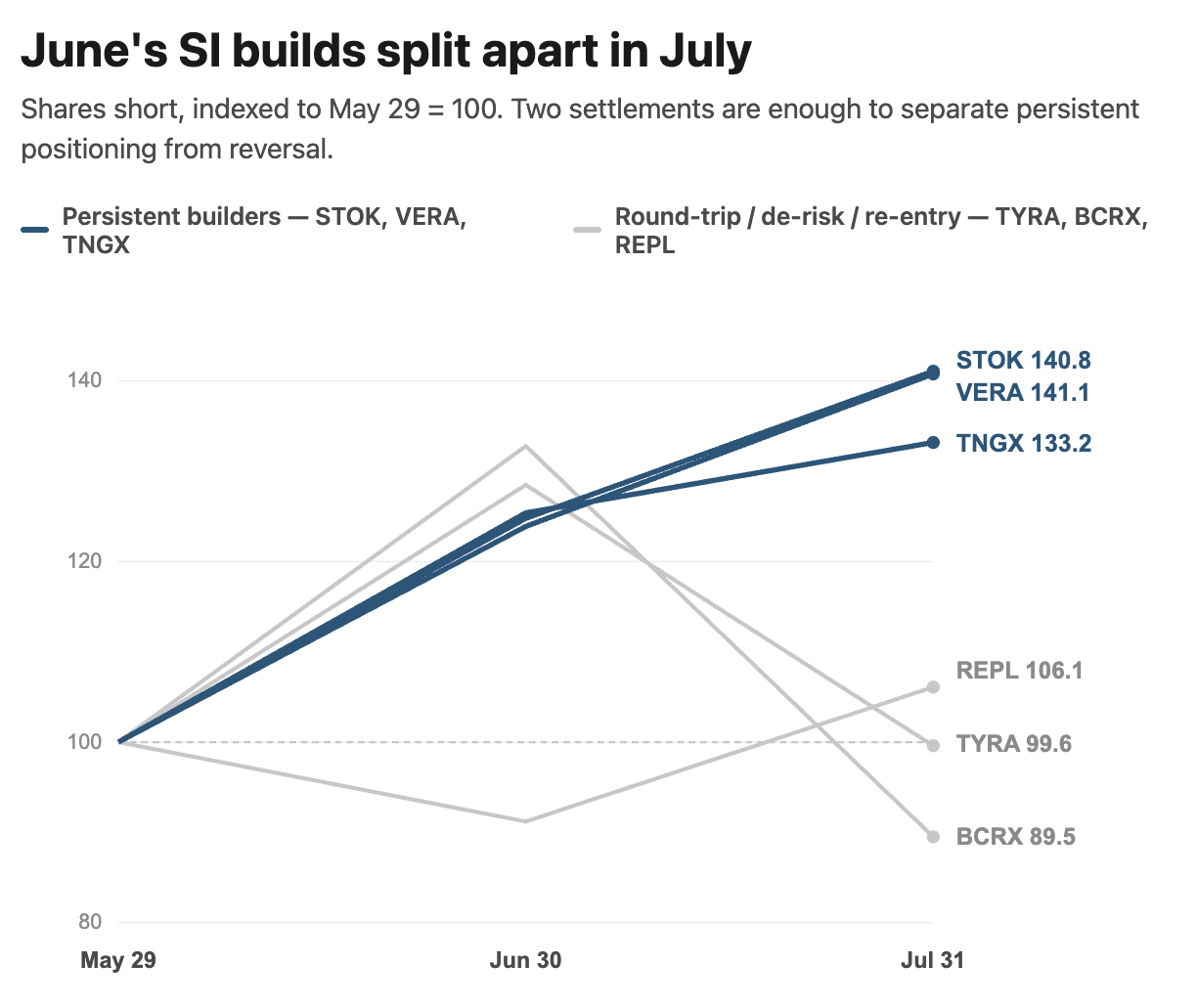
Indices are raw shares short divided by the May 29 count (Index_t = SharesShort_t / SharesShort_May29 × 100).
STOK, VERA and TNGX keep climbing; TYRA returns to its May level; BCRX falls below it; REPL covers and then rebuilds.
Identical cumulative numbers can conceal different paths. REPL ends the period only 6.1% above May — an unremarkable data-point that hides a June cover followed by a larger July rebuild, which a static two-point screen would read as a minor build.
2. The builds worth caring about
Seven clean names increased shares short by more than 5% in both June and July: VERA, STOK, TNGX, VRDN, IRON, SVRA and DNLI. Four deserve more attention once the short build is read against price, crowding and catalyst context: VERA, VRDN, STOK and TNGX. SNDX looks similar on the cumulative number (+36%) but doesn’t qualify: July added only 3.9%, so its June build has stalled.
VERA is the strongest price-confirmed persistent build. Shares short rose another 13% in July, taking the cumulative May→July build to 41%. Atacicept received accelerated approval on July 7, yet the stock fell 25.2% by month-end — underperforming XBI by 18.1 points, the sharpest relative decline of any persistent builder. Settlement data can’t establish whether the incremental short was placed before or after approval, but by month-end, regulatory de-risking had not coincided with net short de-risking. That does not establish what the short thesis is now about — eGFR risk, launch execution and commercial expectations could each explain it, and the data cannot distinguish between them. Confirmatory eGFR risk (Q3 2026) is the most concrete of the open hypotheses.
VRDN is the cleanest adversarial persistent build (+31.8% cumulative). The stock rose 3.0% in July and outperformed XBI by 10.1pp while shorts continued to increase. Lumvoa (veligrotug) was approved June 26 and launch is underway. The contrast with VERA is informative: VERA’s shorts are building alongside substantial relative weakness, so the tape and the positioning point the same direction. VRDN’s build is being maintained against relative strength instead — the cleaner adversarial example in the cohort. The data cannot distinguish between launch skepticism, valuation, or another company-specific driver.
STOK and TNGX also screen high on DTC-20 (25.5x and 17.8x), so the standing shorts sit against relatively thin recent volume.
STOK‘s short build is persistent but only weakly price-confirmed. Shares short are up 41% since May, SI/SO is 24.5% and standardized DTC-20 is 25.5x. The stock underperformed XBI by only 4.7pp in July. With EMPEROR Phase 3 now expected in Q3 2027, the positioning is clear; the near-term catalyst is not.
TNGX combines a persistent build (+33%) with high standing crowding (26.5% SI/SO) and elevated DTC-20 (17.8x). Price confirmation is modest: the stock underperformed XBI by 5.9pp in July. The 2026 data calendar (vopimetostat, TNG456) is dense but largely undated, so the short build cannot be tied cleanly to one event. TNGX and STOK look similar on the surface, but the composition differs: TNGX carries the larger standing short inventory (26.5% SI/SO vs STOK’s 24.5%), while STOK carries the tighter liquidity against its position (25.5x DTC-20 vs TNGX’s 17.8x).
IRON and SVRA accelerated in July (+16.2% and +15.0% short shares), taking cumulative builds to +23.3% and +21.9%. IRON also outperformed XBI by 12.4pp — quantitatively the most adversarial of the three, though incomplete catalyst context keeps that reading provisional. DNLI built more steadily (+16.3% cumulative); DNL593 FTD-GRN data are expected by YE26. SVRA’s molgramostim PDUFA (Nov 22) pairs its build with a dated catalyst, the cleaner setup of the three to watch.
3. Re-entry matters too
REPL is the clearest re-entry. A May→July endpoint of only +6.1% would make it look unremarkable on its own; the path is the information — shorts fell 8.8% in June, then rebuilt 16.4% in July. The stock rose 1.2%, outperforming XBI by 8.3pp. The Jul31 snapshot straddles the July 30 AdCom outcome (10–3 favorable) — under T+1 settlement it may contain July 30 trading, so it can’t separate pre-vote positioning from immediate reaction. Tudriqev was approved on August 6, four days after its target action date. The next settlement should show whether REPL’s July short rebuild persisted through approval.
4. Crowded ≠ actively shorted
RXRX and NTLA are the most crowded names by SI/shares-outstanding (33.8%, 31.4%), yet neither is building; the active builds — REPL (29.4%), TNGX (26.5%), STOK (24.5%) — sit at lower crowding. Standing crowding is inventory; flow is information. A screen sorted only by SI/SO would miss §2–3 entirely.
The settlement-aligned prices sharpen the point. RXRX fell 18.3% (−11.2pp vs XBI), while shorts increased only ~5% — substantial price weakness without a comparable acceleration in short positioning. NTLA is more unusual: it underperformed XBI by nearly 30 points, the worst relative decline in the shortlist, and shorts covered rather than pressed. The data do not explain why shorts were reduced into that weakness. But the contradiction is lost in a static crowding screen. That strengthens the case that July’s new builds deserve more attention than the standing crowding leaderboard — not that these positions are exhausted or that either name is a squeeze candidate.
July leaves three positioning groups: persistent builders (VERA, VRDN, STOK, TNGX, SVRA, DNLI, IRON), reversals of different magnitudes (TYRA’s round-trip, BCRX’s net de-risk), and high standing crowding without incremental pressure (RXRX, NTLA). REPL sits outside all three — the reversal itself is the signal.
Company-level shortlist:
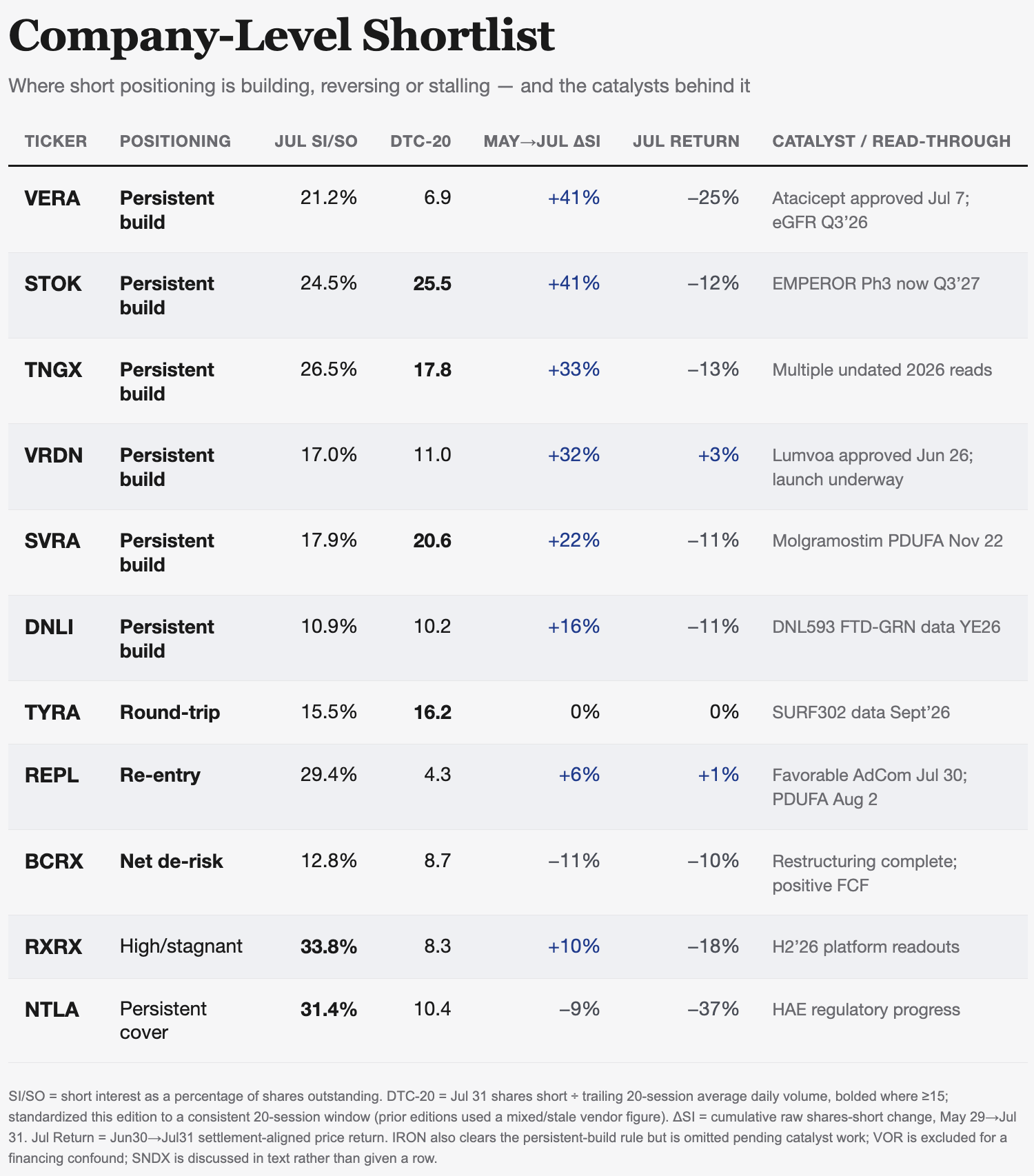
DTC-20 = Jul31 shares short ÷ trailing 20-session average daily volume. Jul return = Jun30→Jul31 settlement-aligned return; Jul vs XBI = excess return versus XBI’s −7.1%. IRON also clears the persistent-build rule but is omitted pending catalyst work. VOR is excluded for a financing confound. SNDX is already discussed elsewhere.
5. What the next settlement tests
The August read shows whether July’s surviving builds were durable or simply slower round-trips:
VERA — does the build persist through another post-approval settlement, particularly as eGFR data approach?
REPL — does the July rebuild survive after the favorable AdCom/PDUFA window is fully reflected?
SNDX — does June’s stalled build restart into Q4 data?
TYRA — does short positioning reappear as SURF302 moves closer?
STOK / TNGX — do persistent builds continue despite limited near-term price confirmation?
Methodology
Positioning flow is measured using raw changes in shares short. Standing short interest is normalized by shares outstanding; vendor float denominators did not reconcile consistently enough for cross-sectional ranking. DTC-20 is calculated as Jul31 shares short divided by trailing 20-session average daily volume. Persistence categories use prespecified June/July thresholds rather than post-hoc classification.
Limitations
Two settlements is positioning that has held for two data points, not multi-quarter conviction. Monthly settlement data cannot establish intra-month timing (VERA, REPL). TSHA, PURR and DMRA are excluded as corporate-action distorted. VOR carries an unresolved financing confound and is excluded from the headline table on that basis. IRON clears the persistence rule but is held out of the table pending catalyst work. The large-cap benchmark is deferred this edition: the available July observations are not settlement-aligned across the 15-name panel, so no large-cap-vs-SMID divergence is asserted.
Disclaimer:
This report is independent research published by Clinaptis Research and reflects the author’s own analysis and opinions as of the publication date. It is provided for informational purposes only and does not constitute investment advice, a recommendation, or an offer or solicitation to buy or sell any security. Clinaptis Research is not a registered investment adviser or broker-dealer. The analysis relies on public disclosures, third-party data and reasonable estimates where noted; Clinaptis Research believes these sources to be reliable but does not guarantee their accuracy or completeness. Estimates, scenarios and forward-looking statements are inherently uncertain and actual results may differ materially. The author and related parties may hold, or may in the future hold, a position in the securities discussed. This report may not be reproduced or redistributed without permission.