
 Open full resolution ↗
1) Category De-risked, but Leadership Hierarchy Evolving
-
Obesity is now firmly de-risked commercially after Wegovy/Ozempic and Zepbound/Mounjaro scaled into massive franchises (~$36B franchise revenues for both Novo’s semaglutide and Lilly’s tirzepatide platforms in 2025), representing the fastest large-scale commercial ramp in pharma history.
-
However, the market has clearly shifted from “infinite demand + monopoly” toward competition, pricing durability, manufacturing scale, and next-generation differentiation.
-
Stock performance reflects this transition:
- LLY +40% in 2H25 despite modest -8.6% YTD26 pullback as Lilly maintained perceived efficacy and commercial leadership
- NVO -26% in 2H25 and still -13.6% YTD26 following REDEFINE-4/CagriSema disappointment (23% WL vs ~25.5% for tirzepatide), oral competition concerns, and broader pipeline scrutiny
- RHHBY +26% in 2H25 as Roche/Carmot data validated CT-388 and broader obesity platform relevance.
-
The transition from a supply-constrained “beta trade” toward a differentiation-led market now looks complete: Wegovy supply normalization removed scarcity premium, pricing pressure is emerging, and investors now demand incremental innovation rather than rewarding category exposure alone.
-
Over the last 12 months, obesity moved beyond binary efficacy validation into a differentiated “Metabolic Stack” where winners will be defined by titration elegance, lean-mass preservation, manufacturing margins, oral scalability, and platform flexibility in a post-generic world.
2) Expansion Story Intact, but Saturation Debate Now Real
-
The obesity TAM story remains intact, with >1B obeseindividuals globally and multiple adjacent indications now pulling GLP-1s deeper into chronic disease management:
- CV risk reduction already validated (~14% in obesity without diabetes; SELECT study),
- MASH overlap now central & commercially important (label expansion in Aug 2025),
- OSA, CKD, hypertension and broader cardiometabolic studies ongoing,
- while oral GLP-1s expand access into primary care, lower-BMI populations, and emerging markets.
-
However, the market is shifting from “peak efficacy” toward durability and persistence:
- GI side effects remain meaningful (e.g. nausea >40%, diarrhea 25-30%, vomiting ~25%)
- real-world injectable adherence at 12 months remains below ~40% in several datasets,
- while investors now debate whether oral GLP-1s materially improve long-term persistence despite chronic GI tolerability burden.
-
Semaglutide LOEs beginning March 2026 across India, China, and Brazil are beginning to reshape long-term market structure:
- India + China alone account for roughly ~25% of the world’s obese adult population
- Indian generic semaglutide pricing has already fallen toward ₹450/week ($5) versus branded pricing closer to ~₹6,000/week,
- implying real-world pricing compression approaching 80–90% in some emerging-market channels post-generic entry.
-
Obesity may ultimately evolve more like:
- oncology (continuous premium innovation),
- or MDD/dyslipidemia (where commoditization foundational therapies coexist with premium next-generation agents).
That distinction may define the next decade of metabolic medicine.
3) Oral GLP-1s Become Distribution and Scalability Innovation
-
Biggest catalyst of past year arguably was Eli Lilly’s Orforglipron Phase 3 success, validating a small-molecule oral GLP-1 with “injectable-like” efficacy, no food/water restrictions, and materially simpler manufacturing/distribution economics versus injectable peptides.
-
The oral debate is less about efficacy and more about:
- manufacturing scalability,
- lower COGS,
- freedom from cold-chain logistics,
- primary-care penetration,
- and emerging-market distribution.
-
Foundayo launch scripts initially lagged Oral Wegovy (~5.6K week-3 scripts), while Oral Wegovy scaled toward ~134K weekly scripts by week 16 following its January 2026 launch. However, Jefferies still models ~$1.6B 2026 sales and ~$30B peak sales potential for Foundayo, reflecting belief that oral GLP-1s could massively expand the obesity funnel globally.
-
Commercialization already looks structurally different from traditional pharma:
- ~45% of Foundayo scripts flowed through LillyDirect,
- ~35% via telehealth,
- and only ~20% through traditional retail,
highlighting how obesity is evolving toward a hybrid consumer-tech / DTC healthcare / subscription medicine model that partially bypasses traditional pharmacy infrastructure.
-
GPCR remains one of the more interesting oral platform names:
- +230% in 2H25 following ACCESS-II data before correcting ~40% YTD26,
- while Roche’s $100M CT-996 licensing agreement reinforced the growing strategic value of oral GLP-1 chemistry/IP protection.
-
Increasingly, the key question is no longer “can oral GLP-1s work?” but:
“Can they get close enough to injectable efficacy while being cheaper, easier, and globally scalable?”
4) The Metabolic Backbone Thesis
-
GLP-1s are expanding beyond weight loss into broader chronic disease management:
- MASH,
- cardiometabolic disease,
- obstructive sleep apnea (OSA),
- CKD,
- hypertension,
positioning obesity therapies as foundational metabolic treatments rather than isolated obesity drugs.
-
The strongest strategic implication is “Indication Encroachment”:
Multi-indication metabolic platforms are pressuring single-indication specialty categories, particularly in MASH where incretin overlap will compete against standalone liver franchises. -
A March 2026 meta-analysis showing GLP-1s improved fibrosis without worsening MASH (RR ~1.59) materially strengthened the “metabolic backbone” thesis and pressured standalone liver franchises.
-
MDGL rallied +94% in 2H25 as Rezdiffra, the first approved MASH therapy, scaled to ~$311M quarterly sales by Q1 2026 and exceeded many early commercial expectations (launch trajectory).
-
However, the long term debate centers on whether standalone MASH therapies ultimately become niche second-line agents layered on top of GLP-1 backbones rather than foundational therapies themselves.
-
Payer incentives now favor integrated metabolic platforms spanning obesity + CV + liver + renal risk rather than multiple siloed specialty therapies.
Which is why obesity is no longer just a weight-loss category. Obesity now sits closer to foundational metabolic infrastructure than a standalone weight-loss category.
· GLP-1 prescriptions remain heavily concentrated within Commercial plans (~81% of claims), while Medicare access remains tightly restricted despite expanding cardiometabolic indications. Following cardiovascular-risk expansion, Wegovy Medicare Part D approval rates only improved from ~12% to ~20%, while Zepbound’s OSA indication drove approval rates from ~10% to ~28%.
· Reimbursement friction remains substantial beneath the category’s growth narrative. GLP-1 gross-to-net (GTN) discounts already range from ~23–45%, while patient out-of-pocket costs exceeding ~$800/month drove treatment discontinuation to >50% in some datasets (IQVIA).
5) Next-Wave Obesity Competition Intensifies
-
The obesity pipeline is rapidly moving beyond first-generation GLP-1 monotherapy:
- Roche’s CT-388 Phase 2: 22.5% placebo-adjusted WL at 48w, with ~48% achieving ≥20% WL and 26% ≥30% WL, positioning Roche as a credible large-cap obesity player behind Lilly/Novo
- Eli Lilly’s Retatrutide remains the upper-end efficacy benchmark (~24.2% WL at 48w in Phase 2)
- VKTX stabilized after its prior speculative unwind as investors reassessed the strategic value of its oral and subcutaneous VK2735 (GLP/GIP) following data that compared favorably against earlier tirzepatide benchmarks.
- ZEAL.CO / Roche combination strategy further strengthened the amylin narrative after ZUPREME-1 data showed ~10.7% WL with “placebo-like” tolerability, while Roche initiated Petrelintide + CT-388 combo development in Q2 2026.
-
Market is rewarding:
- Durability and tolerability
- functional mobility preservation,
- and combo flexibility
rather than headline weight-loss alone.
-
Investors are now distinguishing between:
- “high-efficacy obesity assets”
- versus “scalable chronic metabolic platforms”
which are not necessarily the same thing.
-
At the same time, much of the next-wave obesity pipeline already carries significant strategic premium before the long-term durability, scalability, or commercial differentiation are fully proven.
-
The debate shift:
“Which drug loses the most weight?” → “Which platform remains differentiated once obesity becomes crowded, segmented, and partially commoditized?”
6) Market Structure Bifurcating: Innovation vs Industrialization
-
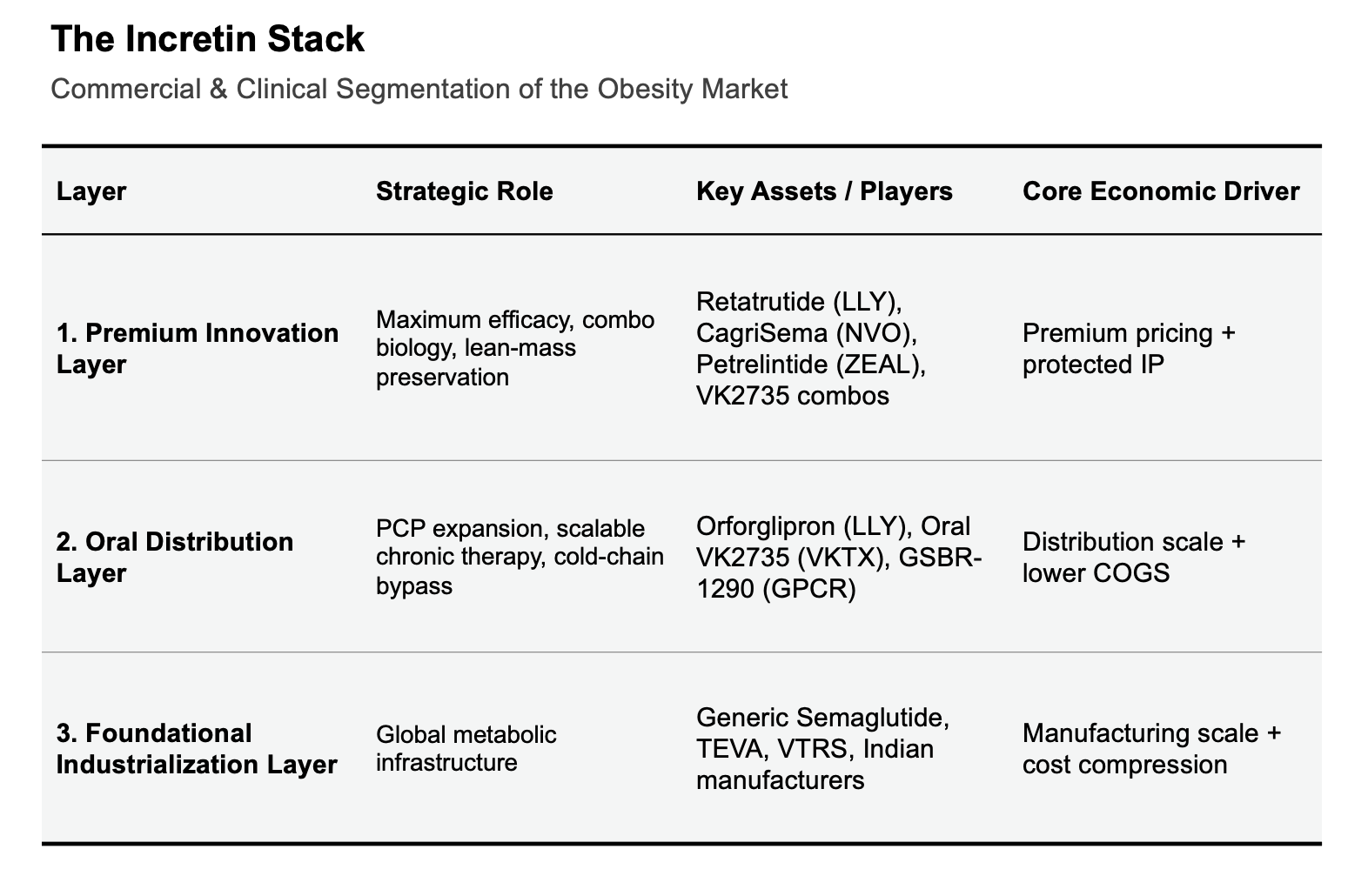
The obesity market is splitting into two parallel ecosystems:
- Frontier Innovation: LLY, RHHBY, AMGN focused on potency ceilings, oral non-peptides, combinations, and next-generation metabolic architectures
- Industrialization Layer: TEVA, VTRS, Dr. Reddy’s Laboratories, Biocon, Divi’s Laboratories focused on peptide manufacturing, fill-finish scale, APIs, CDMOs, and post-LOE metabolic care.
-
The March 2026 semaglutide LOE in India marked a catalyst event for the industrialization layer:
- over 10 manufacturers launched versions within days,
- vial-format semaglutide pricing rapidly compressed toward ~$15–25/month,
- representing roughly ~90% discounting versus innovator pricing in some channels.
-
Importantly, while India moved immediately post-LOE, China remains under a more complex administrative stay into late 2026, though local manufacturers are stockpiling API and positioning aggressively for launches.
-
As efficacy differentiation compresses and semaglutide industrializes post-LOE, investors will focus on who captures manufacturing, supply-chain, and distribution economics beneath the innovation layer.
-
Stock performance underscores this structural transition:
- TEVA (+88% in 2H25) benefited from better appreciation of its CDMO and manufacturing positioning
- VTRS (+40% in 2H25) rallied after confirming expected regulatory decisions for complex generic GLP-1 candidates by YE26.
-
Obesity looks less like a single-drug category and more like semiconductors:
- innovators design the architectures,
- but manufacturing foundries, peptide yields, supply chains, and distribution infrastructure increasingly determine who captures the long-duration economics.
-
The next phase looks like a fight over manufacturing scale, distribution architecture, reimbursement persistence, and who ultimately controls the global metabolic supply chain.