
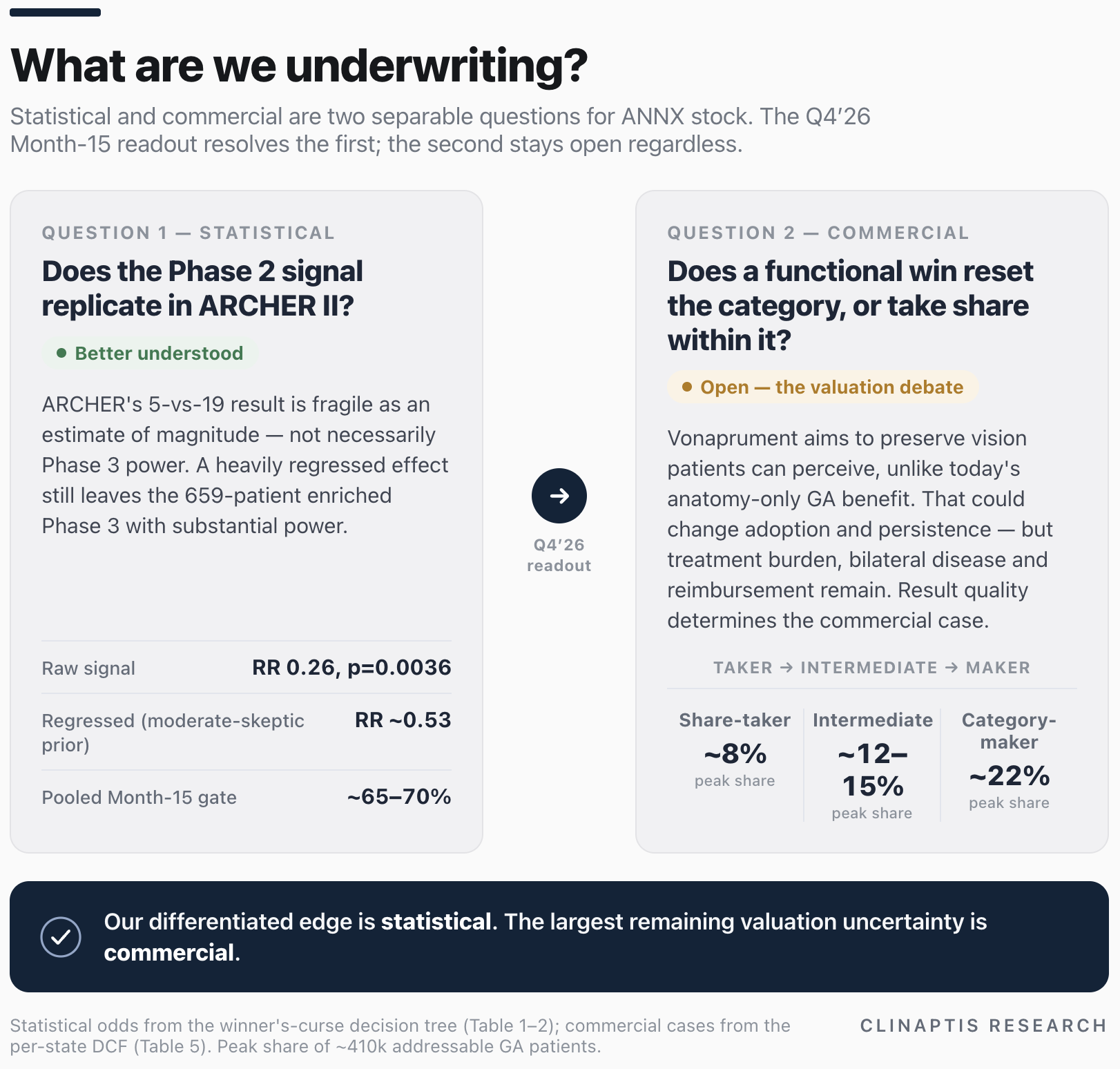
Complement has failed repeatedly in geographic atrophy (GA), and ARCHER’s functional win rests on a handful of events — on the tape, that reads as a low-probability coin flip on a small biotech. It isn’t. A heavily regressed version of the ARCHER effect still clears the 659-patient enriched Phase 3 roughly two-thirds of the time, materially better odds than the “handful of events” framing implies. If ARCHER II replicates with only modest degradation, the debate moves quickly from PoS to commercial magnitude. By 1H27 the question becomes whether visible preservation of vision resets GA treatment or simply takes share.
 Open full resolution ↗
Annexon (ANNX) did not come public as a GA story. Its 2020 IPO (~$250M) backed a broad bet on upstream C1q blockade in neuroinflammatory disease; vonaprument (formerly ANX007), an intravitreal anti-C1q Fab, began in glaucoma before moving to GA. Then ARCHER failed its structural endpoint yet cut severe vision loss ~70% — the signal Phase 3 was rebuilt around. ARCHER II tests whether that was biology or noise.
ANNX stock trades at ~$1.05B fully-diluted equity value (206.8M shares at $5.07) ahead of the Q4 2026 ARCHER II readout. Our reconstruction, detailed below, replaces the raw 5-vs-19 event count with a regressed base rate that holds up under Ph3 conditions. The statistical risk is real — it is simply better than the raw event count suggests.
The harder question is what a win is worth. The approved GA complement drugs slow an anatomic lesion patients cannot perceive; vonaprument could instead preserve vision patients and physicians can observe. That distinction could change dosing persistence and share, but it does not solve intravitreal treatment burden, bilateral disease, reimbursement or adherence. A clean, uniform functional win therefore creates the evidence for category-maker economics without guaranteeing them. Our differentiated edge is statistical; the largest remaining source of valuation dispersion is commercial.
At $5.07, our central fair value is ~$8.5–9; even with GA failure, we see ~$2.5–3.4 of residual value. Tanruprubart in GBS, net cash and the residual pipeline supply that downside support, though GBS regulatory uncertainty and future burn keep it a range rather than a hard floor. Risk/reward looks attractive to us at $5.07, but the upside range is wide. A pass is not enough — readout quality matters.
1. GA Is Commercially Validated, but Functionally Unsolved
Geographic atrophy is the advanced, vision-destroying form of dry AMD, and it is large: ~1.5M US patients carry advanced GA, of whom we treat ~410k as commercially addressable — diagnosed, with vision-threatening (foveal-involving or near) disease where BCVA-loss risk is real. GA has become a meaningful commercial market from a standing start, validating substantial underlying demand, although early adoption has undershot initial expectations: Syfovre generated ~$587M of US sales in 2025, while Astellas cut Izervay’s FY2025 guidance from ~$750M to ~$550M.
The strongest strategic fact in the file is why early launches have undershot. Syfovre and Izervay slow an autofluorescence-defined atrophic lesion — an anatomic endpoint the patient cannot see or feel — and real-world dosing reveals what that is worth: ~6–9 injections a year against a monthly-to-every-other-month label. Physicians keep the drug but dose it sub-label; the clearest read is that slowing a lesion nobody perceives does not command monthly commitment, though injection burden and reimbursement also cap adherence. The ANNX question follows directly: whether visible preservation of vision can expand adoption and persistence beyond what anatomy-only complement therapies have achieved.
Vonaprument’s pivotal endpoint is functional (severe vision loss), not anatomic — which is why the note prices that adoption question directly rather than burying it in a single penetration assumption.
2. Annexon: one target, two assets
Classical-complement biotech built on a single node. Vonaprument (GA) and tanruprubart (GBS) are the same anti-C1q antibody aimed at the top of the cascade in two tissues; Ph3 GBS-02’s primary-endpoint win does not raise ARCHER II’s statistical odds — different tissue, route, disease — but it is human evidence that blocking C1q alters a classical-complement-driven neurodegenerative process, making the SOTP two shots on one biological thesis rather than two unrelated lottery tickets. The enterprise sits at ~$1.05B fully-diluted equity value because both programs carry unresolved regulatory questions: ARCHER II has not read out, and tanruprubart’s US path slipped roughly two years on a generalisability dispute. Net cash is ~$159M ($209.2M cash and short-term investments at 30 Jun 2026 less the $50M drawn Oxford Finance term loan); the $200M Oxford facility (a further $100M unlocking on registrational milestones) takes cash-funded operations and anticipated milestones into 2028 — comfortably past both the 4Q26 gate and the 1Q27 substudy analysis — a runway fact, not PoS validation.
3. Why vonaprument could be different?
The apparent contradiction resolves to a surrogate problem. ARCHER missed its structural primary — FAF-defined GA lesion growth slowed only 6.2% on monthly dosing, p=0.53 — while severe vision loss fell ~70%. Total lesion area is a weak functional surrogate; central macular preservation is what maps to acuity. A drug can preserve vision while barely moving the FAF perimeter, and the anatomic endpoint the approved competitors were built around may be the wrong endpoint for capturing functional benefit. That is the evidentiary base for the commercial thesis.
The OCT data support that mechanism. Annexon’s ellipsoid-zone analyses show the effect concentrated toward the macular center — ~27–29% reduction in EZ loss overall, ~48% within the central 2mm, ~59% within the central 1.5mm — against near-zero on total lesion growth. That pattern is what upstream C1q blockade would predict if it preserves central function without slowing the FAF-visible perimeter of already-atrophic tissue. Independent evidence points the same way: a 2026 AREDS2 natural-history analysis finds total GA area barely tracks vision while central macular integrity does (a 10% decline in central-1mm integrity associates with ~1.9 letters of BCVA loss, 95% CI −3.4 to −0.4), with a separate cohort and biomarker in agreement.
But mechanism explains — it does not prove. The EZ analyses make the functional result harder to dismiss as a fluke, but they cannot tell us how much the 5-vs-19 result overstates the true treatment effect. The evidence also has limits: the EZ analysis covers only ~151 patients with nominal p-values, while the AREDS2 biomarker comes from earlier-stage disease. We therefore treat the mechanism as supportive biological evidence, not proof that the Phase 2 effect will replicate.
The competitive record cuts both ways. Roche’s factor-D inhibitor lampalizumab ran the two largest GA trials to date — Chroma and Spectri, n=1,881 — and failed on lesion growth (differences vs sham of −0.02 to +0.16 mm²), with no benefit even in the CFI-biomarker-enriched subgroup that was its rationale; two C5 inhibitors also failed in GA Phase 2. That record makes the functional-primary choice rational, but is equally a reason not to over-weight vonaprument’s own mechanism: a plausible complement drug can still fail. Chroma and Spectri also provide useful natural-history anchors — ~2 mm²/year GA growth and ~5 letters of BCVA loss over 48 weeks untreated — while their enrichment for faster-progression features provides external precedent for ARCHER II’s design.
4. What resolves in Q4 2026, and what we will actually learn
Q4 2026 is a gate, not a data release. An independent DMC “will assess the primary endpoint at Month 15,” and the company expects to report that assessment in Q4 2026 — a pass/fail signal, not a hazard ratio, KM curve, or event count. If the Month-15 primary is met, the two-substudy analysis follows in Q1 2027; if not, the trial stays masked toward the Month-24 primary (completion Q3 2027). This is a genuine dual primary — success at either timepoint — splitting trial-wise alpha across the two looks, though the allocation is undisclosed.
The investment map is simple:
-
Month-15 pass → GA becomes a registrational franchise debate; the commercial question drives the stock.
-
Month-15 fail, Month-24 alive → uncertainty extends ~9 months into Q3 2027, on a de-rated path.
-
Month-15 fail, no rescue → GBS, cash and pipeline dominate; the stock reverts to its ~$2.5–3.4 GA-failure range (~$3.4 at the fundamental GBS floor; ~$2.7 with added regulatory/burn downside).
The enrichment is empirical, not a design narrative. That grounds our +20% control-event assumption in Phase 2 natural history. Two ARCHER patterns shaped ARCHER II’s inclusion criteria: ≥15-letter loss events clustered in eyes with more vision to lose (patients below ~44 letters could not register a 15-letter drop), so ARCHER II enrolls BCVA >45 and removes that low-event tail; foveal disease carried a higher sham event rate than non-foveal (~25% vs ~18%), so ARCHER II enriches for foveal involvement. Both raise the expected control event rate and, mechanically, power.
A reader positioning for Q4 is positioning for one bit of information: did the pooled Month-15 analysis clear its alpha. More details in Q1 2027.
5. Can we estimate the Phase 3 probability before the readout?
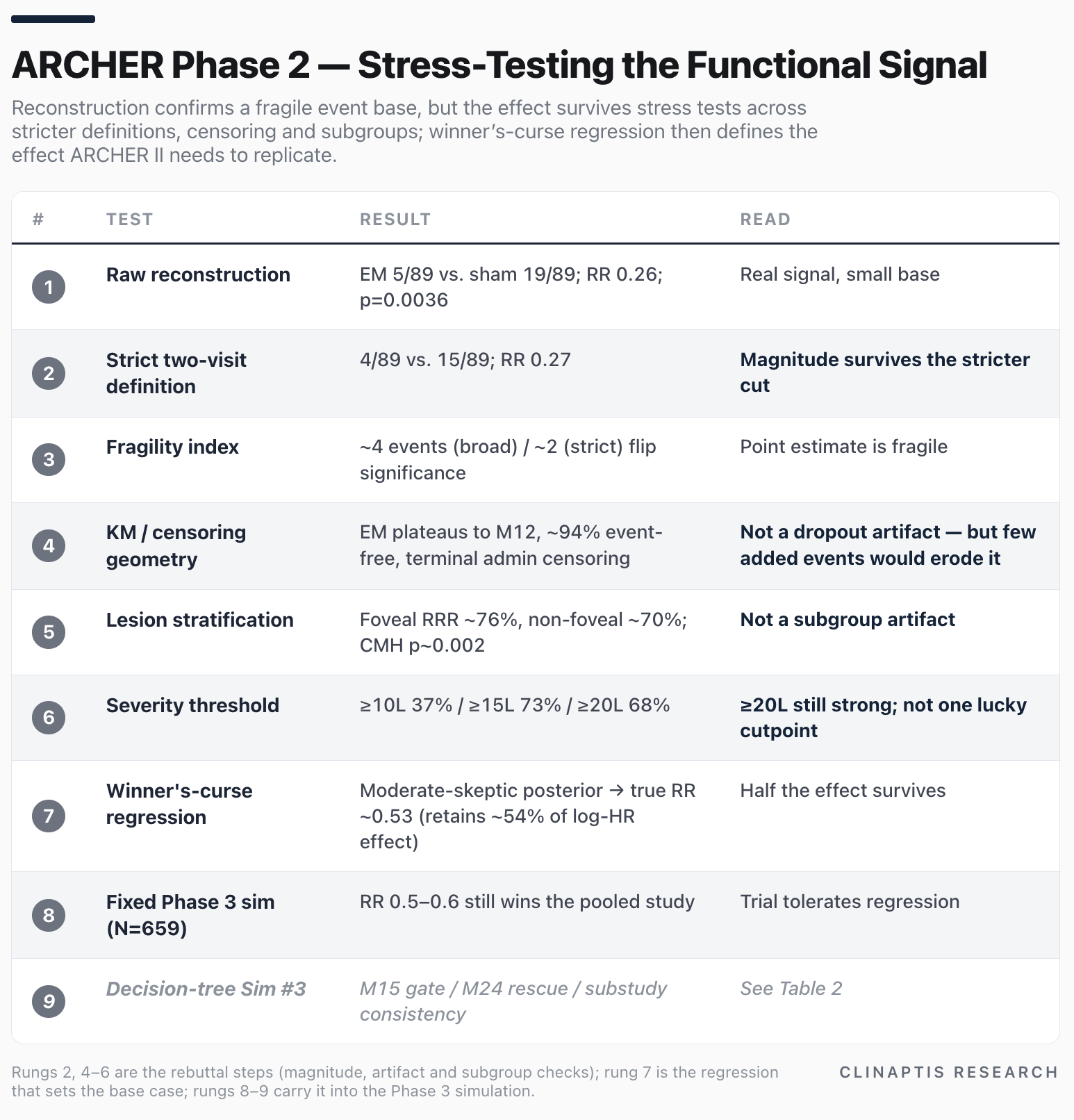
The inputs were never public, and the reported hazard ratio (0.272, 95% CI 0.09–0.82) is wide enough to accommodate almost any prior. We recovered the underlying events and built the probability from the bottom up, stress-testing the signal across definitions, censoring, subgroups and winner’s-curse regression.
 Open full resolution ↗
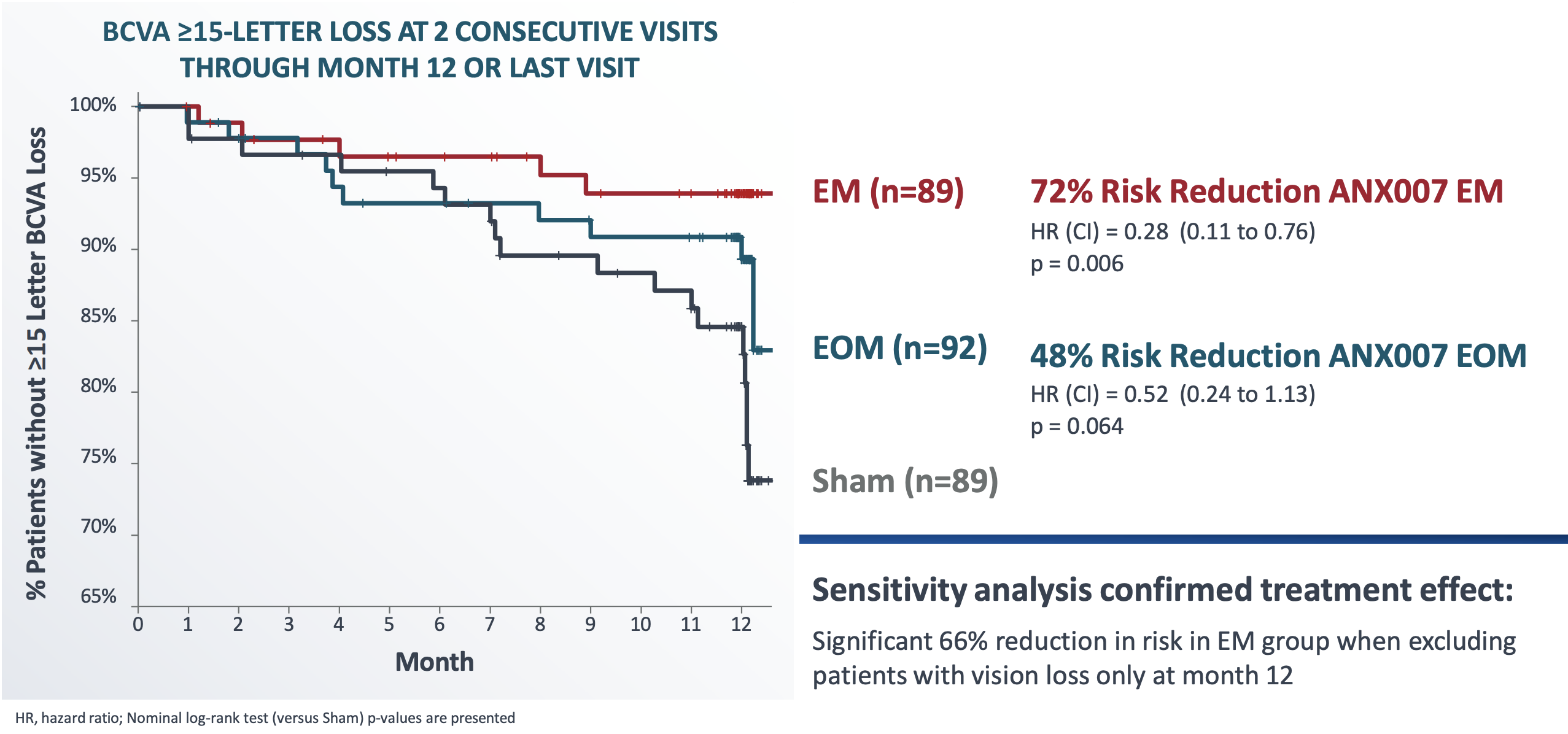
Two things survive the ladder. The effect is fragile but not a mirage: the point estimate holds under the strict two-visit definition (RR 0.27), on a fragility index of only ~2–4 events, which is why we regress it rather than carry it forward. And it is not one lucky cut: the effect holds across foveal and non-foveal lesions and at the ≥20-letter threshold, and the Kaplan-Meier geometry (Exhibit 3, below) is hard to reconcile with a dropout artifact. (We read the KM geometry off a digitized curve without a numbers-at-risk table, so we treat it as a sensitivity check, not reconstructed patient data — the binary 5/89-vs-19/89 counts is still the citable analysis. A handful of additional monthly-arm events along that plateau would visibly erode the separation, which is the winner’s-curse concern in pictures rather than priors.)
 Open full resolution ↗
Exhibit 3 — ARCHER Kaplan-Meier, persistent ≥15-letter BCVA loss through Month 12. Monthly arm separates early and plateaus near 94% event-free; sham declines steadily then steeply after Month 7.
The Phase 2 effect needs a substantial haircut. Rung 7 centers a moderate-skeptic winner’s-curse prior at RR 0.75 on the log-RR scale; the posterior median lands near 0.53. On the multiplicative (log-hazard) scale, that discards roughly half the observed effect — regressing HR ~0.28 to ~0.50 retains only ~54% — below the bull’s 0.28, well above the reflexive bear’s near-zero.
A regressed RR of 0.5–0.6 still wins ARCHER II with reasonable probability — that is the crux of the statistical case. We built a decision-tree simulation that follows the same patients through the actual catalyst structure: a pooled Month-15 gate, a correlated Month-24 timepoint, and a two-substudy consistency question. It draws the true effect from the regressed posterior and projects correlated events to each timepoint on shared patient trajectories, rather than drawing them independently. Under the moderate-skeptic prior with +20% enrichment, the outputs separate into three quantities the market collapses into one.
The pooled Month-15 gate clears with ~65–70% probability, in a tight band across the plausible alpha-allocation range — the undisclosed split does not swing the conclusion.
Any pooled primary success through Month 24 reaches ~79% under constant hazard, but that assumption does not survive stress: a 25% wane cuts conditional rescue from ~36% to ~12%, a 50% wane leaves it near zero and any-primary back at the M15 gate (~68%), and the rescue is adversely composed — the Month-15 misses concentrate where the true effect was weakest. We lead with the two-thirds gate and treat Month-24 as durability-dependent upside.
The two-substudy consistency is the unresolved hurdle, and where statistics and commercial value meet. Conditional on a pooled Month-15 win, both ~330-patient substudies independently reach nominal significance about half the time under a homogeneous model; realistic between-substudy dispersion (site mix, geography, enrollment window) pulls both-significant to ~37–44%. A pooled win with one noisy half is a real outcome the market’s binary framing misses — and not only a regulatory risk, since a non-uniform effect is also a weaker clinical proposition the commercial model prices down (below). FDA’s bar is not public and does not mechanically require two independently significant halves; the effectiveness framework allows a single adequate trial plus persuasive confirmatory evidence. We treat the stricter ~40% end as the better-supported bound.
The strong-skeptic row is the disciplined floor: even with three-quarters of the effect gone, it leaves a non-trivial ~32% M15 probability — well above the ~10–20% the “handful of events” framing implies. The weak prior essentially believes ARCHER and is not our case. Two sensitivities do not change that conclusion: alpha allocation (pooled M15 holds a tight band across 50/50, 70/30, 30/70; program PoS ~77–80%) and enrichment (M15 runs 62%/67%/71% at +0%/+20%/+40%).
These are statistical endpoint probabilities; valuation needs a lower regulatory-and-commercial PoS. We translate one to the other by taking the durability-adjusted any-primary probability (~68–79%) and applying a haircut for the two-substudy bar, giving a blended GA valuation PoS of ~50% (range ~42–55%) — ~42% under a strict FDA bar and waning effect, ~55% under a durable effect and lenient bar. The state build below then values each readout outcome separately.
Execution supports a benign reading of the August amendment. Annexon’s 12 August release reports discontinuation below 10%, compliance above 95%, all patients past 12 months, and masked accrual in line with projections; Jefferies adds >90% power at each timepoint with over-enrollment of 30+ patients. Our ~65–70% is lower than management’s design power only because we integrate uncertainty over whether the effect is real, while their power is conditional on it — both can hold. The clean execution frames the Month-24 addition as statistical surplus from over-enrollment, not a rescue prompted by a worrying interim look: management notes the trial “was already designed to remain masked through Month 24,” so the amendment added a labeled timepoint without touching operations.
6. GBS: downside support, the discount, and the mechanism read-through
Tanruprubart is the more valuable near-term asset, and the source of downside support. Efficacy at the advancing 30 mg/kg dose is well-supported: GBS-02 met its primary endpoint (adjusted OR 2.4, 95% CI 1.3–4.5, p=0.006 on Week-8 disability, more than doubling minimal-disability rates from 12% to 29%), with convergent secondary-endpoint support. A higher 75 mg/kg dose tested in the same trial missed the identical endpoint (p=0.55); Annexon’s explanation — that prolonged C1q suppression interferes with subsequent nerve repair — is biologically plausible but unconfirmed, and we treat the dose-response split as a real diligence flag already reflected in our ~65% PoS, not a clean result. The problem is Western generalizability: the ~60% AMAN pivotal population is a subtype uncommon in the West (where AIDP predominates), and the placebo arm reflected settings without IVIg or plasma exchange. That cost the program roughly two years — Annexon’s 10-Q now discloses FDA may require additional data and that even FORWARD (the ~30-patient Western bridge) may prove insufficient — while EMA accepted the MAA in January.
We carry tanruprubart at ~$491M risked (~65% PoS) — high because activity is well-supported and EMA has accepted the filing, but below a routine filed-asset level because FDA has not accepted the U.S. package — that is our SOTP figure. The market plausibly applies a further ~15% credibility discount after the two-year slip, giving a market-assigned ~$417M that feeds only the implied-GA-PoS back-solve below, not our fair value.
The correction matters beyond GBS: it raises the residual left for GA in the decomposition below. US net pricing of $100–175K is confirmed via Uplizna-class acute rare-neuro biologic analogues; the company’s >$7B disease-burden figure is societal cost, not addressable market.
The mechanism read-through is why GBS belongs in a GA note. It makes the platform thesis — that upstream classical-complement blockade is therapeutically active in neural tissue — something the market has already seen work once.
7. What a GA win is commercially worth, and why the readout sets the size
GA rNPV is the largest swing in the valuation, and it turns on whether a functional label changes adoption. These are not independent commercial scenarios. A cleaner ARCHER II result should support higher adoption assumptions; a split or late win would temper our GA penetration assumptions.
-
Share-taker (~$690M unrisked rNPV, ~$475M peak). The functional label is a marketing edge, but adoption looks like the incumbents’: ~8% peak share of the ~410k addressable pool, sub-label dosing (~7.5 inj/yr), incumbent net price — the benefit is real but changes no behavior.
-
Intermediate (~$1.2B unrisked, ~$800M peak). A clean but not transformational shift: ~12–13% share, ~7.5 inj/yr, full net price (a functional label supports pricing even where it does not reset volume). Better than the incumbents, but intravitreal burden, bilateral disease and reimbursement still cap share.
-
Category-maker (~$2.55B unrisked, ~$1.76B peak). A distinct clinical proposition — treat to preserve vision, earlier, with better persistence — earning a differentiated agent’s economics: ~22% share, dosing nearer the label at ~9 inj/yr, defensible pricing.
The sanity check on the upper case is Syfovre’s footprint. ~130k cumulative treated patients by YE25 on an invisible, lesion-slowing benefit. Our category-maker case implies ~90k vonaprument patients at peak (22% × ~410k) — below Syfovre’s reach, for a drug with a perceivable benefit — against a branded GA market already running ~$1.5B on lesion-slowing alone. A ~$1.76B functional-drug peak is not heroic against that; the 8%-share-taker case is the one that requires believing a perceivable benefit changes nothing.
That is why the valuation runs per state rather than on one blended PoS. The ~$475M-to-$1.76B peak-sales range depends heavily on readout quality, not just whether ARCHER II technically passes.
8. What probability is in the price, and what the stock is worth in each branch
Fix every term in the sum-of-the-parts except GA, and the market’s GA valuation falls out by subtraction. Against the ~$1.05B equity value, subtracting net cash (~$159M), the market-adjusted GBS value (~$417M), and other pipeline (~$50M) leaves a residual of ~$422M for GA. Divided by the category-maker unrisked rNPV of ~$2.55B, that residual implies only a ~17% probability of a category-maker GA franchise; at share-taker economics, the same residual implies ~61%. Neither is an observable market belief on its own — the number is conditional on which commercial case you assume the market is pricing.
The commercial case decides whether GA looks cheap or fair. If a functional label resets the category, the market’s implied ~17% sits well below our ~50% analytical PoS, and GA is materially underpriced; if vonaprument is only a share-taker, the market’s implied ~61% sits close to our own, and GA is fairly valued. On the undiscounted GBS value the category-maker cell reads ~14% rather than ~17% — either way, below our analytical PoS.
That is why we prefer the state build below to one blended PoS: GA value changes with the quality of the win. GBS, net cash and pipeline are held fixed across GA states (~$700M); only the GA leg moves.
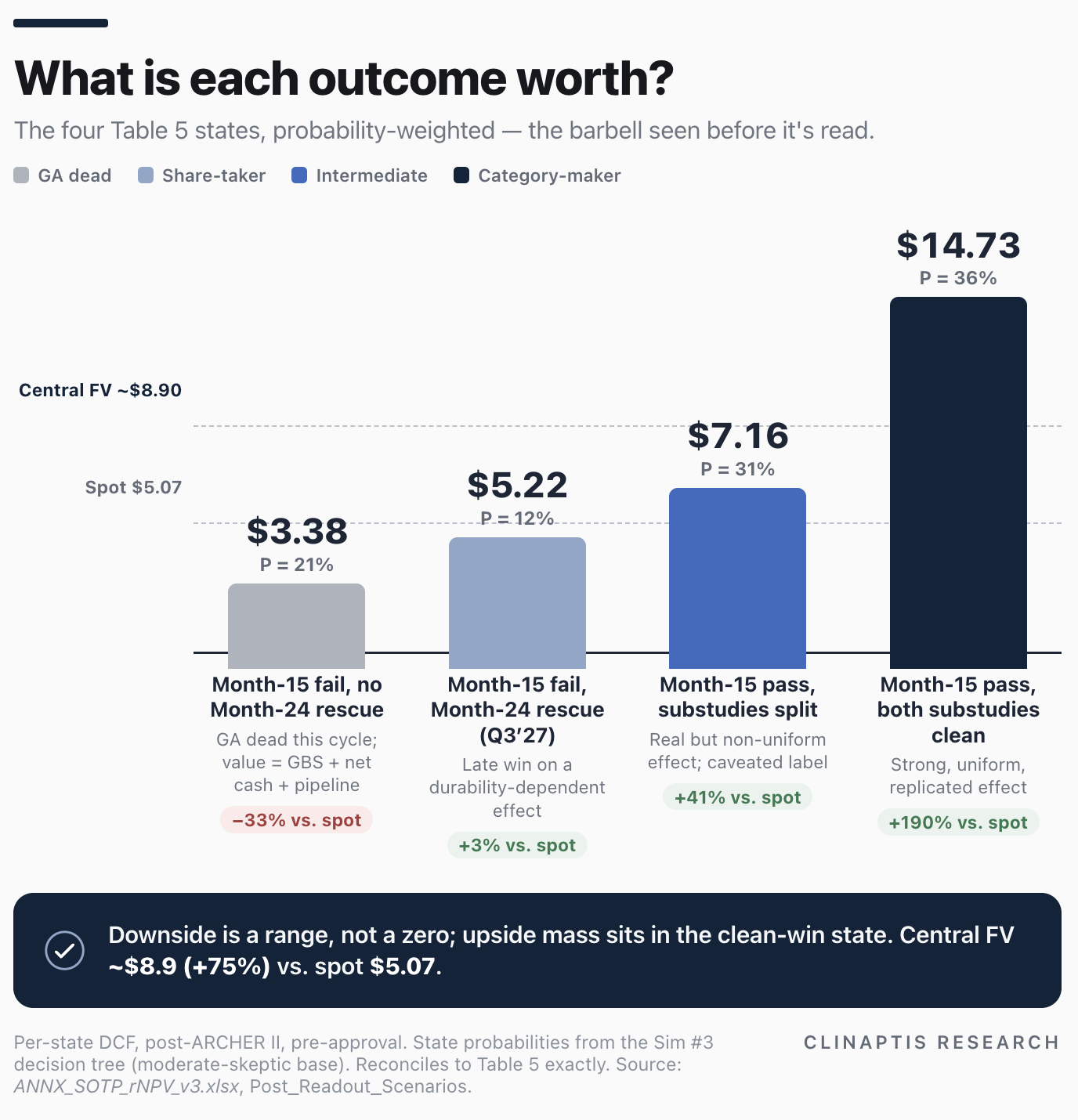
Each outcome carries the commercial magnitude its evidence supports, for a central fair value of ~$8.5–9 — roughly 70–75% above spot. Two features carry the investment point. The downside is a range, not a hard floor: a GA failure leaves ~$2.5–3.4 — the state tree carries ~$3.4 at the fundamental GBS-plus-cash-plus-pipeline floor, with ~$2.7 reflecting additional GBS regulatory and burn downside. The upside concentrates in the clean-win state (~$10–11 once its commercial distribution is respected; ~$14.7 at full category-maker realisation), which holds ~36% of the probability mass. If a functional label changes nothing even after a clean readout — every success state at share-taker economics — the same tree is worth ~$5–6, roughly spot. That single sensitivity is the whole bear case, and it is commercial, not statistical.
 Open full resolution ↗
A second, independent build lands in the same neighbourhood. The pre-trial blended-PoS SOTP — applying our ~49–50% blended GA PoS to the category-maker anchor magnitude — gives ~$9.4 ($2,550M × ~49% plus non-GA assets), against the state build’s ~$8.9. These are structurally different estimands (a single pre-trial PoS versus a probability-weighted set of state-specific commercial magnitudes), so they are expected to sit close rather than coincide — see the appendix (Table 5a).
Strategic-value comps bound the ceiling but do not set our number, which rests on the rNPV. (Astellas paid ~$5.9B for Iveric Bio in 2023 ($40/share), struck while its GA asset was still under FDA review — a read on strategic value for a not-yet-approved GA drug. Biogen closed its ~$5.6B Apellis acquisition in May 2026 ($41/share plus a CVR up to $4 tied to Syfovre milestones), though that deal bundles Syfovre with Empaveli and is an upper reference, not a pure GA multiple.)
Where our assumptions could move. The statistical case can tolerate substantial regression of the Phase 2 effect, while GBS, cash and pipeline leave ~$2.5–3.4 of value if GA fails. Our base assumes a clean ARCHER II win can support category-maker economics, with split or late success worth less; we carry GBS at ~$491M risked. The main downside sensitivities are a strict FDA two-substudy bar, waning efficacy through Month 24, or a worse GBS regulatory outcome. A broader GA label — dropping the foveal filter and roughly doubling the addressable pool — or early evidence of better dosing persistence would move value higher. The biggest uncertainties remain FDA’s substudy bar and the GBS US package; commercially, the key question is still whether preserving vision actually changes treatment behavior.
9. Risks and thesis invalidation
The thesis fails, cleanly, in four ways (for different reasons):
-
The statistical case breaks if ARCHER II misses Month-15 and the Month-24 rescue proves weak. The durability sensitivity already shows the rescue collapsing under a waning hazard, so a masked, drifting effect is the scenario that turns the roughly two-thirds gate into a genuine failure.
-
The regulatory-commercial case breaks if FDA holds the package to a strict two-substudy bar and the result is a strong pooled win with one noisy half. That outcome is approvable-looking but registration-uncertain, and it also caps the commercial magnitude at intermediate — the split state is the widest unpriced risk in the note.
-
The commercial case — the one that matters most for the payoff — breaks if vonaprument launches on a clean win and adoption still resembles the existing complement drugs: sub-label dosing, capped share, net-price erosion. That would confirm share-taker economics even after a statistical success and compress fair value toward spot.
-
The GA-failure support weakens if FDA rejects the GBS generalizability package outright even with FORWARD, pulling the downside range toward its lower end.
We caveat that real-world dosing behavior post-launch is not an immediate/topical lever but an important one for a more longer-term structural view. If physicians dose vonaprument to label because patients report perceptible benefit, the category-maker case is right. If they ration it as they ration Syfovre, we won’t be modelling bullish-scenarios anymore.
10. Bottom line
ARCHER’s fragility justifies substantial regression of the Phase 2 effect — it does not justify treating ARCHER II as a 10–20% statistical event. A regressed RR near 0.53, in a 659-patient trial enriched on the Ph2 natural history, clears the pooled Month-15 gate roughly two-thirds of the time. That is materially better than the superficial fragility narrative implies, though not the same as settled: even our base leaves roughly one failure in three, and the FDA two-sub-study consistency question remains a genuine unresolved risk.
The investment then turns on the commercial question the statistical debate has crowded out. Clinical success is not binary: the quality, uniformity and timing of the readout determine both regulatory confidence and commercial magnitude. A clean, uniform win creates the evidence a vision-preserving drug needs to change adoption, and at that magnitude GA is a ~$2.5B franchise — an outcome today’s $5.07 is consistent with only a ~17% chance of at category-maker magnitude, against a statistical picture (the M15 gate) we read closer to even. Our central fair value is ~$8.5–9, with clean-win upside to ~$10–11, a ~$5–6 case if a functional label changes nothing, and a ~$2.5–3.4 GA-failure range supported by GBS and cash. Category-maker economics are the amplifier that separates attractive from multiple — not required for the stock to work. We carry that framework as our base, and we are new to the name. The largest remaining variable is whether a convincing functional benefit changes GA commercial behavior, which the Q4 readout resolves only in part.
Appendix
The static and state builds are structurally separate estimands that land close. The pre-trial blended-PoS SOTP applies our ~49–50% blended GA PoS to the category-maker anchor magnitude: $2,550M × ~49% + non-GA = ~$9.4. The state build, which instead weights each outcome by its own commercial magnitude (and carries pipeline inside the state floor), gives ~$8.9. Because a single blended PoS on the maker magnitude values the lower states more richly than their own magnitudes do, the static figure sits modestly above the state build — the ~$0.5 gap is expected, not a discrepancy. On share-taker commercial economics the same static build is ~$5–6.
Open questions
The FDA two-substudy success criterion, approximated from precedent (the SAP is unavailable pre-readout). Whether FDA wants both substudies individually significant (~42% GA PoS) or accepts a pooled win with directional consistency (~55%) is the widest remaining swing on the analytical GA PoS, and it also caps the commercial magnitude of the split-substudy state.
Post-launch real-world dosing and share for the GA class, as the direct test of share-taker vs category-maker — the single most important commercial input, and the one the Q4 readout resolves only in part.
A base rate for FDA generalizability disputes resolved via a small open-label Western bridge, to anchor the ~65% GBS fundamental PoS empirically rather than by judgment.
Sources:
-
ARCHER Phase 2: 2024 ARVO abstract; ARCHER ≥15-letter-loss Kaplan-Meier curve (digitized for the geometry/censoring exhibit, not IPD); Annexon ARCHER II PR (5 Aug 2024).
-
ARCHER II design & execution: Annexon Q2’26 release and 12 Aug 2026 dual-primary amendment PR (”Annexon Expands Vonaprument Phase 3 Program… with Addition of Month 24 Dual Primary Endpoint,” GlobeNewswire, ir.annexonbio.com) — source for the DMC-gate disclosure language, the <10% discontinuation / >95% compliance / July-2025 enrollment-complete execution facts, and the dual-primary structure; company corporate deck (Phase 3 design);
-
Capital structure: ANNX 10-Q (share count); 30 Jul 2026 Oxford Finance facility PR (”Annexon Secures Strategic Credit Facility for up to $200 Million,” GlobeNewswire — $50M drawn at closing, $100M milestone-gated, $50M at lender discretion).
-
Mechanism / surrogate: Annexon EZ/OCT analyses; 2026 AREDS2 Ophthalmology Science natural-history analysis; lampalizumab Chroma/Spectri Phase 3 (Holz et al., JAMA Ophthalmol 2018;136:666–677; NCT02247479/NCT02247531).
-
GBS: tanruprubart GBS-02 topline and 10-Q generalizability language; CDC / Sejvar et al. (Neuroepidemiology 2011) GBS incidence.
-
Regulatory precedent: FDA “Multiple Endpoints in Clinical Trials” final guidance (2022).
-
Commercial: Apellis/Syfovre and Astellas/Izervay 2025 reporting; Astellas/Iveric (2023) and Biogen/Apellis (May 2026) deal terms.
Disclaimer. This note is provided for informational purposes only and does not constitute investment advice, a recommendation, or an offer or solicitation to buy or sell any security. It reflects Clinaptis Research’s independent analysis, built from publicly available information and management commentary believed to be reliable but not independently verified in every instance; the estimates, probabilities, and valuation ranges throughout are analyst judgment, not guarantees, and may prove wrong. As of publication, the author, the author’s immediate household, and accounts over which the author exercises investment discretion hold no direct or derivative position—long or short—in any issuer discussed. Past performance is not indicative of future results, and forward-looking statements about clinical, regulatory, or commercial outcomes are inherently uncertain. This note is not intended for redistribution. Readers should conduct their own diligence and consult a qualified financial advisor before making any investment decision.