
CB1 antagonism works: rimonabant drove ~4.7 kg placebo-adjusted weight loss (WL) at one year, across the full metabolic-syndrome phenotype, before psychiatric toxicity killed the drug and buried the class in 2008. The unresolved question was whether enough efficacy survives once CB1 exposure is pushed out of the brain. CANYON-1 reopens that question in September: whether medicinal chemistry has finally separated CB1’s efficacy from its psychiatric toxicity.
CRB-913 did not start from scratch. It descends through ibipinabant and JD5037/CRB-4001 — a predecessor that already pushed CB1 exposure largely out of the brain and held strong preclinical efficacy; what stopped it was PK and formulation, not biology. CRB-913 carries that biology forward with better drug properties and very low brain exposure. Twenty years after rimonabant, the experiment has narrowed from whether CB1 works to whether the molecule is finally good enough.
Corbus (CRBP) is still priced like a small biotech taking another shot at a damaged mechanism. At ~$114M EV, assign CRB-701 a US-only OPSCC-plus-cervical value, net of development and licensing burden, and ~$3.8/share is left for CRB-913. Our own risk-adjusted work puts CRB-913 nearer $5. A failure takes the stock toward ~$7.5; a clean ≥5% weight-loss (WL) result supports ~$16.5 or better. We think $3.8 under-prices CRB-913: the market still treats peripheral restriction as unsolved biology, but the chemistry has materially narrowed the problem — CANYON tests whether that translates clinically.
 Open full resolution ↗
Why does 5–7% weight loss (WL) from a non-incretin matter?
A 5% WL drug earns a place in this market only if it is differentiated on something other than magnitude — and CRB-913 is designed to be. The relevant early efficacy bar is already visible: oral VK2735 (n=280, 13 weeks) and oral amycretin (n=144, ~12 weeks), the cleanest design peers on duration and size, post ~9–12pp WL placebo-adjusted at their higher doses, while the smaller aleniglipron Ph2a (n=64, 12 weeks) posts 6.2pp WL. CRB-913 does not have to clear that bar. It needs enough standalone efficacy to support an oral, non-incretin, GI-clean niche alongside incretins — as monotherapy for patients who cannot tolerate or access GLP-1s, and as a combination or maintenance agent.
Against those duration-matched datasets, ~5–6pp WL at Wk12 reads as meaningful-but-not-elite, ~6–8pp as strong, ~9–12pp as top-tier. Below 5% WL, CRB-913 still needs a differentiation argument to reach the market; at or above it, it has established standalone efficacy. That would justify further development. It would not, by itself, validate the $1.1B commercial case: our $1.1B peak assumes only ~1.5% of the ~10M-patient US branded-AOM pool at a below-incretin ~$5k/yr net price, grossed up for ex-US — a single differentiated-niche outcome CANYON will need to earn, not a base case.
What has twenty years of CB1 chemistry solved?
CB1 antagonism is not an unproven mechanism. The last two decades turned it into a chemistry problem: keep the efficacy, push exposure to periphery. ~30 molecules have solved part of that trade-off and failed the rest.
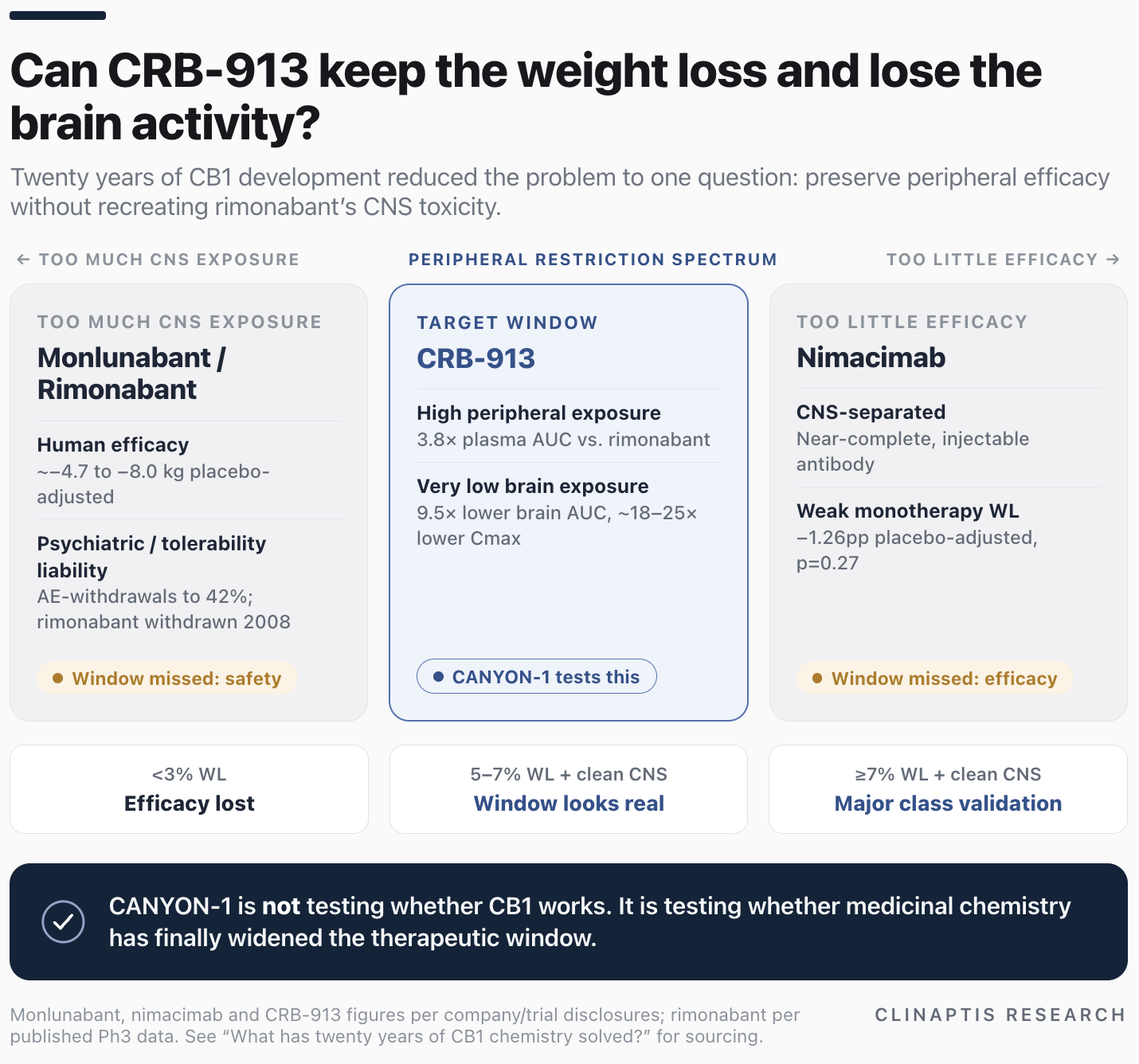
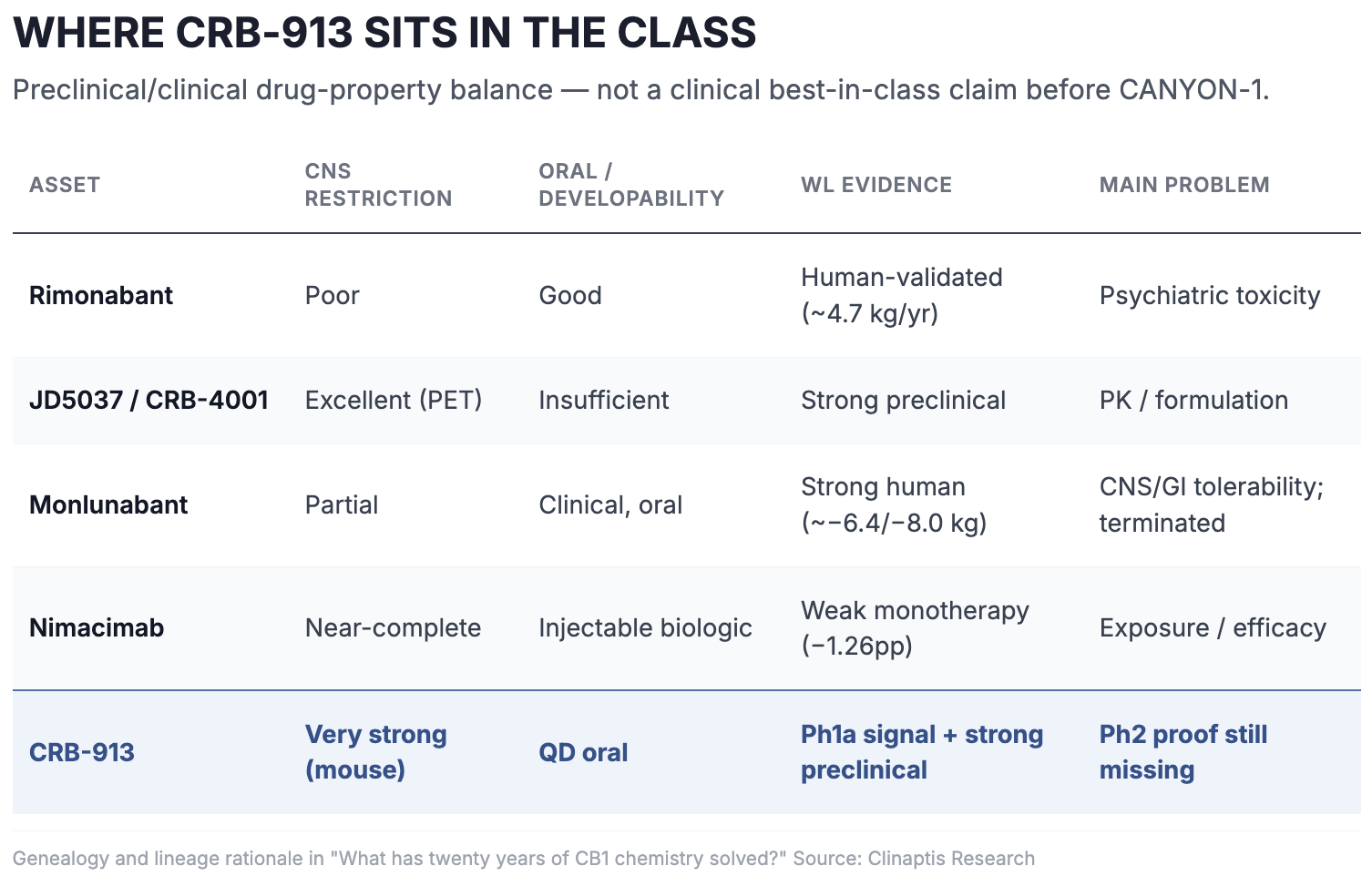
Two clinical assets bracket the window CRB-913 targets. Monlunabant (Novo) kept efficacy — ~−6.4 to −8.0 kg placebo-adjusted at Wk16 — but under-restricted the brain, with adverse-event withdrawals climbing 13% → 27% → 42% across dose; Novo terminated it in Q2 2026 against a DKK 4.0B impairment. Nimacimab (Skye), an antibody with near-complete CNS separation, produced almost no monotherapy weight loss (WL) (−1.26pp placebo-adjusted, p=0.27): too much brain exposure on one side, not enough effective peripheral target engagement on the other. CRB-913 is engineered for the gap between them: high peripheral exposure, very low brain Cmax, oral once-daily. In mice, its brain levels ran ~15× lower than monlunabant’s — an absolute comparison, not a human head-to-head, but directionally consistent with the restriction case.
JD5037/CRB-4001 already demonstrated excellent peripheral restriction (PET-confirmed) and strong preclinical efficacy; its development was limited by PK and formulation, not by a failure to achieve peripheral restriction. CRB-913 is a developability fix on that same chemistry, not a new attempt to prove CB1 biology. That is a better starting point than a rimonabant-redux read implies, though it remains, until September, only a preclinical drug-property claim.
How good is the prior evidence, really?
Ph1a proves CRB-913 does something, just doesn’t prove how much. The 2.9% WL came from nine treated patients over 7 days of dosing and seven days of continuous in-clinic observation — a near pure observed-case dataset with none of the outpatient dropout a 12-week trial introduces, so it should not be read against any future Ph2/3 number. The dose-response shape is the more useful clue: ~2.0% WL placebo-adjusted at 75 mg versus ~1.5% WL at 150 mg is flat. Either CRB-913 already sits on the flat part of the exposure-response curve — encouraging for a 60 mg trial — or the 75≈150 mg similarity is small-N noise. CANYON-1 discriminates between the two.
The preclinical package is strong and murine. In diet-induced-obese mice, CRB-913 matched rimonabant on weight loss (WL) at equal daily dose (−17.4% vs −16.5%) at 9.5× lower brain AUC and ~18–25× lower brain Cmax, with little accumulation on repeat dosing — the clearest sign yet that peripheral efficacy and brain exposure separate in this molecule. The same mice added 7–16.5pp WL on incretin backbones, with 85–89% of the loss coming from fat. That supports the combination/muscle-sparing hypothesis, but it remains mouse-only optionality and gets zero differentiation credit before human body-composition data.
GI tolerability is the one axis where Ph1a reads clean rather than merely directional: no nausea, vomiting or constipation and one mild diarrhea case across the full n=112 SAD/MAD population, no discontinuation. That is the best early signal available, but exposure was brief — MAD dosing was limited to seven days — nowhere near enough to establish a commercial tolerability advantage. CANYON-1’s 12-week outpatient population at N≈240 is the first real test.
Two facts temper the safety narrative. The 2023 paper does not settle whether the weight loss is peripheral: CRB-913 strongly suppresses food intake, and the authors concede central and peripheral CB1 could both contribute despite low brain levels. And Ph1a was not neuropsychiatrically silent — formal scales (C-SSRS/PHQ-9/GAD-7) stayed negative, but the 150 mg cohort logged three mild anxiety events and one irritability event. CANYON-1 then excludes patients with meaningful psychiatric history (PHQ-9 >4, GAD-7 >4, prior depression or ideation), so a clean CNS readout describes a population selected to be clean.
What clears our bar in September?
CANYON-1 is far more informative than Ph1a. At ~240 patients over 12 weeks, it is closer to VK2735’s n=280/13-week dataset than to the small Ph1b studies that usually drive early-obesity narratives — a clean outcome here carries far more evidentiary weight than the nine-patient Ph1a prior. But it is still constrained by design. Weight loss is a secondary endpoint — the registered primary is safety (TEAEs/AESIs) — so Corbus will headline a percentage the protocol does not enshrine. And the signal investors are extrapolating came from 150 mg, while CANYON-1 tops out at 60 mg, reached only from ~Week 5 under a 20→40→60 titration; the readout tests the mechanism at a fraction of the dose that produced the original number. The headline WL number cannot be read on its own — CNS safety, dose-response trajectory and how discontinuations are handled all bear on what it means.
We use 5% weight loss (WL), placebo-adjusted at Week 12, as the efficacy line — not as a standalone pass/fail criterion. Nimacimab showed peripheral CB1 can under-deliver on efficacy and monlunabant showed it can under-deliver on safety; a clean 5–7% WL result with no neuropsychiatric imbalance separates CRB-913 from both and is hard to dismiss mechanistically. Above 7%, efficacy itself becomes difficult to dismiss, assuming CNS safety remains clean. The third read is trajectory: whether the effect is still climbing at Week 12 or has flattened speaks to durability in a way the topline number alone does not.
Neuropsychiatric safety carries more weight than the headline WL percentage, and asymmetrically. CRB-913’s entire case is peripheral restriction, so even a small anxiety/depression/suicidality imbalance attacks the differentiation directly — and at ~60 patients per arm, the trial cannot rule out low-frequency signals either way. A reproducible neuropsych imbalance collapses any efficacy band back toward the fail case (Figure 2 assumes a clean CNS read throughout).
The analysis convention will also shape the number, and the SAP is not public. Three questions decide how much to discount the headline: which estimand is reported, what the D/C rate and its driver (GI vs CNS vs unrelated) were, and whether Corbus shows a treatment-policy or ITT sensitivity alongside. We would not import a discount from longer incretin trials onto a 12-week Ph1b, and we would not attach a haircut before the disclosure (mechanics in Appendix E).
What is the stock pricing in?
At a $114M EV despite $118M of net cash, very little value is being assigned across the two clinical assets. We value CRB-701 as a US-only 2L franchise — OPSCC ($125M peak) plus cervical ($75M peak) — at ~$97M gross, then charge its development and licensing burden: near-term study spend plus the ~$120M of remaining CSPC milestones, probability- and time-weighted rather than booked in full. That nets CRB-701 to ~$33M on our base. Against the EV, the market pays ~$3.8/share for CRB-913, in a $3.3–4.8 range depending on how hard the oncology burden is costed — neither free nor deeply negative. The ~$3.8/share CRB-913 stub is therefore model-derived, not directly observable. The market already pays for some success.
Our own number is higher. We value each CANYON outcome as a development-stage asset: commercial NPV if approved, times the approval probability from that state, minus only the development spend that state incurs (Ph2 if Corbus proceeds, Ph3 if it gets there).
Probability-weighted across our 35/30/25/10% WL-bucket weights (our distribution, not market-implied), CRB-913 is worth ~$5/share versus the ~$3.8 implied stub; lowering every approval-PoS bucket by one notch still leaves ~$3.7/share. The payoff is convex because the downside is real.
A sub-3% WL print strips almost all of the $3.8 and drops the stock toward oncology-and-cash alone ($7.5, −32%); a clean 5–7% is ~$16.5 (+50%) and ≥7% ~$21 (+89%). $7.5 is a modeled fundamental floor, not a trading one — a failed catalyst plausibly arrives with continued burn and tighter financing terms, and the market would not hesitate much to immediately further discount full oncology rNPV against that backdrop. Even the marginal 3–5% WL state clears ~flat, because a validated-but-unresolved mechanism keeps option value once it no longer carries the full Ph3 cost.
Approval PoS rises from 12% at 3–5% WL to 25% at 5–7% WL and 35% at ≥7% WL. That ladder is analyst-calibrated, not a statistical estimate: it reflects increasing confidence in development viability as efficacy improves, not validation of the $1.1B commercial case. The $1.1B peak itself is the single-niche outcome derived earlier, not a base-case forecast. The oncology floor is a US-only base marked below the sell-side range ($17.25–$48); crediting ex-US or urothelial optionality would raise it, but we exclude both, since CRB-701 is a differentiated-tolerability, HPV-focused entrant in a validated, crowded field, not a first mover (Appendix D).
The combo and muscle-sparing optionality (+7–16.5pp WL on incretin backbones; 85–89% fat loss) is excluded from these numbers. A clean ≥5% WL result would make it worth developing as a muscle-sparing oral add-on to the incretin winners — more valuable still at ≥7% WL — but it stays at zero credit until human body-composition data exist.
Positioning sharpens the trade
Shorts built into the catalyst and have not covered. Short interest was 2.30M shares as of Aug 28 (15.17% of float per Fintel/NASDAQ), essentially flat against the ~92% build from mid-May even as Corbus issued stock through its ATM — a bet that the Ph1a signal will not survive larger N, a lower dose and 12 weeks. Days-to-cover fell from 9.4 (July 31) to 2.66 (Aug 28) as trading volume increased. The short base remains large, but the squeeze setup is less extreme than the 15% headline suggests.
The tape precedent is company-specific and recent. CRBP ran ~50% into late May, then fell ~13% on May 26 and ~a third peak-to-trough over the next two weeks on updated CRB-701 data ahead of ASCO — clinically acceptable, not differentiated enough to hold a doubled stock, and paired with a CMO departure. CANYON-1 sets up the same way: a recovery toward pre-crash levels, shorts freshly rebuilt, and a print that has to beat expectations rather than meet them. For this name, an in-line 3–5% WL result is the kind of outcome the tape has already punished; “not a failure” does not hold the stock, and even a clean 5–7% WL print can sell off on positioning before it re-rates.
Positioning determines how a result trades, not what it is worth: Fig 3 maps the tape reaction, not the fundamental value already set out in Fig 2.
Two points keep this from being a clean long. A strong print is still a dilution risk: Corbus guides cash runway into 2028, but the ATM stays open, and management could opportunistically raise into a squeeze regardless of near-term need. And short interest offers no downside cushion: if the readout confirms regression-to-mean, the shorts are simply right.
Bottom line
CB1’s problem was the therapeutic index, not the biology — CANYON-1 tests whether twenty years of chemistry has finally solved it. Some success is priced: ~$3.8 of the $11.03 tape is CRB-913. Our development-stage valuation puts it nearer $5. The readout is convex — a failure resets the stock ~32%, a clean ≥5% WL re-rates it +50% to +90%. We would own the setup into the print for that convexity, sized for the May precedent and the open ATM (cash runway guided into 2028, but Corbus could still raise opportunistically into a squeeze), and walk on a sub-3% result or any reproducible CNS signal. What matters is a clean ≥5% WL at Week 12 with no neuropsychiatric imbalance: the point where a validated mechanism becomes an investable oral asset.
CANYON-1 is primarily a therapeutic-index test, not a test of whether CB1 can drive weight loss. We think the market still prices too much of the risk as if those were the same question.
Appendix (reference — not part of core note)
A. Where CRB-913 sits in the class (preclinical/clinical drug-property balance; not a clinical BIC claim before CANYON; genealogy and lineage rationale in section “What has twenty years of CB1 chemistry solved?”)
 Open full resolution ↗
B. CRB-913 preclinical package (mouse DIO, n=6/group; Obesity 2023) — CB1 IC50 1.2 nM (>800× vs CB2); vs rimonabant plasma AUC 3.8× higher, brain AUC 9.5× lower, brain Cmax ~18–25× lower; monotherapy Day-18 WL −9.9%/−17.4%/−22.0% at 2.5/5/10 mg/kg BID; +7–16.5pp WL over incretin backbones; 85–89% of loss was fat. Food-intake effect does not prove CNS exposure; peripheral-vs-central contribution remains unresolved.
C. Comparator set (WL; cross-trial, not head-to-head; different timepoints/BMI/N)
Mechanistic class — same peripheral-CB1 competitive set, not duration-matched: monlunabant Wk16 ~−6.4/−6.9/−8.0 kg placebo-adjusted (10/20/50 mg), AE-withdrawal 13/27/42%, terminated Q2 2026; nimacimab Wk26 mono −1.26pp (p=0.27), + semaglutide Δ−2.95pp (p=0.037); orforglipron ATTAIN-1 Wk72 ~12.4% at top dose; aleniglipron ACCESS II ~15.3% placebo-adjusted at Wk44 (too long a duration to read against a 12-week trial directly).
Duration/N-matched efficacy comps — the closer test of what a strong Wk12-ish placebo-adjusted number looks like across the broader obesity field, at N and timepoints closer to CANYON-1’s own (~n=240, 12wk + 4wk FU). We weight comparators by design similarity rather than by simply collecting early-obesity datasets. VK2735 oral and oral amycretin are the primary duration/N peers; aleniglipron and dapiglutide are secondary anchors.
Benchmark ladder (Wk12-ish WL, placebo-adjusted): ~5–6pp = meaningful but not elite; ~6–8pp = strong early efficacy; ~9–12pp = top-tier early-obesity trajectory (VK2735 oral, amycretin oral). CRB-913’s 5% Wk12 WL threshold sits at the lower boundary of this ladder — the line where the mechanism becomes investable, not where it becomes best-in-class; CRB-913’s differentiation case rests on oral dosing, mechanism and CNS separation, not on matching amycretin- or VK2735-scale Wk12 magnitude.
Note on SC amycretin (a different trial/formulation, NCT06064006): its only officially reported endpoint is Wk36 (−24.3% WL vs −1.1% placebo, p<.0001); it does not publicly report a Wk12 number. A ~−5.5pp Wk12 WL figure sometimes cited for this trial is a digitized approximation off the published trajectory chart, not a Novo-reported value — useful only to illustrate a slow-building curve, not to rank against the table above.
D. Nectin-4 ADC landscape (CRB-701 context) — Padcev (enfortumab vedotin) validates Nectin-4 commercially and defines the incumbent benchmark: 1L urothelial SOC with pembrolizumab, ~$1.6B sales. Next-gen entrants — 9MW2821, LY4052031, SHR-A2102 — span cervical, lung and urothelial settings. CRB-701 holds FDA Fast Track designation in both HNSCC/OPSCC and cervical cancer — the same two indications the valuation is built on — and is entering a validated but increasingly crowded field, with its case resting on tolerability and HPV-focused activity rather than first-mover advantage.
E. Key caveats for the desk
-
WL is a secondary endpoint; safety is primary.
-
CANYON-1 tops out at 60 mg vs. the 150 mg QD obesity cohort that produced the Ph1a weight-loss signal.
-
Psychiatric exclusions limit how far the “clean CNS” read generalizes.
-
Phase 1a GI evidence is clean — no nausea, vomiting or constipation and one mild diarrhea case across n=112 — but exposure was brief, with MAD dosing limited to seven days.
-
Estimand/SAP not public — read the headline as efficacy-estimand.
-
CRB-913 stub is sensitive to CRB-701 burden costing: $3.3–4.8/sh range.
-
Cash runway guided into 2028 (2Q26 PR); ATM remains open — opportunistic-raise risk on a squeeze, not a near-term funding need.
-
~$7.5 downside is a modeled SOTP value, not a trading floor.
Estimand mechanics: the efficacy (hypothetical) estimand excludes intercurrent events (D/C, rescue) and reads higher than the treatment-policy estimand that includes them; which estimand is headlined, the D/C rate and its driver, and any treatment-policy/ITT sensitivity are the decision-useful items.
Sources:
CRB-913 / CB1 biology
-
Morningstar J, et al. “Novel cannabinoid receptor 1 inverse agonist CRB-913 enhances efficacy of tirzepatide, semaglutide, and liraglutide in the diet-induced obesity mouse model.” Obesity. 2023;31:2884–2894.
-
Corbus Pharmaceuticals — ObesityWeek 2024 CRB-913 data: brain exposure versus monlunabant/rimonabant; dose-response and combination experiments.
-
Selected CB1R reviews (2020–2022) — rimonabant/class history, JD5037 and peripheral-CB1 restriction.
Obesity comparators
-
Novo Nordisk — monlunabant Phase 2 obesity results and Q2 2026 discontinuation disclosures.
-
Skye Bioscience — CBeyond Phase 2 nimacimab results.
-
Structure Therapeutics — GSBR-1290/aleniglipron Phase 2a and ACCESS II.
-
Zealand Pharma — dapiglutide Phase 1b Part 1.
-
Viking Therapeutics — oral VK2735, VENTURE-2, 13-week data (ECO 2026).
-
Novo Nordisk / The Lancet — oral and subcutaneous amycretin clinical datasets.
CRB-701 / Nectin-4
-
Corbus Pharmaceuticals — CRB-701 clinical disclosures and FDA Fast Track designations for HNSCC/OPSCC and cervical cancer.
-
Astellas/Seagen — Padcev (enfortumab vedotin) clinical and commercial disclosures.
-
ASCO 2026 — Nectin-4 ADC data, including 9MW2821, LY4052031 and SHR-A2102.
Market / valuation
-
Nasdaq/exchange-reported CRBP short interest; Fintel snapshot (Aug. 28, 2026).
-
Sell-side consensus and market-data feeds.