
PANORAMA arrives with an unusual burden for a confirmatory psychiatric trial. DT120 has already produced one of the larger placebo-adjusted effects in modern GAD development, and DFTX has already captured much of the valuation uplift that followed. September is therefore a test of what kind of drug investors should value DT120 as.
At roughly a $5B-plus equity value, Definium is no longer trading on whether DT120 can deliver a successful Phase 3 on validated neuropsychiatric endpoints. VOYAGE delivered a very strong −5.4-point placebo-adjusted HAM-A effect (d≈0.81) and re-rated the stock from ~$13 to the low-$40s. PANORAMA, the confirmatory GAD readout due in September, has to answer the harder question: how much of that unusually large efficacy is reproducible?
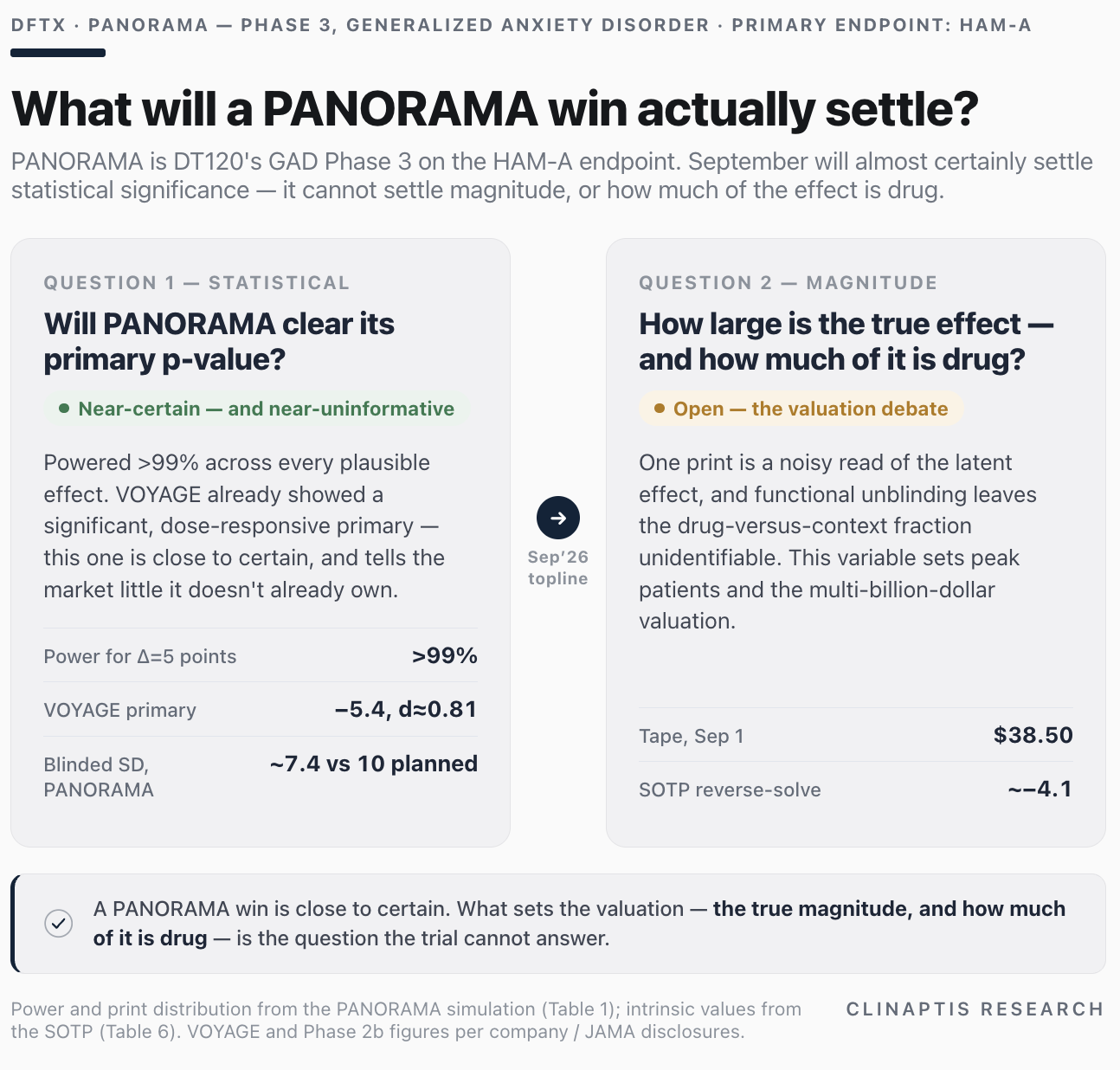
Our clinical distribution stays centered on VOYAGE’s −5.4, with τ=1.25 residual trial heterogeneity. Our commercial model translates that distribution into a probability-weighted intrinsic value of ~$45/share against the $38.50 reference. We are constructive on fundamental value and cautious on the event: PANORAMA observes a noisy trial realization, not underlying efficacy, and statistical significance is already near-certain across the range that matters.
 Open full resolution ↗
What matters in PANORAMA
Our fundamental value sits above the tape. Our central −5.4 state is worth ~$48/share; integrating residual clinical heterogeneity (τ=1.25) gives a probability-weighted E[IV] of ~$45.4. The $38.50 reference corresponds to roughly a −4.1 GAD commercial-scenario equivalent, about one τ weaker than our clinical center. Roughly 82% of our modeled efficacy states clear $38.50 — a statement about fundamental value across states, not an 82% chance the stock rises after the print.
Statistical success is near-certain under our central design assumptions, so magnitude is the swing variable. Conditional power exceeds 99%; predictive success — stressed for weaker effect, higher heterogeneity and worse realized variance — is closer to 81% even at the low end of the range we treat as commercially relevant, so another positive p-value resolves little either way. The economically important question is whether DT120 behaves like a −5.4 differentiated franchise (50–65k peak patients) or drifts toward a ~−4 drug (30–40k) — a ~$1.5–2B swing in GAD rNPV at ~$40k net revenue.
The 50 µg arm is the identification test. Phase 2b already weakens the simplest unblinding critique: ~80% of patients recognized 50 µg as active without reproducing 100 µg efficacy (−1.8 vs −5.0 placebo-adjusted). PANORAMA becomes far more informative if 100 µg separates cleanly from 50 µg; convergence between the two leaves the magnitude of the 100 µg result hard to attribute.
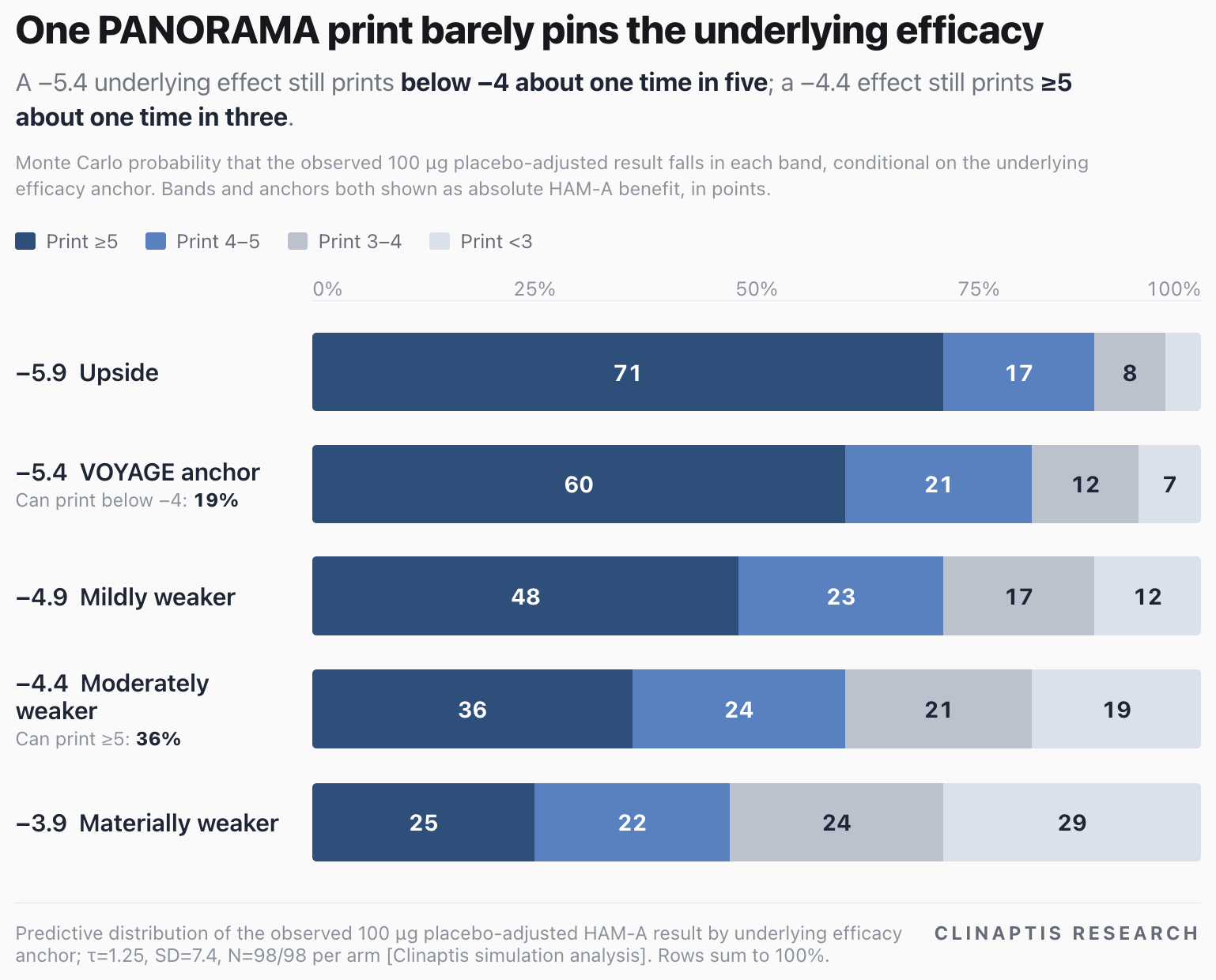
A weak print tells us more than a strong one. A strong 100 µg print is consistent with several nearby latent states — a −4.4 drug still prints ≥5 about one time in three — so beating VOYAGE is supportive rather than definitive. A weak print is harder to dismiss given the contextual tailwind of an unmistakably psychoactive treatment. We turn decisively more constructive at ≥−5.4 with preserved 50→100 µg separation, and the view breaks around ≤−3.5 or a 100 µg effect collapsing toward 50 µg.
Replication uncertainty carries a valuation cost. Holding the mean at −5.4 and raising τ from 0.75 to 2.0 cuts probability-weighted IV from ~$47 to ~$43/share: commercial upside saturates near VOYAGE economics while weaker efficacy keeps eroding differentiation, adoption and PoS.
Why a positive Phase 3 is not enough
Five years ago, the former MindMed was part of a psychedelic boom that priced pre-revenue companies as though the field’s central measurement problem — unblinding — had been solved. The sector corrected 70–80% when it had not. MindMed survived by narrowing focus to DT120, developing an FDA-aligned, purpose-built Phase 3 design, rebranding to Definium, raising $805M, and delivering highly positive MDD (EMERGE) and GAD (VOYAGE, −5.4) data. VOYAGE showed that a psychedelic can clear the conventional Phase 3 efficacy bar. What it did not resolve is how much of that efficacy reflects drug versus expectancy.
That problem is functional unblinding. A drug producing unmistakable perceptual effects cannot be hidden from the patient, and the FDA wrote psychedelic-specific guidance in 2023 precisely because unblinding, accompanying context, and durability make ordinary RCT interpretation unusually hard. Lykos showed the corollary a year later: two statistically significant Phase 3 trials did not settle how much of an unblinded psychedelic’s effect is the drug.
Definium is no longer developing in a regulatory vacuum: COMPASS Pathways’ COMP360 sits under rolling NDA review for treatment-resistant depression (TRD), and the FDA holds a public hearing on psychedelic-drug therapeutic use on September 14 — days ahead of PANORAMA’s market-implied topline window.
PANORAMA is powered above 99% across every downside effect Definium would need to worry about, so another significant p-value tells the market almost nothing it does not already own.
What does one PANORAMA print actually tell us?
The regulatory and commercial questions have come apart, and only the first is close to settled. PANORAMA was designed around a 5-point HAM-A difference at 90% power, then re-powered upward on blinded accumulating data. The sample-size re-estimation shows a HAM-A SD near 7.4 (6.2 in VOYAGE), well below the assumed 10, with 6-10% non-evaluable rates vs. 15% planned; conditional power for 5 points — power evaluated at the design’s central assumptions — now exceeds 99%. Predictive success is lower once we integrate over the full uncertainty in effect size, heterogeneity and variance: even a still-commercially-relevant combination (underlying effect −3.9, τ=1.5, SD=8) succeeds only ~81% of the time. Magnitude, not the p-value, is the investment variable — and the gap between 99% conditional and ~81% predictive is itself part of that argument.
But PANORAMA observes a noisy realisation of the underlying effect, not the effect itself. The simulation makes the degeneracy explicit: an underlying −4.4 drug still prints ≥5 about one time in three, and a drug that genuinely replicates VOYAGE’s −5.4 still prints below 4 about one time in five. Beating −5.4 is supportive, not diagnostic, of stronger efficacy; a genuinely weak print is harder to dismiss — particularly given the contextual tailwind of an unblinded psychedelic.
 Open full resolution ↗
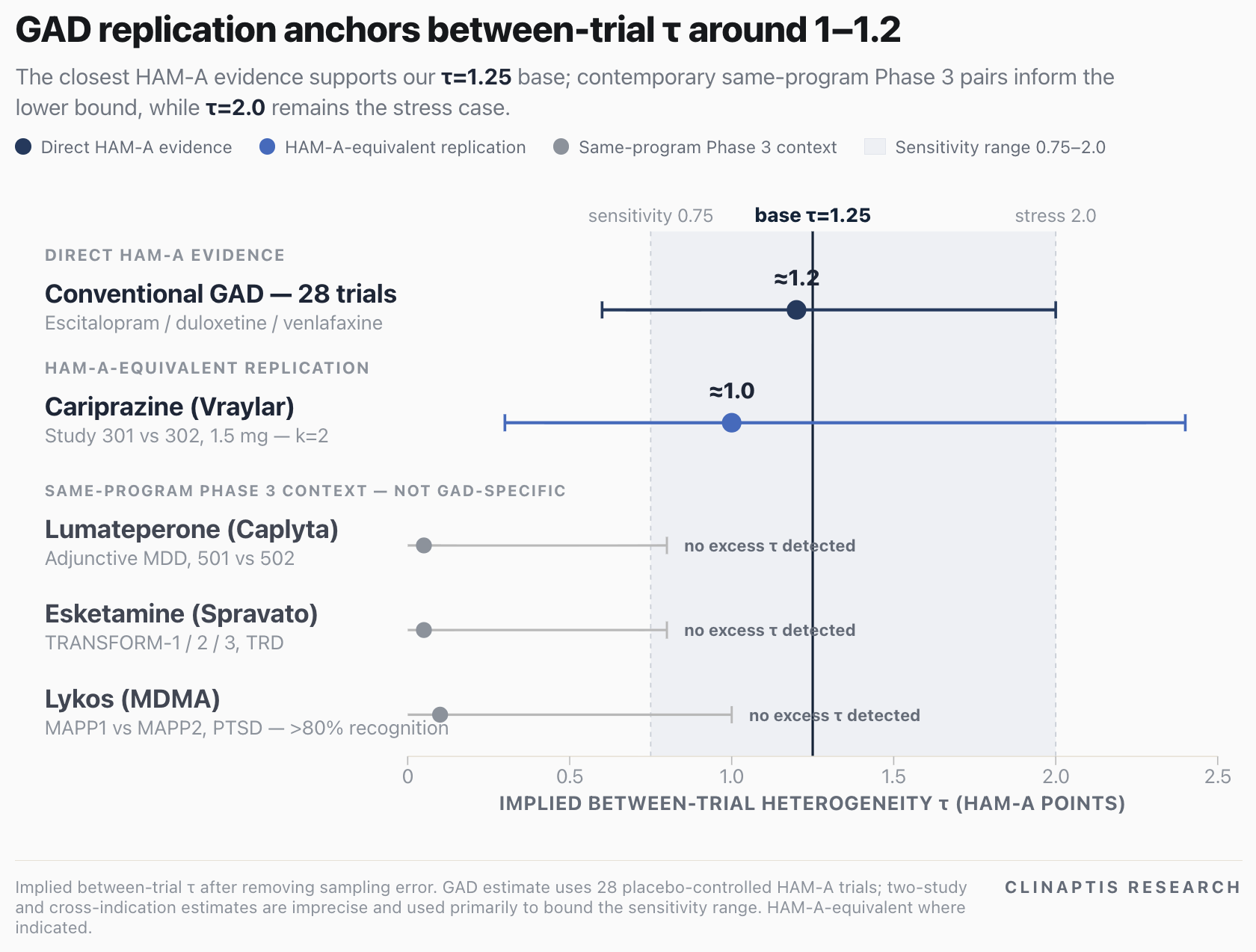
The parameter driving that spread is between-trial heterogeneity, τ — the trial-to-trial shift in true effect that survives sampling error. τ is distinct from systematic attenuation, a real regression toward a lower reproducible mean already priced in by anchoring on VOYAGE’s −5.4 rather than Ph2b’s −7.7; τ describes dispersion around that center, not a shift in it; conflating the two loads a systematic mean shift into the heterogeneity estimate.
We calibrate τ against modern psychiatric replication programs rather than assume it. Twenty-eight placebo-controlled GAD trials of escitalopram, duloxetine and venlafaxine imply a direct HAM-A τ≈1.2, tightening to ~0.5–0.7 in the largest studies; cariprazine’s replicate 1.5mg trials imply τ≈1.0 on a HAM-A-equivalent scale. Three contemporary same-program Phase 3 pairs — lumateperone, esketamine and Lykos’s two unblinded PTSD trials — cluster near τ≈0 after sampling error is removed. They show that substantial trial-specific contextual or unblinding concerns need not produce large replication variance; because they are not GAD- or HAM-A-specific, they inform the floor rather than the base. We hold τ=1.25 centrally (grid 0.75–2.0). Widening τ mostly widens uncertainty rather than moving the center: at the VOYAGE-replicating mean, P(print ≥5) is ~63%/60%/57% at τ=0.75/1.25/2.0.
 Open full resolution ↗
The remaining question is whether −5.4 is the right center. Phase 2b provides two different anchors: the prespecified Week-4 MCP-Mod estimate was −5.0 at 100 µg, while the observed Week-12 trajectory was −7.7. VOYAGE subsequently delivered −5.4 at Week 12. We therefore center PANORAMA on the confirmatory Phase 3 result and use the Phase 2→3 attenuation exercise only as a calibration check, not as a second haircut.
That uncertainty carries an economic cost. Because commercial upside saturates while weaker efficacy erodes differentiation, penetration and PoS, holding the mean at −5.4 and widening τ from 0.75 to 2.0 lowers probability-weighted intrinsic value from ~$47 to ~$43/share. Replication uncertainty is therefore its own discount — generated by the commercial curve, not imposed as an arbitrary catalyst haircut.
How much of the effect is the drug?
The bull case is strong. DT120 has produced large effects across two GAD trials — Phase 2b −5.0 at Week 4, VOYAGE −5.4 at Week 12 — alongside a published dose-response and a large MDD result in EMERGE (−8.1 MADRS, roughly twice the modern comparator field). The parsimonious reading is genuine, clinically meaningful drug activity. EMERGE adds support from a different indication and scale, but not an independent identification test: it shares the same psychedelic-unblinding problem, corroborating activity without identifying how much of the observed magnitude is pharmacology versus context.
That distinction matters because functional unblinding is unusually severe in psychedelic trials: a 2026 systematic review of 112 psychiatric psychedelic RCTs found recognition frequently in >90% at psychoactive doses, with no control strategy consistently adequate. Phase 2b nevertheless rules out the crudest critique: ~80% recognized 50 µg as active, yet placebo-adjusted efficacy was only −1.8 vs −5.0 at 100 µg — recognition alone can’t explain the dose-response. What it cannot exclude is intensity-scaled expectancy: subjective effects rose with dose alongside efficacy, so the two remain entangled rather than separated.
Definium’s trial designs attempt to mitigate this issue. Central raters stayed blinded in more than 80% of HAM-A assessments despite ~85% participant recognition, which limits rater expectancy but cannot stop a blinded rater from scoring symptoms reported by a patient who knows they received active drug. Durability does not settle it either: DT120’s VOYAGE improvement is essentially flat from Week 1 to Week 12 (−11.9 to −11.6), and separation narrows from −7.7 to −5.4 because placebo keeps rising (−4.2 to −6.2), not because the drug fades. All of this is to suggest that the clinical response holds, not that it is pharmacologic — persistent expectancy can also produce durable symptom effects. Persistence confirms durability; it doesn’t answer what fraction is ‘drug effect’?
We do not translate any of this into a corrected HAM-A number. The FDA reached the same limit in its Lykos review (in PTSD though): there is no straightforward computational approach to strip expectancy from a functionally unblinded psychedelic effect — the fraction is not identifiable from the trial. The one prospective, randomized mediation estimate in antidepressant trials puts ~19% of the treatment-context effect through measured expectancy; we carry a ~20% central allowance through commercial adoption on that basis, never subtracted from HAM-A. PANORAMA can strengthen or weaken the pharmacological read through magnitude and 50→100 µg dose separation; it cannot tell us what percentage of the observed HAM-A effect is the drug.
How informative is the 50 µg arm?
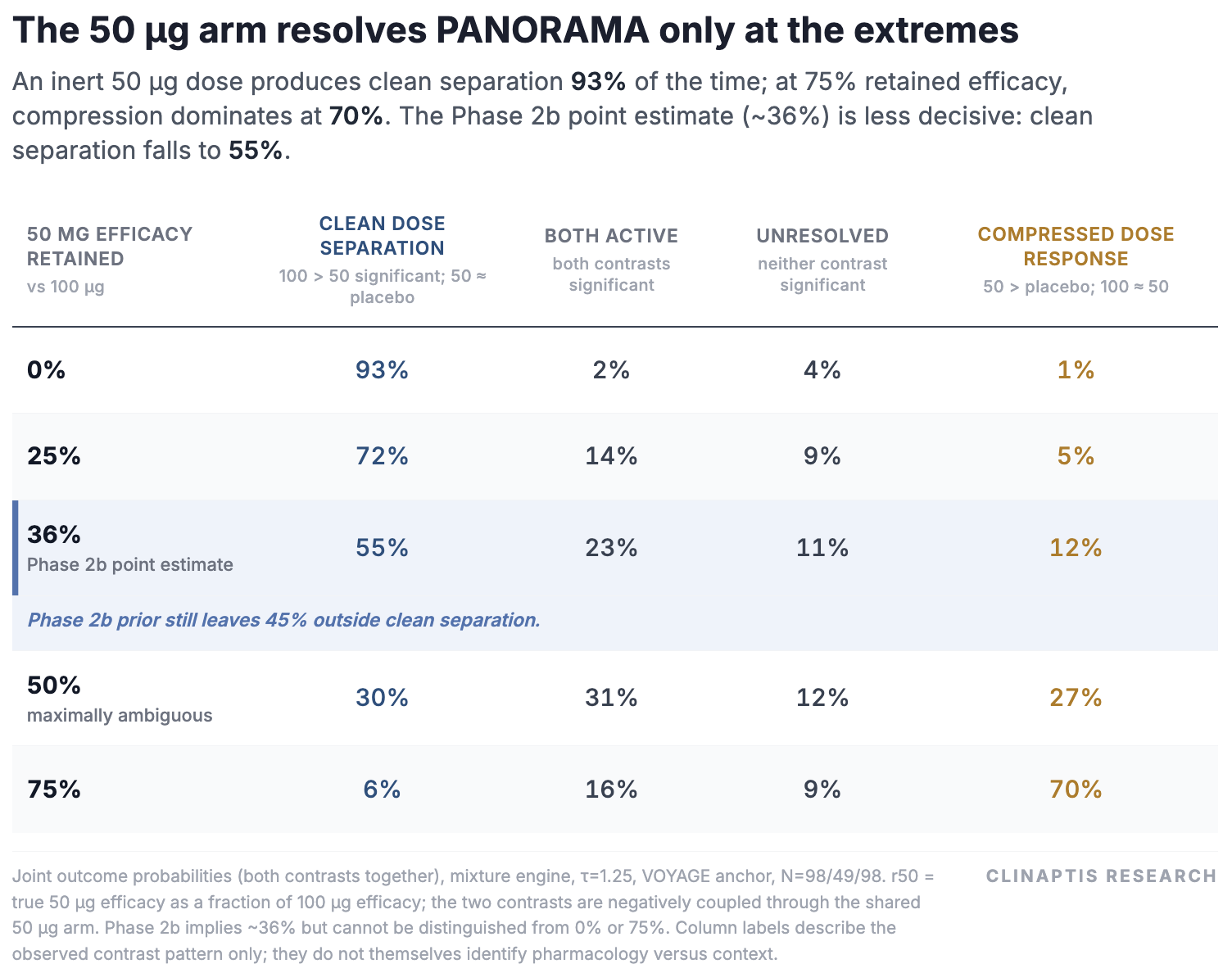
PANORAMA’s 50 µg control is the design feature meant to separate pharmacology from recognition, and its resolving power is conditional on the very thing it is trying to measure. Two contrasts carry the signal: a clean 100 µg-vs-50 µg separation, or a 50 µg-vs-placebo effect with 100≈50. Their significance depends on how active 50 µg truly is, as a fraction of the 100 µg effect (r50).
 Open full resolution ↗
The two contrasts share the 50 µg arm with opposite signs — the same 50 µg estimate is subtracted in 100−50 and added in 50−PBO — so they are negatively coupled: a noisy-high 50 µg reading shrinks the pharmacology contrast and inflates the contextual one at once. A marginal reading treats them as independent and overstates how cleanly they resolve. And r50 itself is unmeasured going in: Phase 2b implies ~36%, but the estimate spans essentially the entire 0–100% range, so the arm’s resolving power is uncertain before the trial runs. If 50 µg is inert, PANORAMA has a 93% probability of showing clean 100→50 separation with 50 µg indistinguishable from placebo. If 50 µg retains substantial efficacy, it increasingly beats placebo while the 100→50 contrast compresses, making the dose-response less discriminating between pharmacology and context. Around r50 ≈ 50% neither contrast is reliably significant and PANORAMA lands in an identification gray zone. The 50 µg arm can confirm the read at the extremes but not settle it through the middle.
Even a clean 100>50 separation doesn’t fully settle mechanism: dose-scaled expectancy — stronger subjective effects at 100 µg producing stronger belief-driven improvement — predicts the identical pattern. And Definium hasn’t disclosed (to our knowledge) whether the 100-vs-50 contrast is a prespecified, multiplicity-controlled comparison or an exploratory one; absent that, a single readout of it should be treated as suggestive, not confirmatory.
What HAM-A efficacy magnitude is worth
Once approval is likely, magnitude drives value through commercial differentiation and adoption, not regulatory PoS. A durable −5.4 HAM-A effect supports materially greater penetration than a ~−4 drug; with external models framing DT120 as a ~$2–4B combined GAD/MDD peak-sales asset, relatively small changes in reproducible efficacy move substantial franchise value.
Holding the rest of our SOTP constant, $38.50 corresponds to a ~−4.1 commercial-scenario equivalent — between our −4.4 ($41.4/share) and −3.9 ($35.7/share, before franchise read-through) states, roughly one τ weaker than our −5.4 clinical center, and consistent with the ~−4.9 equivalent implied at the August peak before the fade back to spot. This is not a market-implied HAM-A estimate: price jointly reflects efficacy, adoption, pricing and other valuation assumptions. It does show that, on our model, spot discounts substantially weaker GAD economics than our central case.
The asymmetry is commercial. Regulatory PoS is high and barely sensitive to magnitude across −5.9 through −4.4, cut only modestly at −3.9, while the commercial multiplier swings roughly 0.60x to 1.15x across the same range — VOYAGE replication versus severe attenuation is worth roughly $13/share, almost entirely commercial. Our adoption curve is effectively threshold-shaped: penetration begins to accelerate around a ~4-point reproducible HAM-A advantage and saturates as efficacy approaches VOYAGE, so the existing 30k→50k patient ladder across −3.9→−5.4 is not a linear per-point extrapolation. The ~20% expectancy allowance is already embedded in the −5.4 case through 50k versus 65k peak patients, and is not applied again. Integrating the full efficacy distribution gives probability-weighted intrinsic value of ~$45.4/share — median near $48, P10 ~$31, upside saturating near $52 — with ~82% of modeled efficacy states above $38.50. That 82% describes fundamental value across efficacy states, not the probability of a positive stock reaction to PANORAMA. The ~$31 P10 now reflects the correlated MDD/PTSD franchise read-through in weak GAD states; the orthogonal regulatory-interpretation tail (Lykos-type) is a separate sensitivity below it, excluded from these figures.
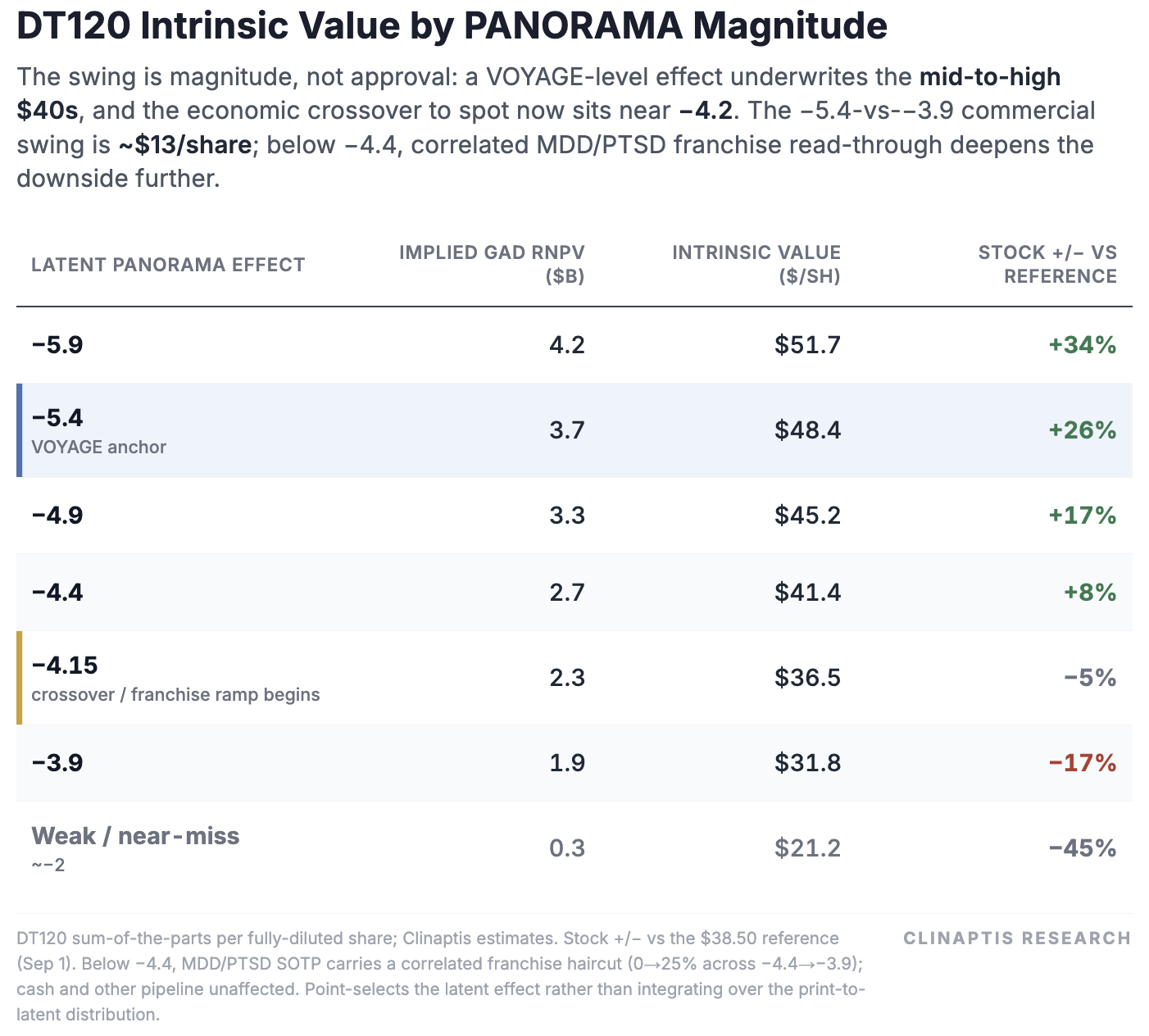 Open full resolution ↗
The tape has already shown its reaction function
We have already observed the market’s response to a positive but magnitude-ambiguous readout. EMERGE re-rated DFTX sharply on the existence/de-risking leg; six weeks later VOYAGE beat the Street’s ~−5 HAM-A bar but produced a muted reaction, with the stock subsequently fading from the mid-$40s toward $38.50. The sequence is consistent with significance and approval having been increasingly owned before VOYAGE, leaving magnitude to drive the marginal re-rate. This makes VOYAGE a template: PANORAMA faces a higher bar, where a positive p-value alone should add little, and a clean ≥−5.4 print with preserved 50→100 µg separation is what can reopen the magnitude trade. The constructive difference is starting price — at $38.50, our SOTP implies roughly a −4.1 pt. commercial-scenario equivalent, leaving more room for genuine magnitude confirmation than the stock had immediately after VOYAGE.
What to watch on readout day
The 100 µg-versus-placebo primary will almost certainly be positive, so the read sits elsewhere. Four things carry it — three are about reading the print itself; the fourth is about where you’re starting from.
-
Magnitude, through the print-distribution analysis/figure. A −5ish print is compatible with several underlying efficacy states, not one — read it through the distribution, not literally. A print below ~−4.5 is the more concerning signal, particularly given the contextual tailwind of an unblinded psychedelic.
-
A weak print has two causes, not one. VOYAGE’s DT120 arm improved −11.6 points in absolute terms against a −6.2 placebo, so a PANORAMA delta near −4 could reflect DT120 falling short of that ~−11.6 response, or an unusually responsive placebo arm — VOYAGE’s own −6.2 had already climbed from −4.2 at Week 1. Those are different fundamental reads of the same headline number, and only Definium’s disclosure of absolute LS-mean change by arm, not the delta alone, separates them.
-
The 50→100 µg separation, through the joint-state table. A clear 100>50 contrast with 50 µg near placebo strengthens the dose-dependent read — though intensity-scaled expectancy predicts the same pattern and can’t be ruled out by this contrast alone; convergence between the two doses, or neither contrast resolving, leaves the identification problem open — the more likely outcome if r50 sits mid-range, since the 50 µg arm is decisive mainly at the extremes.
-
Secondaries qualify, they do not resolve. VOYAGE disclosed only HAM-A, CGI-S and response/remission at topline; the comparisons that would actually separate drug from context — patient-global versus blinded-clinician ratings, functional (Sheehan) versus symptom improvement — surface only at full publication. Treat that as a second identification event, not a missing piece of topline detail.
Where the tape starts
At $38.50, our SOTP corresponds to roughly a −4.1 commercial-scenario equivalent against a clinical distribution centered on −5.4, so a magnitude-confirming read has real fundamental room, while a weak read moves the economics quickly into the low-$30s — ~$32 at −3.9 and below $29 by −3.5 once correlated MDD/PTSD read-through is included — neither should be inferred from the p-value alone.
Bottom Line
DT120 probably works; PANORAMA is about how well, and how reproducibly. VOYAGE was positive, the JAMA dose-response is real, and PANORAMA is powered above 99% across the commercially relevant range. Centering underlying efficacy on VOYAGE’s −5.4 with τ=1.25 gives probability-weighted intrinsic value of ~$45.4/share (vs. spot $38.50); the ~20% expectancy allowance is already embedded as a 50k peak. Magnitude, not significance, is the swing — −5.4 versus −3.9 is ~$13/share, almost entirely commercial, because approval holds across the range while adoption does not.
PANORAMA observes a noisy realization of efficacy, not efficacy itself, and the September straddle (±15.7% on spot) is wide relative to the value an ordinary print actually moves. VOYAGE already showed the market’s reaction to a positive readout that didn’t fully resolve magnitude — beating expectations, moving the stock only modestly, and giving the move back into September. A merely significant result may therefore add little. Net: constructive on value, patient on the event. The view turns decisively bullish on a print at or above −5.4 with a preserved 50→100 µg separation, toward the mid-to-high $40s and a 50–65k peak; it breaks on a −3.5-or-below print, or a 100 µg result collapsing toward the 50 µg arm, into the high-$20s–low-$30s.
A note beyond DFTX: in any trial where treatment cannot be blinded, a significant primary and a large effect size are the easy part — how much of the effect is the drug is what the design is often structurally unable to deliver. A low-dose active control like PANORAMA’s rescues that only when the truth sits far from the middle. Pricing the catalyst means asking not just whether the trial wins, but whether its design can separate the scenarios the valuation actually depends on.
DD / Methods notes
Valuation framework. Underlying-efficacy distribution mapped through GAD commercial economics and DCF, with correlated MDD/PTSD SOTP read-through. Core assumptions: ~$40k net revenue, 11% WACC, 147.0M FD shares. At τ=1.25: E[IV] ~$45.4, median ~$48.4, P10 ~$31; ~82% of modeled efficacy states exceed the $38.50 reference. This is a fundamental-value distribution, not a probability of positive stock reaction. Wider heterogeneity modestly reduces value: E[IV] ~$47.2 / $45.4 / $43.1 at τ=0.75 / 1.25 / 2.0.
Adoption calibration. Peak penetration is modeled as threshold-shaped rather than linear with HAM-A magnitude: limited adoption around conventional ~3-point efficacy, acceleration around the ≥4-point differentiation zone, and saturation approaching VOYAGE-like efficacy. Central peak-patient ladder: ~30k / 38k / 45k / 50k / 54k at −3.9 / −4.4 / −4.9 / −5.4 / −5.9. Auvelity, Vraylar and Spravato inform the commercial shape and supervised-dosing constraint, not the efficacy-to-adoption slope.
Correlated franchise downside. MDD/PTSD value is conditioned on GAD reproducibility rather than held fully static. No haircut at −4.4 or better; progressively weaker GAD states carry increasing shared-franchise read-through. Base maximum haircut 25% (15–35% sensitivity). Limited effect on central E[IV], larger impact on the downside tail: P10 ~$32.6 / $31.0 / $29.4 across the sensitivity range. Separate regulatory-interpretation downside excluded from base to avoid double-counting.
Clinical hierarchy. Print-distribution analysis conditions the observed PANORAMA result on reproducible underlying efficacy with between-trial heterogeneity integrated. Commercial value maps to reproducible efficacy, not a single trial realization.
τ calibration. Lumateperone 501/502 ~0; esketamine TRANSFORM ~0; Lykos MAPP1/2 ~0 despite >80% treatment recognition; cariprazine 301/302 ~1.0 on HAM-A-equivalent scale; 28-trial GAD dataset ~1.2, falling toward ~0.6 in larger studies. Base τ=1.25; sensitivity 0.75–2.0.
Phase 2→3 calibration. External psychiatric programs imply substantial but incomplete preservation of earlier-stage efficacy; VOYAGE excluded from calibration to avoid circularity. Its −5.4 result falls within the modeled non-tail range.
Durability / expectancy. TADS re-analysis: Week-6 treatment belief predicted Week-12 outcome (p < 0.001), randomized allocation did not (p=0.49). Ketamine mediation work shows a directionally similar pattern. Both support the narrower point that persistence does not establish pharmacologic attribution.
Secondary endpoints. Topline and publication-stage secondaries evaluated across rater type, endpoint type and placebo behavior. Functional/self-reported concordance can support cross-domain validity but does not independently identify pharmacology versus expectancy.
Street context. External models span roughly ~$2–4B combined risk-unadjusted peak DT120 sales across GAD/MDD, with detailed cases around the mid-$2Bs. Used as triangulation, not formal consensus; no broker attribution.
Observed catalyst tape. EMERGE drove the major de-risking re-rate; VOYAGE subsequently beat the ~−5 HAM-A bar but produced a muted response and faded from the mid-$40s toward ~$38.50 by Sep. 1. Read-through: significance was increasingly pre-owned; magnitude and identification became the marginal valuation variables.
Options. Sep. 18 straddle ±15.7% (IV ~85%); Oct. 16 ±26.5%. Interpreted as priced event uncertainty only, not directional information.
Sources:
-
Robison et al. MM120 Phase 2b in generalized anxiety disorder. JAMA. 2025;334(15):1358–1372. doi:10.1001/jama.2025.13481.
-
Definium Therapeutics. VOYAGE Phase 3 GAD and EMERGE MDD topline results, corporate presentations, trial disclosures, and 2Q26 financial/corporate materials.
-
Orsini DK, et al. Blinding Integrity in Psychedelic Randomized Clinical Trials: A Systematic Review. JAMA Psychiatry. 2026;83(7):755–769. doi:10.1001/jamapsychiatry.2026.0255.
-
Rutherford BR, et al. Expectancy and treatment effects in antidepressant clinical trials. American Journal of Psychiatry. 2017.
-
Durgam S, et al. Generalized anxiety disorder clinical-trial evidence and treatment outcomes. Journal of Clinical Psychiatry. 2025.
-
Sachs GS, et al. Lumateperone clinical-trial evidence. American Journal of Psychiatry. 2023.
-
Popova V, et al. Esketamine nasal spray in treatment-resistant depression. American Journal of Psychiatry. 2019.
-
Iosifescu DV, Tabuteau H, et al. AXS-05 clinical-trial evidence in major depressive disorder. 2022.
-
U.S. Food and Drug Administration. Psychedelic-drug development guidance and Lykos/MDMA advisory-committee and regulatory-review materials. 2023–2024.
-
Slee A, et al. Pharmacological treatments for generalized anxiety disorder: systematic review and network meta-analysis. The Lancet. 2019.
-
Koponen H, et al. Duloxetine treatment and functional outcomes in generalized anxiety disorder. Primary Care Companion. 2007.
-
Laferton JAC, et al. Expectancy effects and treatment outcomes in antidepressant trials. Frontiers in Psychiatry. 2018.
-
Jureidini J, et al. Antidepressant trial methodology, expectancy, and treatment-effect evidence. 2024.
-
Aepfelbacher CJ, et al. Clinical-trial evidence relevant to expectancy, blinding, and psychiatric treatment effects. 2024.
-
Definium Therapeutics. DT120/MM120 clinical-development, PANORAMA trial-design, commercial and corporate materials.
-
Broker/Sell-side Estimates (publicaly quoted). DT120/GAD and MDD commercial forecasts and revenue models, used for triangulation of external commercial expectations.
-
DFTX listed-options market data, including contemporaneous September and October 2026 option chains and implied catalyst moves.