August handed the crowded XBI short book its first real test in months. Two names that shorts had spent the summer pressing — Vera and Replimune — won FDA accelerated approvals inside the settlement window, and nearly the entire cohort reported second-quarter earnings alongside them. For a book built on binary risk, this was the fortnight the bets came due.
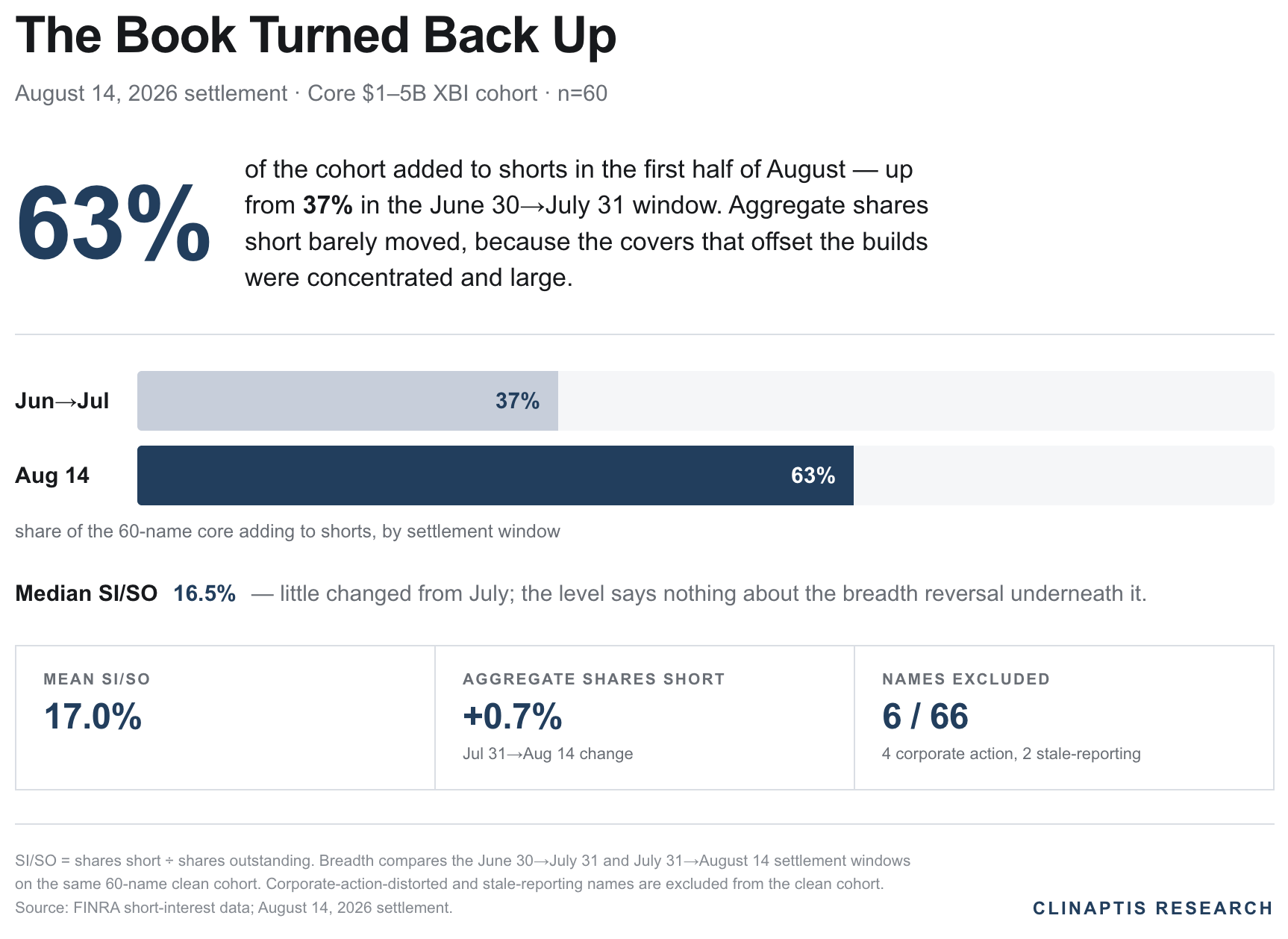
The aggregate tape looks like nothing happened. Median short interest across the clean 60-name cohort sits at 16.5% of shares outstanding, roughly where it ended July, and total shares short across the group rose 0.7% between the July 31 and August 14 settlements. A most-shorted screen run on those two numbers would call August a hold and move on.
The screen would be wrong, because the calm is an average of two opposite moves. Breadth turned sharply back up: 38 of the 60 core names added to shorts in the first half of August, versus 22 of the same 60 names during the June 30→July 31 interval — 63% versus 37%. Yet aggregate shares barely moved, because the names that covered, covered hard — and they covered into exactly the catalysts that should have invalidated the short case. The book did not hold still. It sorted.
What it sorted on was conviction. The July note graded the summer’s short builds on persistence — which one-month moves survived a second settlement. August graded them on something harder. When a crowded short finally meets its catalyst, the flow shows whether the position was a view or a rental — a settlement snapshot can’t identify the holder, but it can show who stayed and who left. Some shorts took the approval or the earnings beat and left. Others pressed straight through the news — and a few added into stocks that were ripping. The gap between those groups is the story of the month, and it is not visible in the aggregate.
Methodology. We screen $1–5B XBI-cohort biotechs against the August 14 short interest, reconciled to the July 31 and June 30 settlements we already hold. Standing crowding is measured as shares short over shares outstanding (SI/SO); vendor float denominators still diverge too much across sources to anchor a cross-sectional ranking. Positioning flow is the raw change in shares short. Corporate-action-distorted names (TSHA, PURR, DMRA, TRAX) and stale-reporting names (CPRX, KALV) are excluded from the 66-name raw $1–5B population, leaving the 60-name core. Price returns are settlement-aligned and measured against XBI (which rose 7.1% over the fortnight, so several superficially positive stocks in fact lagged biotech). Catalyst information is drawn from issuer releases and FDA materials dated July–August 2026. Two supplementary cohorts — a $5–8B cohort (n=13, present in the supplied dated XBI universe file) and a curated block of US large-cap biotech (n=8) — run as separate blocks in Section 6 and are never pooled into the core statistics.
 Open full resolution ↗
1. The book turned back up, but only at the margin
July’s headline was a retreat: fewer than half the cohort added to shorts, and the crowded leaders stopped building. August reversed the breadth without reversing the level. Nearly two-thirds of names added shares, but the median position grew by low single digits, and the group total was flat because a handful of large covers offset a broad base of small builds.
This is a book adding incrementally across many names while unwinding conviction in a few. The interesting positions are not the median names drifting up a point or two. They are the outliers on both tails: the large covers into good news, and the builds that ran against the catalyst — including, this month, shorts added into stocks rising 20 to 60 points against the tape.
2. The catalyst sort
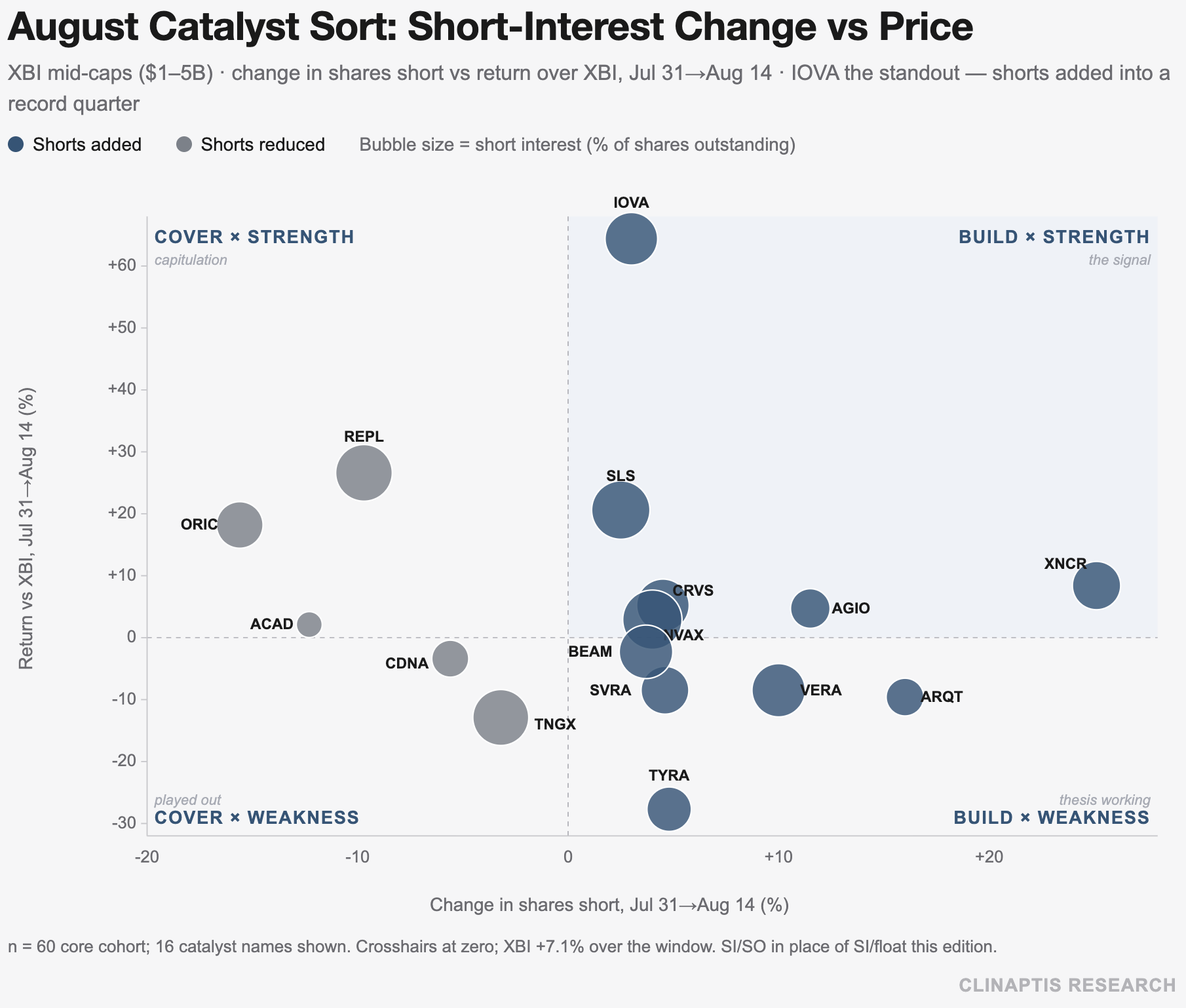
Placing each name on two axes — the change in shares short from July 31 to August 14, and the stock’s return against XBI over the same window — separates the cohort into four groups that mean different things.
Shorts covering into strength — the thesis resolved. Replimune is the cleanest case: RP1 won accelerated approval on August 6 after two prior complete response letters, the stock beat XBI by 27 points, and shorts cut the position 9.7% — the regulatory risk cleared and the riders left. Acadia covered 12% into a DAYBUE/NUPLAZID beat-and-raise; Oric covered 16% into an 18-point run as its Himalayas-1 Phase 3 launched with Bayer/darolutamide validation. These are positions that got their answer. Stoke is a related but distinct case: shorts covered 18% as EMPEROR fully enrolled and a rolling NDA was set for 1Q27, covering through an ATM financing — but the stock’s excess return over the window was roughly flat (+1.3%), so this reads as a cover on regulatory de-risking taken on its own terms, not a cover into a rising stock.
Shorts building against strength — where the information is. Iovance is the standout of the entire screen. A record Q2 (revenue $99.3M, Amtagvi ~$91M) sent the stock up 64 points against XBI, and shorts added 3% into it. That is a short thesis being run over in real time: the print sharply reduces near-term demand risk, so the surviving bear case shifts to launch durability and manufacturing margin rather than the demand question itself. Xencor built the most in the cohort (+25%) into an 8-point outperformance with no obvious deterioration and no clean mechanical explanation — an aggressive clinical/valuation hedge ahead of ESMO, and the one name we would dig a layer deeper on. Sellas (+21 points) and Agios (+5) are cleaner reads: binary-event hedges, with SELLAS’s REGAL Phase 3 AML final analysis approaching and Agios carrying a November 1 SCD PDUFA. Corvus and Novavax round out the group. A short growing against a rising price is early or wrong; in a thin-float SMID cohort it is also fuel.
Shorts building into weakness — the thesis working. Arcutis fell 9.6% against XBI despite ZORYVE revenue +59% — a gross-to-net and valuation bet after a strong launch, not a reaction to a bad quarter. Tyra dropped 28 points ahead of SURF302’s slip to September with shorts still adding — the most conventional bearish flow in the screen, positioning and price pointed the same way. Vera sits here too, and gets its own section below.
Shorts covering into weakness — played out. Tango (−3.2%) and CareDx eased as the stocks lagged — profit-taking on shorts that already worked, the least informative quadrant.
The sharpest single lesson: short flow and price momentum diverged this month. The most informative positions — Iovance, Sellas, Xencor, Agios, Corvus — are shorts added into relative strength, not shorts riding weakness down.
 Open full resolution ↗
Build vs strength (the signal) — IOVA, XNCR, SLS, AGIO, CRVS, NVAX
Build into weakness (thesis working) — VERA, ARQT, SVRA, TYRA, BEAM
Cover into strength (capitulation) — REPL, ORIC, ACAD
Cover into weakness (played out) — TNGX, CDNA
3. Vera: the launch short
Vera is the sharpest single-name version of the build-into-weakness story. Atacicept won FDA accelerated approval in IgA nephropathy on August 10 — and shorts responded by adding another 10% by August 14, four days after the label, taking the cumulative build since May to 55% and SI/SO to 23.3%, among the most crowded in the cohort. The shorts had the news and stayed. The stock cooperated: Vera lagged XBI by 8.5 points over the fortnight.
The read is a launch short, not a regulatory one. With the drug cleared, the bet has moved to the commercial ramp — the payer path, the nephrology uptake curve, and the durability of the IgAN opportunity against a competitive field — a slower, harder catalyst than an approval date. Positions that covered on the approval read as event-driven; this one did not. The build has been unbroken across all four settlements since May — shares short have risen every period (May 29 → Jun 30 → Jul 31 → Aug 14), including straight through the approval itself. Settlement snapshots can’t identify who holds the position or why — but four consecutive builds through an approval is a standing commercial-risk view, not a trade that closed on the news.
4. What survived from July
The July note flagged seven names that added to shorts in both June and July: Vera, Stoke, Tango, Viridian, Iron, Savara and Denali. One settlement on, the group splits by what the catalyst did to each thesis.
Three kept building, all on forward events rather than deteriorating fundamentals: Vera (+10%, launch short), Savara (+4.6%, a clean hedge into its November 22 MOLBREEVI PDUFA after an earlier review extension), and Denali (+3.0%, skepticism that the AVLAYAH launch scales from a $3.6M first quarter). Stoke broke hard — a 17.9% cover on clean regulatory de-risking (see Section 2) that cut its cumulative build from 41% to 16%.
Three paused, and Viridian carries a caveat worth flagging. On the surface it is July’s cleanest adversarial build (+30% cumulative) holding steady while the stock outran XBI by 10 points — bears committed but no longer pressing. But Lumvoa’s June 26 approval de-risked the thesis, and Viridian’s May financing included $225M of 1.75% convertibles, so a portion of the standing 16.8% SI is convert-arb rather than outright bearishness. The July characterization was directionally right but overstated: some of that “conviction” is a hedge. Iron (−0.7%) held on unresolved APOLLO/bitopertin regulatory risk; Tango eased post-financing ahead of a high ESMO bar.
5. The crowding leaders and the watchlist
The top of the SI/SO ranking is, once again, quiet — but quiet for different reasons. Recursion (33.2%) covered 1.6% as Genentech exercised its first neuroscience target option and opex guidance fell; the standing 33% remains a platform-validation bet that only human efficacy resolves. Intellia (32.0%) added 2% on a mixed print — HAELO/lonvo-z materially de-risked hereditary angioedema, but the nex-z liver-enzyme history leaves a genuine gene-editing overhang. Sarepta (25.6%) is the cleanest example of the pattern: shorts covered 1.9% into $329M of product revenue and profitability under a new CEO, yet a 25.6% short survives on ELEVIDYS’s boxed warning, fatal liver-injury history and narrowed ambulatory-only label. Standing crowding marks where shorts already sit. The most-crowded and fastest-building lists barely overlap, three settlements deep.
Two watchlists come out of the month. The build-against-strength names are the top diligence priority — Iovance, Xencor, Sellas, Agios and Corvus — because a short added into relative strength is either early or wrong, and either way it is the position most likely to be reassessed. Whether any of them is also a forced-cover setup is a separate, liquidity question: FINRA’s own days-to-cover figures put Iovance at the low end of this group (4.8 days) and Corvus at the high end (22.5 days), so SI/SO and recent price strength alone do not rank squeeze risk — that needs borrow and lendable-supply data we don’t yet have. The crowded-but-improving names — Sarepta, Recursion, Intellia — are the potential future unwinds if execution holds. And the standing SI on Viridian is a reminder that a headline number is not always conviction.
6. Above the core: the $5–8B and large-cap read
We compare the SMID core with two larger-company reference cohorts, both reconciled to the same FINRA August 14 settlement file and measured over the July 31→August 14 window. The first comprises 13 $5–8B names present in the supplied dated XBI universe file. We excluded seven additional names that met the market-cap screen but did not appear in that file. Because the file lists tickers with settlement data rather than providing an attributed, weighted holdings snapshot, inclusion confirms presence only in our XBI reference list—not independent index membership. The second cohort comprises eight US large-cap biotechs selected for crowding rather than size. Both cohorts remain separate from the core statistics.
Crowding steps down once, then flattens. The $1–5B core carries a 16.5% median SI/SO. The $5–8B band sits at 12.7% and the large-cap block at 11.5% — closer to each other than to the core, so the SMID core is materially more crowded than anything above it, while the two upper tiers are within a couple of points of each other on crowding.
On the matched window, the $5–8B band tracks the core rather than retreating from it: 8 of 13 names added to shorts (+1.0% in aggregate shares short), close to the core’s own 38/60 breadth (+0.7%). The large-cap block did retreat — four of eight names adding, aggregate shares short down 2.0%, driven by a 10.1% reduction in Tempus, with smaller cuts in Exelixis, Guardant and BridgeBio against builds in Cytokinetics and Halozyme. So the clean cross-tier read is narrower than “short concentration is marginal and retreats up-cap”: only the large-cap block covers, and that block was screened for standing crowding, not for size — the covering may say as much about the sample as about capital rotating down the cap scale. Within the $5–8B band, CRISPR Therapeutics is still the one to watch: the most crowded name at 19.4% SI/SO, easing 0.4% on the matched window (a smaller move than the mid-month read implied) rather than pressing. Two of the smaller names in the band are worth flagging for the opposite reason — the raw flow reads as a build but likely isn’t a clean bearish signal. Erasca’s build (+3.0%) probably contains offering-related technical shorts: early, thin Phase 1 data (N=7) in July preceded a $632.5M equity raise, and mechanical shorting around an offering is a different animal from a fundamental short. Cogent’s build (+2.9%) is the cleaner case — shorts are adding ahead of two Q4 PDUFAs (GIST, NonAdvSM) despite three positive pivotal readouts, which reads as a regulatory-event hedge rather than a deteriorating thesis.
Two extensions sit outside this edition. A mature large-cap pharma benchmark is deferred again this cycle pending settlement-aligned data. And the NBI-only universe (the Nasdaq Biotech names outside the XBI screen) is reviewed separately, in a sandbox, rather than folded into the note — its short-interest profile differs enough from the XBI cohort that it warrants its own treatment before it earns a place here.
Bottom Line
The crowded XBI shorts did not break when the catalysts came — the more useful finding is that short flow and price stopped agreeing. Positions covering on a regulatory or earnings event — Replimune, Oric, Acadia, Stoke — read as event-driven. Positions that kept building despite the news — Vera through an FDA approval, Arcutis through a beat-and-raise — read as standing views; a settlement snapshot can’t confirm the holder’s reasoning, only the direction. A third group did the most striking thing of all: added shorts into stocks that were ripping, Iovance above all, where bears increased exposure into a 64-point relative move on a record quarter (+3.0% Δ short into +64.4% excess return). Positioning fighting price this hard is the diligence flag of the month.
Three things follow. The build-against-strength names are the top diligence priority — Iovance and Xencor first — where shorts are adding into stocks the market is marking up; whether that pressure becomes a forced squeeze is a separate question that needs borrow and liquidity data beyond what a settlement snapshot shows, and on days-to-cover alone Iovance is not the most exposed name in the group. Several of the most crowded names are binary-event hedges rather than durable fundamental bearishness (Sellas, Beam, Agios, Savara, Iron), so a high SI number should not be read as long-duration conviction — and at least one, Viridian, is partly convert-arb. And the summer’s headline short, Vera, now reads as a commercial call rather than a clinical one: the build continued through approval (+10.0% Jul31→Aug14, 55.2% cumulative since May), consistent with a bet that the launch disappoints rather than that the drug fails. September’s settlement will show whether that bet is early or wrong.
Clinaptis Short Interest Monitor. $1–5B XBI cohort, n=60 (excludes 4 corporate-action names and 2 stale-reporting names from a 66-name raw population); supplementary $5–8B cohort, n=13 (present in the supplied dated XBI universe file; 7 additional names originally screened by market cap alone did not appear in that file and were dropped — the file is a settlement-date short-interest pull, not an attributed, weighted holdings snapshot, so presence there is not independent confirmation of XBI membership) and US large-cap block, n=8, run separately. Short interest settled August 14, 2026, reconciled to June 30 and July 31. SI/SO = shares short / shares outstanding. Core and supplementary cohorts share a common flow window, July 31→August 14, reconciled against the FINRA Aug 14 settlement file. Price returns settlement-aligned vs XBI (+7.1% over the window). Catalyst information is drawn from issuer releases and FDA materials dated July–August 2026.