
Novartis’ Pelacarsen missed both co-primary endpoints in a large Phase 3 cardiovascular trial called HORIZON Lp(a). This was a surprise headline-negative result, with 10%+ hits to both AMGN and NVS market valuations. Using only HORIZON’s disclosed design, the dual miss strongly disfavors the large cardiovascular effect the trial was built to detect. Two key culprits include attenuated clinical benefit of Lp(a) lowering and null biology. Our HORIZON → OCEAN(a) simulation puts outright mechanism-null biology at ~19%, which to our surprise was stable across every prior construction we ran, and OCEAN(a)‘s post-HORIZON statistical-success probability at ~65–72% under the locally crafted constructions from Ph3 design disclosures. The notable distinction is HORIZON materially reprices olpasiran without resolving it: conditional on meaningful Lp(a) biology surviving, OCEAN(a)’s deeper lowering and trial design still give it a high probability of statistical success. The November AHA disclosure should tell us which branch deserves more weight (§8).
Lp(a) has been a causal risk factor without a treatment for most of two decades. Genetic studies beginning with Kamstrup et al. (JAMA, 2009) made the causal case, but available therapies couldn’t lower Lp(a) enough to test it cleanly. Antisense and siRNA chemistry finally changed that: HORIZON is the first Phase 3 outcomes test of whether a large, selective pharmacologic Lp(a) lowering translates the genetic association into fewer cardiovascular events. Novartis ran that first test with pelacarsen, licensed from Ionis’s antisense platform; Amgen is now testing the same biological thesis with the siRNA olpasiran.
For investors, the topical question is now olpasiran. AMGN’s OCEAN(a)-Outcomes differs materially from HORIZON in exposure, enrollment threshold, population, and endpoint construction. Those differences can’t erase a genuinely null mechanism, but they matter considerably if HORIZON missed because the true cardiovascular effect was smaller than expected or pelacarsen under-delivered. The rest of the Lp(a) class provides reference points (Appendix D); the investment question here is how much of HORIZON’s miss should carry over to AMGN.
What the topline miss told us:
-
Both co-primaries failed their significance boundaries, which can be reconstructed from the disclosed design (§3). The actual HRs remain undisclosed. That constrains the observed result, not the true effect.
-
On the true effect, HORIZON is highly informative against a large benefit and weak against a small one (§4): full LDL-calibrated (Burgess) translation is disfavored ~10–12:1, but the topline cannot distinguish a modest residual benefit from no benefit at all.
-
This note reconstructs the boundary HORIZON had to clear, tests which true effect sizes remain compatible with the dual miss, and separates four explanations — mechanism, attenuated biology, delivery, and trial/population dilution — before transporting each to olpasiran (§6). AHA should narrow those explanations; §8 states the position and what would end it.
1. What the topline establishes, and what it cannot
The disclosed design still places a useful bound on what the topline can mean.
On September 4, Novartis (NVS) said pelacarsen — an antisense oligonucleotide modeled to lower Lp(a) ~80% — did not significantly reduce four-point MACE versus placebo in Lp(a)HORIZON, an 8,323-patient outcomes trial in established cardiovascular disease with elevated Lp(a). The drug lowered Lp(a); the trial still missed. NVS withheld the hazard ratio, confidence interval, event rates, and subgroups, with full data expected at a subsequent congress.
The SAP defines success as meeting either co-primary — the full population or the pre-specified ≥90 mg/dL subpopulation (79% of enrollment) — so “did not meet its primary endpoint” means both failed. Given the disclosed event count and testing structure, that alone places a meaningful statistical constraint on the result before NVS discloses a single hazard ratio — but it does not reveal the underlying treatment effect, let alone whether the explanation is null biology, a smaller-than-expected effect, delivery failure, or trial dilution. Those distinctions need the full dataset.
2. Why Lp(a) was never properly tested, and why the market underwrote HR 0.80
Each pre-HORIZON source — genetic, observational, and pharmacologic — supported a large effect, but each required substantial transport into a finite-horizon CVOT on optimized background therapy.
Genetics support roughly 20% risk reduction for ~100 mg/dL of lifelong lowering (Burgess, LDL-calibrated); Madsen’s observational analysis suggested a similar effect might require only ~50 mg/dL over five years. Pelacarsen Phase 2 established that pharmacologic lowering of this magnitude was achievable. FOURIER provided supportive, if confounded, pharmacologic evidence: evolocumab’s coronary benefit was larger among patients with higher baseline Lp(a). ODYSSEY pointed in the same direction, but its narrow-range mediation relationship was unsuitable for linear extrapolation to pelacarsen-scale lowering. Unlike earlier niacin experience, pelacarsen lowered Lp(a) far enough that HORIZON constituted a credible test of pharmacologic Lp(a) reduction — though clearing that bar doesn’t guarantee a large effect (§5).
FOURIER’s coronary composite (OCEAN(a)‘s own endpoint) fell 23% (HR 0.77) above median baseline Lp(a) vs. 7% (HR 0.93) below (P-int 0.07, LDL-confounded). ODYSSEY’s per-mg/dL mediation analysis, naively extrapolated to HORIZON’s ~87 mg/dL, implies a benefit larger than the trial’s own boundary allows (§3). HPS2-THRIVE: niacin’s Lp(a) lowering (~34 nmol/L) fell short of the authors’ own ~≥80 nmol/L threshold; pelacarsen’s modeled ~185 nmol/L reduction cleared it by a wide margin.
Taken together, the evidence made HR ~0.80 a defensible design assumption, but not an empirically established drug effect. That distinction matters now: HORIZON’s dual miss is a substantial update precisely because the prior was reasonable, not because HR 0.80 had ever been directly demonstrated (§3, §4).
The rest of the class was built on the same genetics before HORIZON’s evidentiary bar was known:
Olpasiran now inherits the biological question but not HORIZON’s exact experiment. OCEAN(a) combines deeper lowering with a higher Lp(a) floor and a coronary-only population and endpoint — a narrower, higher-signal bar than HORIZON’s 4-point MACE in broader ASCVD. The class shares HORIZON’s biological update without sharing all of its trial architecture.
3. The boundary math
Both co-primaries failed; the design math bounds what their HRs could have been.
The either/or rule establishes both endpoints failed; the boundary each needed to clear gives the magnitude. Using the disclosed event target (993 events), the final one-sided alpha (0.0245), the nested co-primary structure, and a correlation-adjusted joint significance boundary,¹ the observed hazard ratios sit at or above roughly HR 0.874 (full) and 0.86 (≥90), robust across plausible inter-stratum event-rate ratios. An observed 0.82–0.84 would have cleared either boundary. Both tests failed, so the observed estimates sat above their boundaries; where above them is undisclosed, and nothing in the topline narrows it further.
4. Which true effects survive the dual miss
Which effect size counts as “full translation” depends entirely on the anchor: Burgess and Madsen imply different headline HRs from the same trial. Burgess (2018, ~101.5 mg/dL) is the lifetime-genetic, LDL-calibrated standard; HORIZON’s ~86.6 mg/dL modeled lowering implies HR ~0.81 in full-population (~0.79–0.81 for ≥90) — though HORIZON’s 4-point MACE includes stroke, so the Burgess expectation for it runs somewhat below 0.81. Madsen (~50 mg/dL) is the softer, observational 5-year alternative, with a 27–138 mg/dL confidence interval wide enough that the anchor debate mostly sits inside Madsen’s own CI.
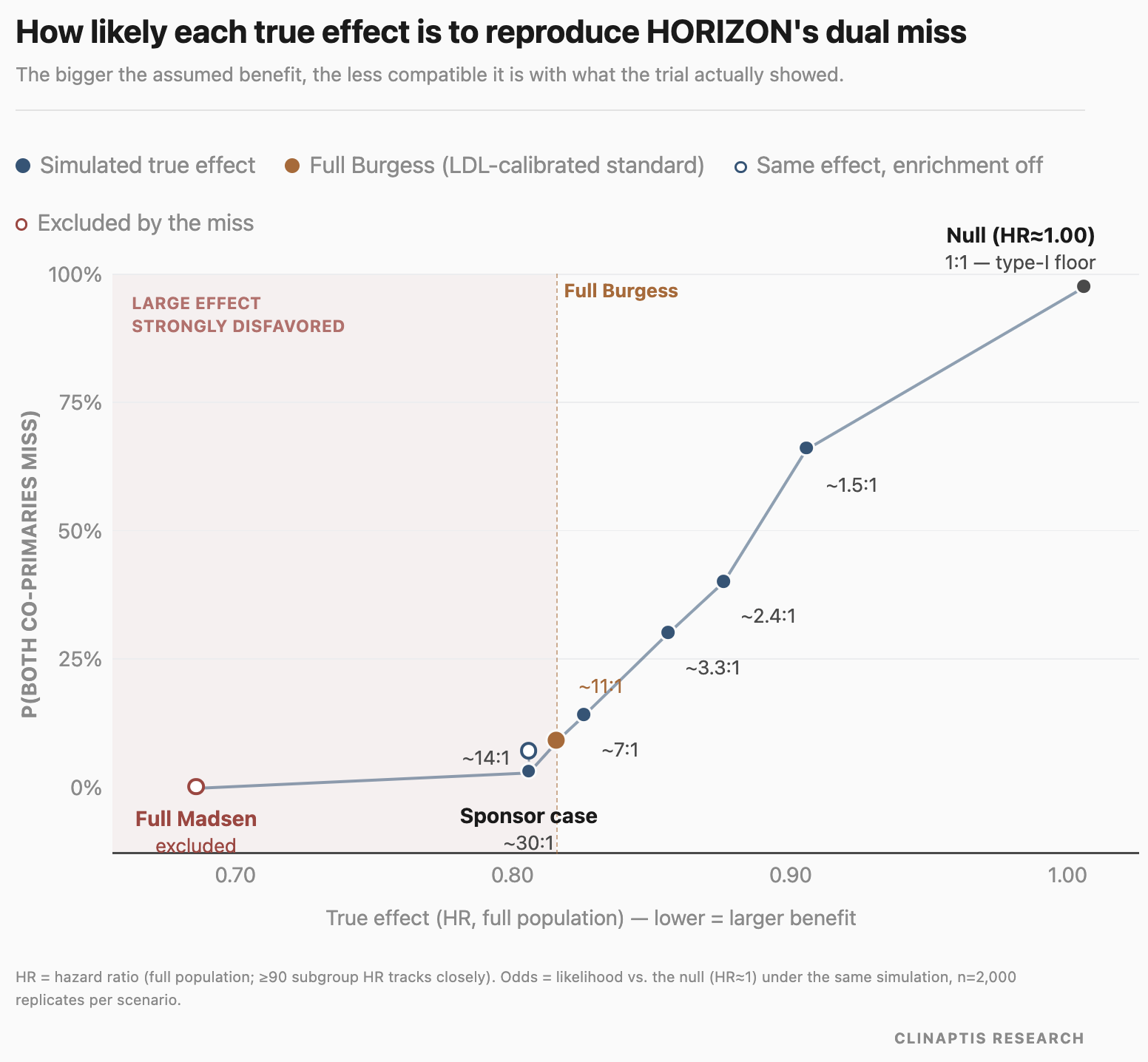
Rather than fit an uncalibrated dose-response curve, our simulation tests named true effects spanning Madsen-to-Burgess translation, plus the sponsor and benchmark cases as direct hazard ratios, and asks how often each reproduces the observed dual miss. It returns a likelihood, not a posterior.
 Open full resolution ↗
HR is primary; Burgess is the standard, Madsen the aggressive end.
The dual miss sharply discredits the larger-effect states without identifying the true effect. Full Madsen translation (HR ~0.68) is effectively incompatible with the result. Full Burgess translation (~0.81) is disfavored roughly 10–12:1 relative to null, while an attenuated effect around HR 0.87 is only ~2.5:1 against and HR 0.90 remains readily compatible with the miss. These are likelihood comparisons, not posterior probabilities: HORIZON strongly updates against full LDL-calibrated translation but cannot distinguish cleanly between a modest residual benefit and no benefit.
One scale note carries into §6: the simulation indexes translation to the Madsen anchor, on which full Burgess translation sits near 50% translation, not 100%. Madsen-scale and Burgess-scale figures are kept distinct throughout.
Madsen and Burgess miss for different reasons: Madsen is already a 5-year estimate, so exposure duration cannot explain why it over-predicts HORIZON — residual confounding in an observational cohort is the likelier driver. Burgess, the lifetime-genetic estimate, needs the horizon argument instead: a ~5-year pharmacologic intervention late in life cannot reproduce a lifetime of genetically lower exposure.
5. Why HORIZON may have failed — and what AHA can tell us
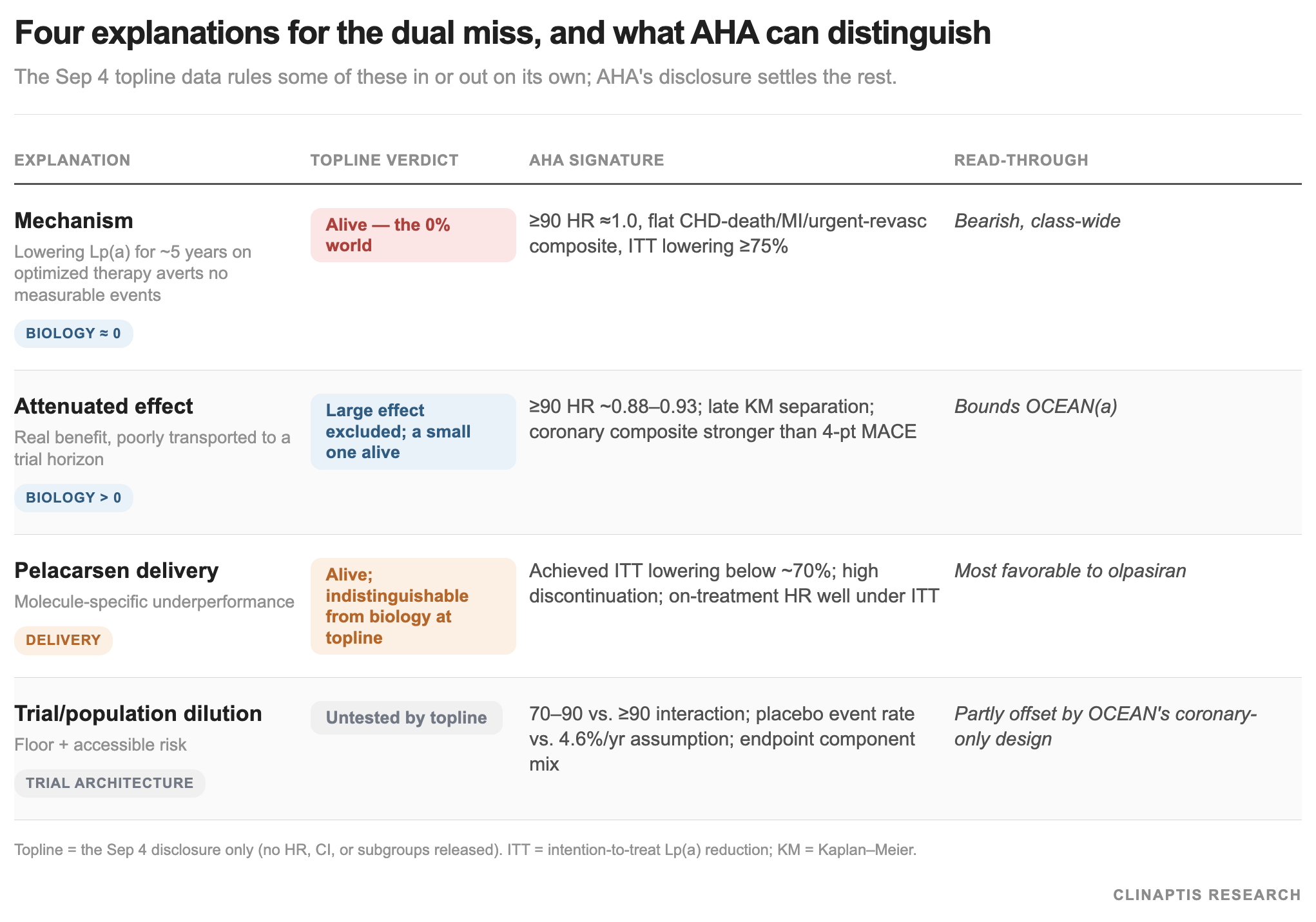
§4 established how much of a true effect survives; this section asks why HORIZON could have produced that result, and how much AHA’s disclosure can settle.
 Open full resolution ↗
Three things the topline still cannot settle:
-
Did pelacarsen under-deliver? The ≥90 subgroup miss does not rule this out: its test statistic is ~0.89 correlated with the full population, so the second miss adds little independent information. The cleaner test is whether achieved lowering and treatment effect differ between 70–90 and ≥90 mg/dL — unreleased, and likely underpowered even if disclosed.
-
Was absolute lowering sufficient? At the modeled ~80% reduction, each baseline tier clears the observational 50 mg/dL benchmark. At 65–75% achieved lowering, that margin becomes thin or disappears near the enrollment floor. Severe under-delivery is therefore possible, but requires a meaningful miss versus modeled exposure.
-
Was there enough accessible risk? HORIZON assumed a 4.6% annual placebo event rate. A materially lower realized rate on contemporary therapy would reduce information independently of pelacarsen’s biological effect; the January 2025 timeline extension was attributed to blinded event accrual.
The topline therefore identifies the size of the miss better than its cause. A large treatment effect is difficult to reconcile with the result; mechanism failure, attenuated effect, pelacarsen delivery and trial/population dilution remain only partly distinguishable. AHA can narrow these through achieved lowering, subgroup and on-treatment effects, event rates and endpoint components — imperfectly, since several comparisons are non-randomized. §8 defines the signatures that would change our view.
6. How Much Does HORIZON’s Miss Cost OCEAN(a)?
HORIZON leaves ~19% probability that Lp(a) lowering produces no measurable cardiovascular benefit over this horizon. That estimate is unusually stable: across nine representations of our pre-HORIZON belief structure, mechanism-null biology lands between 18.5% and 20.0%. Under the same framework, OCEAN(a)’s statistical-success probability falls from 87.9% pre-HORIZON to ~65–72% post-HORIZON. The dual miss therefore costs olpasiran ~16–23 points without killing the trial.
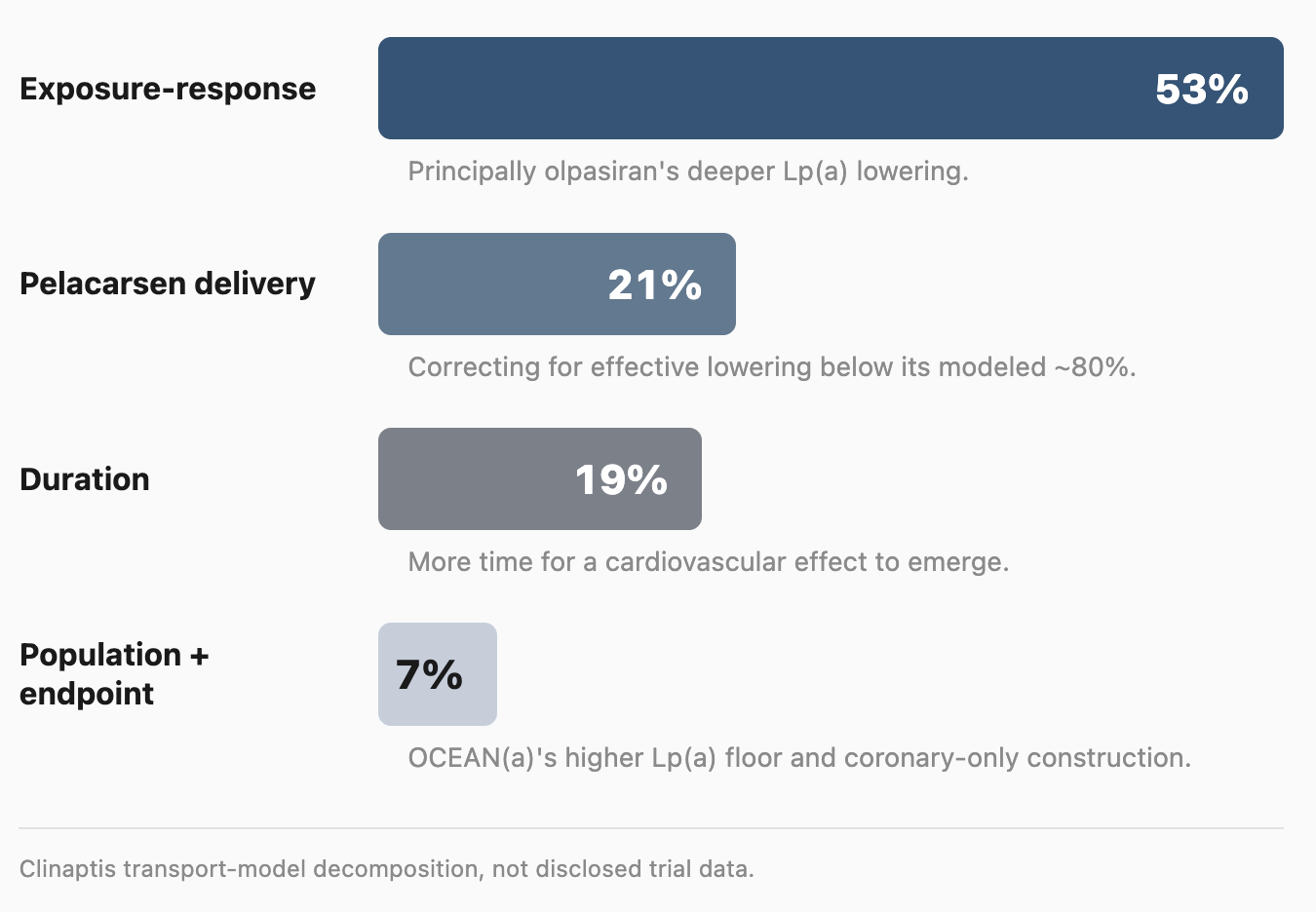
Why doesn’t it cost more? Mostly because OCEAN(a) gets substantially more exposure to the same biology. Median HORIZON→OCEAN transport is 1.93× on the log-hazard scale, with the modeled contribution split across:
 Open full resolution ↗
The case for OCEAN(a) therefore rests much more on deeper lowering than on its cleaner population or endpoint. Exposure-response is also the largest uncertainty in the transport model (Appendix F).
A moderate surviving-effect state shows the consequence. At 35% of the Madsen-anchored exposure-response, HORIZON’s true HR would be ~0.87, an effect that still misses both co-primaries ~40% of the time. Transport the same biology into OCEAN(a), and median RRR reaches ~24%, with ~96% probability of statistical significance. That result still depends on modeled inputs — particularly OCEAN(a)’s baseline Lp(a), pelacarsen’s effective delivery, and the exposure-response and follow-up assumptions.
Across surviving biological states, OCEAN(a) reaches significance around 83% of the time. Its event count and information efficiency move that probability by only single points. The main uncertainty is therefore how much biology survived HORIZON, not whether OCEAN(a) is adequately powered to detect it.
HORIZON pins down the null state reasonably well at ~19%, but not how the remaining ~81% splits between weak and stronger positive biology. That distinction drives nearly all of the model spread. Our locally constructed priors give OCEAN(a) ~65–72% statistical-success probability; allowing all nine admissible prior shapes widens the range to ~44–72%. We do not treat 44% as a calibrated bear case — it comes from constructions that assign substantially more probability to weak-positive biology, something HORIZON cannot resolve (Appendix F).
One result is stable across every construction: ~7–9% probability of a statistically positive OCEAN(a) result with an observed RRR below 15%. That is a technical win without necessarily confirming the commercial thesis.
7. The tape does not cleanly price the Lp(a) read-through
AMGN fell 10.1% on Sep 8, but treating that move as the market’s valuation of olpasiran is difficult. The correction was confounded by stock-run up into Sept ‘26; on overall valuation/LOE grounds and even a positive DeLLphi-305 readout; Tavneos also carried a separate regulatory and franchise overhang around the same period (Appendix E). AMGN price action therefore contained substantially more than HORIZON.
AMGN’s 1-day or 5-day tape cannot tell us with much confidence what HORIZON cost olpasiran. Sure, some derating was warranted, but a fundamental olpasiran reset explains only a minority of AMGN’s decline.
IONS gives the opposite signal. Shares closed down only 2.38%, a small reaction relative to our ~$1.9–2.8B estimate of pre-readout risked pelacarsen economics to Ionis (Appendix D). The divergence between AMGN and IONS is itself evidence against extracting a clean olpasiran value from either stock move.
Our model gives the more useful anchor. HORIZON materially reduces OCEAN(a)’s probability of statistical success, while the probability of a win with ≥15% RRR sits lower still at ~60%. Some repricing of olpasiran is therefore earned — particularly because a statistically positive but commercially modest outcome remains possible. But a conventional probability-and-peak-sales reset explains only a minority of AMGN’s broader decline under our valuation sensitivity (Appendix C).
The tape confirms that HORIZON mattered. It does not tell us how much olpasiran is worth. That requires the biological and delivery information still missing from the topline
8. The AHA decision tree, the position, and what would end it
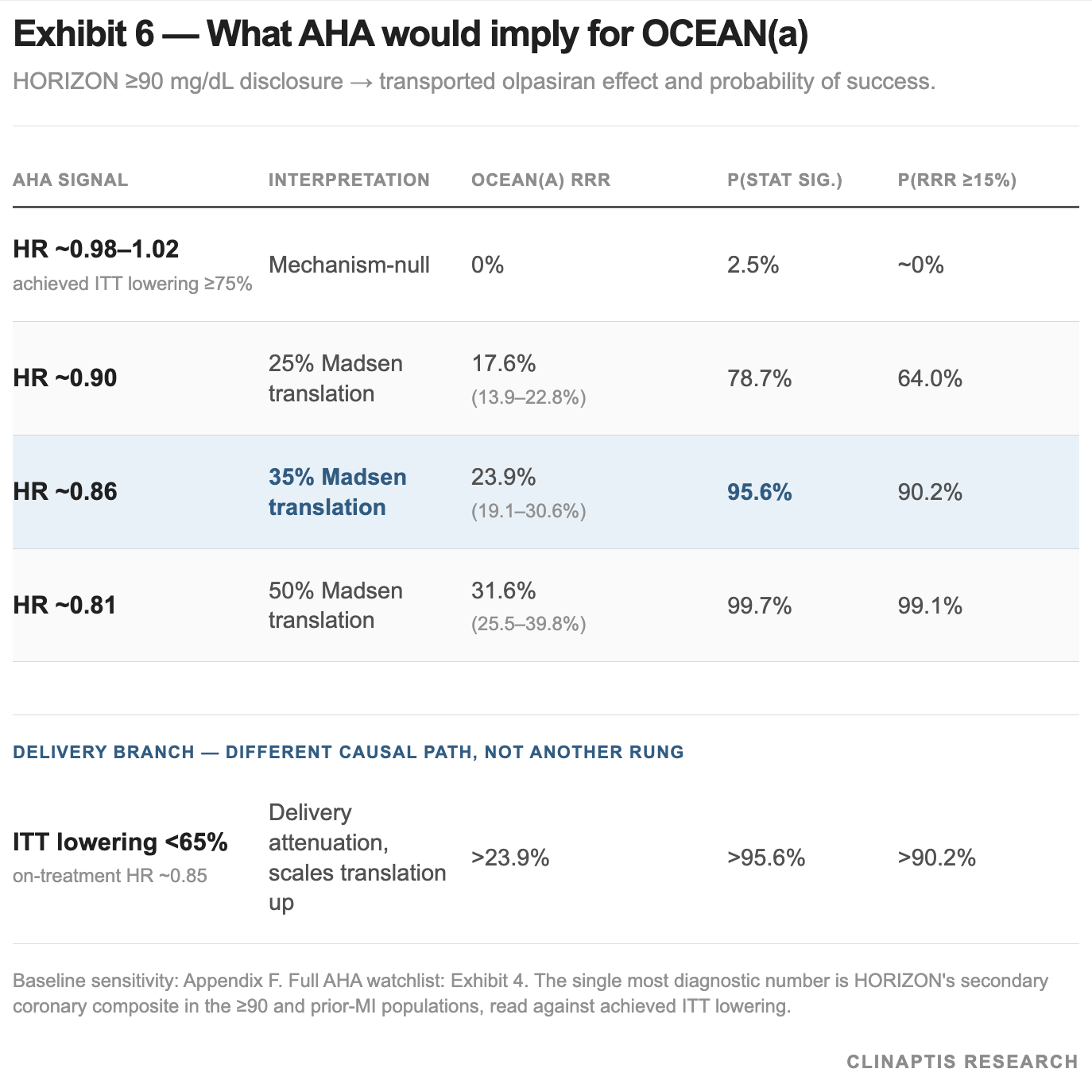
AHA should give the market far more to work with than the September topline did. Exhibit 6 maps the main HORIZON disclosure states directly onto OCEAN(a); unlike §6’s unconditional probabilities, these are conditional statements — once HORIZON’s achieved lowering and treatment effect are known, the prior largely drops out, which is why this is the most robust section of the note.
 Open full resolution ↗
The numbers that matter are simple: the point HR and confidence interval in the ≥90 mg/dL subgroup, achieved ITT lowering, placebo event rates, and whether the curves separate with longer follow-up. The single most useful read-through is HORIZON’s own secondary coronary composite — essentially the endpoint OCEAN(a) is trying to win on — in the ≥90 mg/dL and prior-MI populations, read against achieved lowering.
AHA, not OCEAN(a)‘s March-2028 readout, is what resolves this. What the disclosure shows should determine the position, not a directional call made now. The stronger part of the argument concerns olpasiran’s probability of success, not AMGN’s valuation: our transport work does not support the scale of probability compression that AMGN’s September reset would require (§7) unless the full data land close to mechanism-null — every surviving-biology state Exhibit 6 tabulates keeps OCEAN(a) above 78% statistical-success probability. We’re far less willing to argue with the peak-sales side of that reset; a technically positive but commercially modest result remains a live outcome (§7).
Some of AMGN’s broader September de-rating may reverse on a favorable disclosure, but that’s confounded with the Tavneos overhang and a possible multiple re-rate rather than an olpasiran-specific signal — optionality, not something this framework underwrites.
Invalidation. One disclosure ends it: a ≥90 mg/dL subgroup HR of ~0.98–1.02 alongside achieved ITT lowering of 75% or better. That state takes OCEAN(a)‘s statistical-success probability to the 2.5% type-I-error floor, and we close the position. A ≥90 HR of ~0.88–0.93, particularly with later KM separation, keeps the thesis intact; achieved ITT lowering below 65% with a materially better on-treatment effect is the most favorable read-through for olpasiran.
Tavneos is a separate risk, sized separately: the MHRA revocation is dated 1 March 2027, and the FDA hearing remains unresolved, while the EU marketing authorisation has been revoked (Appendix E). A favorable HORIZON disclosure does nothing to remove that overhang.
What a probability move is worth. Moving P_win≥15 from our own post-HORIZON ~60% (§7) to the ~90% Exhibit 6 assigns the HR ~0.86 branch is worth roughly $6.7–8.3/share at a $4–5B peak-sales assumption (Appendix C), undiscounted for the ~18 months to OCEAN(a)‘s own readout. Against AMGN’s ~$379 close, that’s ~2% upside and only 10–14% of the ~$58–65/share shed since the last pre-disclosure close — real, but a minority of the drawdown.
We don’t need HORIZON to prove Lp(a) works, and we don’t need the September selloff to reverse. We need the full data to show the dual miss came from an effect smaller than HORIZON was built to detect, not no effect despite adequate delivery. If Novartis shows the latter, the thesis is over.
Appendix A: Boundary methodology and robustness
Solved via the bivariate-normal joint exceedance equation, correlation derived from the ≥90 stratum’s disclosed 78.9% enrollment share. The multiplicity procedure across the two co-primaries is assumed — NVS has not disclosed its exact method — but the boundary is robust: Bonferroni gives ~0.867/0.852, no adjustment ~0.883/0.869, a ±0.01 band.
A separate multiplicity question — spend across the trial’s two interim looks — is not assumed: the design paper specifies interims at ~546 (55%) and ~745 (75%) events with a conservative Bonferroni spend (one-sided α 0.0001 and 0.0004), leaving one-sided α = 0.0245 for the final analysis. That is the figure §3 uses; it is barely different from a naive, no-interim 0.025 (the group-sequential spend was small by design), so it does not reopen the boundary the way a more aggressive interim spend could have. Event count is likewise settled: HORIZON is event-driven — it continues until 993 primary events are adjudicated — so target and achieved are the same number by construction. Full methodology and verification: AMGN_Draft_SimLog.md.
Appendix B: The optimised-care pattern behind the mechanism-binary case
Three unrelated cardiovascular outcomes trials on contemporary background therapy missed within eight weeks: CARDIO-TTRansform (eplontersen, ATTR-CM), ZEUS (ziltivekimab, 3-point MACE, HR 0.99, 95% CI 0.88–1.11),³ and Lp(a)HORIZON. The three drugs and populations share no biology, so this is not evidence of a common mechanism. It is evidence for something narrower: modern background therapy and endpoint design may be compressing the incremental effect any new intervention can show.
That possibility is why our prior construction assigns some prior weight to a binary/threshold translation model rather than treating graded dose-response as the only base case — it does not justify the specific ~25% weight, which stays judgment. The same logic bounds §8: if background care compresses the achievable effect regardless of how much Lp(a) comes down, pelacarsen’s under-delivery can’t by itself support an uncapped delivery-branch re-rate for olpasiran.
³ Novo Nordisk, “Novo Nordisk provides update on the ZEUS phase 3 trial in people with ASCVD, CKD and inflammation,” July 31, 2026
Appendix C: Olpasiran valuation — an external anchor and a sensitivity
Pre-HORIZON external estimates framed a successful Lp(a) franchise at roughly $3–6B worldwide peak sales: Royalty Pharma’s own materials cited >$3bn for olpasiran (its own footnote: “based on analyst research estimates”) and >$5bn for pelacarsen (Novartis’s own marketer guidance), with CNBC (Sep 8, 2026) separately citing sell-side estimates of $4–5B for pelacarsen. These are opportunity anchors, not Clinaptis forecasts, and likely overstate the post-HORIZON opportunity — they predate both the biological update and the smaller effect sizes this note’s own math supports (§4, §6).
A valuation sensitivity, not an rNPV — no launch curve, margin, primary-prevention contribution, or competitive erosion is modeled; those belong in the dedicated AMGN work.
AMGN fell ~$58/share (~$31B market cap) from its last undisturbed close through Sep 11; using the Sep 3 close instead widens this to ~$65/share (~$35B). Even a generous olpasiran reset explains only a minority of that move: resetting PoS from 70% to 30% at $6B peak sales removes only ~$13/share (~$7.2B, 20–23% of the decline); a $4–5B central-case reset removes materially less. The tape can’t be reverse-engineered into an olpasiran valuation — the residual most likely reflects the confounded Sep 8 print, broader multiple compression, and technical selling into a 3x-volume session.
Appendix D: Ionis (IONS) / Royalty Pharma (RPRX) / Arrowhead (ARWR) reference
Pelacarsen itself now carries little value — it failed its registrational CVOT, an apheresis-sparing niche aside. The impairment to IONS is economic, not a mark against its underlying platform: it separately forgoes up to ~$650M in pelacarsen milestones from NVS, on top of RPRX’s foregone $625M (RPRX holds 25% of IONS’s tiered pelacarsen royalty). On our judgment inputs — royalty economics, discounted milestones, and a ~66% pre-readout PoS — pelacarsen’s risked value to IONS was roughly $1.9–2.8B [judgment], against the actual −2.38% reaction (§7).
The live class exposure shifts to olpasiran: RPRX also holds ARWR’s entire olpasiran royalty, while ARWR retains up to $400M in olpasiran milestones from AMGN — RPRX sits on both sides of the class outcome. The August 2023 NVS license of an IONS next-generation Lp(a) compound is now a rights-return risk rather than an independent positive catalyst.
Appendix E: Tavneos (avacopan) — the second September event
Tavneos confounds any reading of olpasiran value off AMGN’s September tape. In April 2026, the FDA proposed withdrawing the Tavneos NDA, alleging the pivotal study did not establish efficacy and raising data-integrity concerns; Amgen requested a hearing and contests FDA’s characterization, and that contest is unresolved. The pivotal study was retracted in late June. On September 1, the MHRA concluded the available evidence no longer supported a positive benefit-risk balance and began a UK withdrawal, with revocation intended for 1 March 2027; EMA recommended revocation in June, followed by a final European Commission decision on 4 August 2026 revoking the EU marketing authorisation.
CSL Vifor, not Amgen, holds the ex-US marketing rights, so the exposure runs to franchise durability rather than UK revenue. Amgen acquired ChemoCentryx for $4B in 2022, which bounds the outer scale of a full-franchise impairment; a ~$3–4B full-franchise impairment is a Clinaptis estimate at that ceiling, not an observed market attribution — and since the FDA action dates to April, not September, it can’t be attributed wholly to this readout window. The relevance here is narrow: AMGN had a second material pipeline-credibility event three days before HORIZON, which is why the September stock decline can’t be reverse-engineered into an olpasiran valuation alone (§7, §8).
Appendix F: Model lineage, prior constructions, and sensitivity
Frozen model chain. HORIZON simulation → OCEAN biological transport → statistical-observation layer; 250,000 draws, all downstream constants unchanged across prior constructions. Primary events D = 800 / 950 / 1,150, weighted 0.25 / 0.50 / 0.25 (OCEAN(a) event scenarios); one-sided α = 0.025. No futility rule or interim boundary is modeled, so P_stat is conditional on the trial reaching its event target.
Prior constructions and the one axis that matters. Nine representations of the pre-HORIZON graded belief structure, all sharing the same null spike and the same downstream transport:
Fitted across all nine: P_stat ≈ 0.706 − 0.795 × P(γ<0.15), R² = 0.991.
All nine constructions reproduce the only quantified pre-HORIZON elicitation — ~65% trial PoS — within ±2.4%, yet generate materially different posterior mass below γ<0.15. The elicited prior therefore does not identify its own shape; we report the range rather than privilege one construction.
OCEAN(a) baseline Lp(a) — the second-largest unverified input. The ~317 nmol/L median is a Clinaptis extrapolation from truncating HORIZON’s own floor/median distribution at OCEAN(a)‘s ≥200 nmol/L threshold [modeled], not disclosed trial data. Sensitivity, varying that input alone:
Named falsifier: a disclosed OCEAN(a) baseline near ~250 nmol/L moves the central band down ~8 points (67.5→59.6%). Baseline is the second-largest unverified input; prior shape the largest.
Known methodological limitation. The HORIZON delivery correction is applied linearly while 45% of draws use a concave exposure-response; under concavity the correction should itself be concave. This overstates modeled transport by ~2.7% on the log-hazard scale, worth under one point of P_stat. Disclosed rather than corrected.
Resources
-
Novartis. Lp(a)HORIZON Phase 3 topline results and trial disclosures, September 2026.
-
ClinicalTrials.gov. Lp(a)HORIZON (NCT04023552): pelacarsen cardiovascular outcomes trial design and endpoints.
-
ClinicalTrials.gov. OCEAN(a)-Outcomes (NCT05581303): olpasiran cardiovascular outcomes trial design and endpoints.
-
Burgess S, et al. Association of LPA variants with risk of coronary disease and implications for Lp(a)-lowering therapies. JAMA Cardiology, 2018.
-
Madsen CM, et al. Lipoprotein(a)-lowering and cardiovascular risk reduction in secondary prevention. Arteriosclerosis, Thrombosis, and Vascular Biology.
-
O’Donoghue ML, et al. Olpasiran in patients with atherosclerotic cardiovascular disease. New England Journal of Medicine, 2022.
-
Tsimikas S, et al. Lipoprotein(a) reduction with pelacarsen in patients with cardiovascular disease. New England Journal of Medicine, 2020.
-
O’Donoghue ML, et al. Lipoprotein(a), PCSK9 inhibition, and cardiovascular risk: analyses from FOURIER. Circulation, 2019.
-
Schwartz GG, et al. Lipoprotein(a), alirocumab, and cardiovascular outcomes: analyses from ODYSSEY OUTCOMES. European Heart Journal, 2020.
-
Amgen, Novartis, Ionis Pharmaceuticals and Royalty Pharma. Public regulatory filings, investor presentations, earnings materials and clinical-program disclosures cited throughout this analysis.