
Rhythm Pharmaceuticals (RYTM) spent a decade establishing MC4R agonism in rare genetic obesity, first in ultra-rare deficiencies and then in Bardet-Biedl syndrome. Acquired hypothalamic obesity (aHO) changed the scale of the company: TRANSCEND had already de-risked much of the opportunity by 2025, and the March 2026 approval opened Rhythm’s largest commercial market to date—a broader, easier-to-find population with no previously approved therapy. The launch has started strongly, with >400 start forms in its first 14 weeks. SIGNAL, meanwhile, made an oral MC4R successor credible.
Approval removed the remaining regulatory uncertainty. At $104.71 (Sep 11, 2026 close), Rhythm carries ~$8.0B of fully diluted enterprise value, and current valuation is largely underwriting commercial scale and durability rather than clinical or regulatory risk. We value each piece explicitly (U.S. aHO through a patient cohort model, ex-U.S. aHO, the legacy genetic franchise, lifecycle and pipeline) and our Base EV reaches ~$4.8B, or ~$63/share (~$0.22B of net cash).
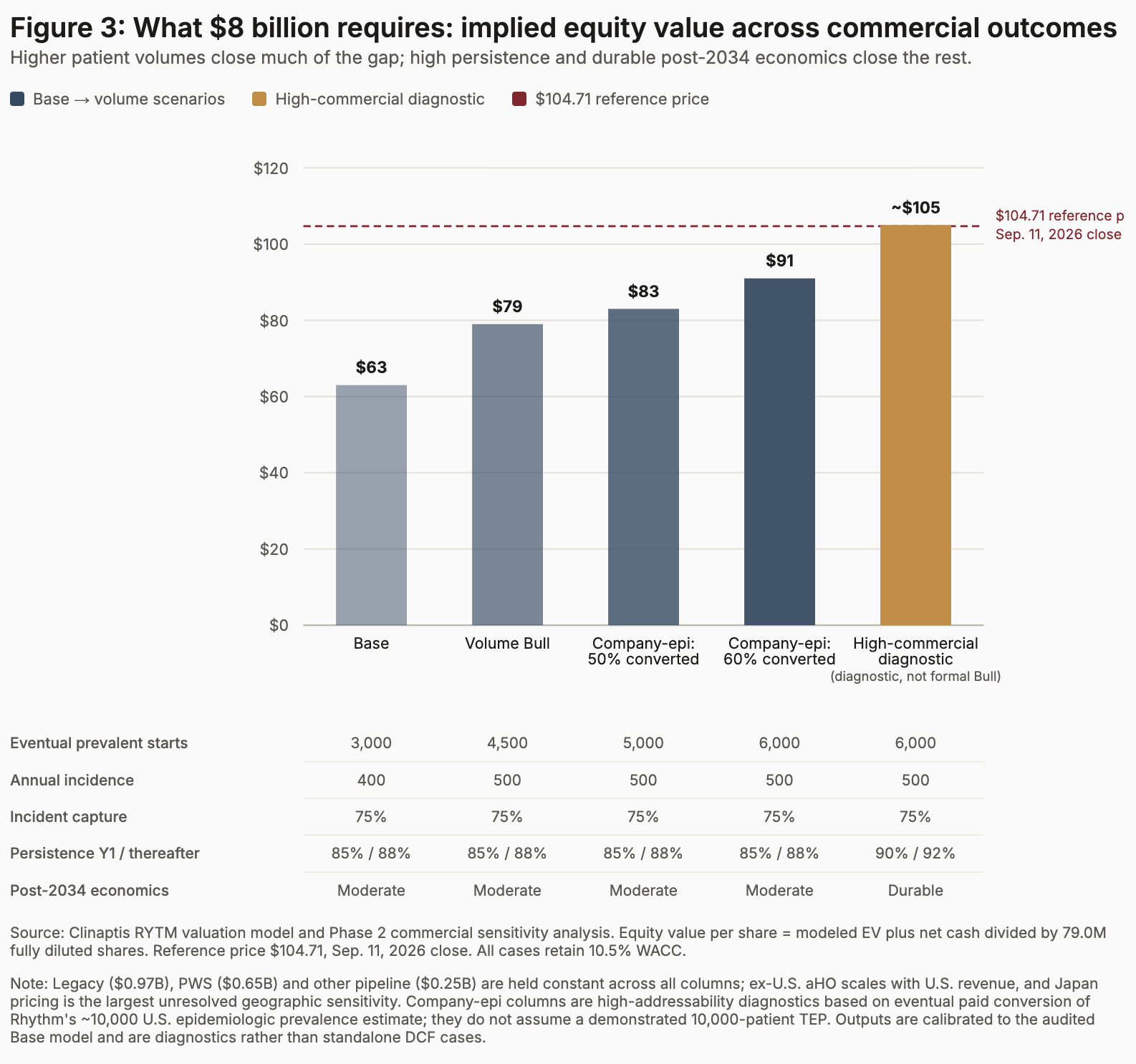
At Base economics, 3,000 eventual prevalent starts support ~$63/share. Even 6,000 (~60% of Rhythm’s ~10,000 U.S. epidemiologic estimate) plus ~500 annual incident cases reaches only ~$91. Getting to ~$105 also requires 90%+ persistence and durable post-2034 economics. The clinical case is largely made; the remaining debate is patient capture and duration.
1. Rhythm won the clinical argument. What does the price still require?
Rhythm had its worst and best weeks three days apart. On March 16, EMANATE missed in all four heterozygous-obesity substudies. On March 19, the FDA approved IMCIVREE for aHO in patients aged ≥4, with no BMI threshold on the label. The stock looked through the first headline as aHO is worth far more than the genetic expansion that failed.
TRANSCEND is as clean as rare-obesity data get. Setmelanotide reduced BMI by 16.5% at 52 weeks versus a 3.3% gain on placebo (−19.8pp placebo-adjusted; N=120, NEJM), and 80% of treated patients lost ≥5% of BMI. The label is broader than the trial population: no BMI floor and no hyperphagia requirement.
The initial launch signal is encouraging with >400 start forms in the first 14 weeks (66 of them trial conversions). Scripts split roughly evenly between patients ≤21 and ≥22, and no payer policy so far requires a GLP-1 trial first, even though ~50% of early patients had prior or current GLP-1 exposure. Rhythm’s BBS launch already showed it can navigate reimbursement (~70% conversion) and scale internationally.
The efficacy debate is largely settled, and early execution is strong. Neither establishes the steady-state conversion, persistence and pricing that ~$8.0B already assumes.
2. How many paid patient-years can acquired HO support?
Rhythm estimates ~10,000 prevalent U.S. aHO patients, derived from craniopharyngioma incidence, survival and post-treatment obesity rates; it has historically cited a 5,000–10,000 range. We do not dispute either number, but neither is a commercial denominator.
We model the patients who generate revenue. Our Base Treatment-Eligible Population (TEP) is 7,500, of whom 40% eventually initiate paid therapy: 3,000 prevalent starts (Bear 1,500, Bull 4,500). We assume 400 new aHO cases a year against Rhythm’s ~500 estimate, with 75% eventually initiating therapy, or ~300 mature incident starts a year. Persistence is 85% in year 1 and 88% a year thereafter. Three variables (prevalent paid starts, annual incident paid starts and persistence) set the patient-year denominator.
-
We use 40% penetration as an underwriting assumption; 14 weeks of launch data cannot support an estimate. It is 40% of our filtered TEP but only ~30% of Rhythm’s headline ~10,000 epidemiologic figure, and BBS and biallelic IMCIVREE, on broader unfiltered denominators, sit at just ~10–12% of their own epidemiologic prevalence after several years. §5 tests 4,500, 5,000 and 6,000 eventual prevalent starts explicitly.
-
Revenue is patient-years × realized net price. We spread prevalent starts over an eight-year backlog harvest, layer in a recurring incident cohort each year, and age both through persistence. Price is ~$345k per full-dose adult equivalent in 2026, less ~5% for pediatric dosing, titration and interruptions, stepping up ~2% Y/Y from 2027.
-
Early scripts are drawing on backlog. About half came from patients injured >10 years ago and only ~15% from within two years, so ~110 ex-trial start forms a month is not steady-state demand. Management’s 2Q26 commentary implies at least ~$5.7M of incremental U.S. aHO demand, or ~65 full-quarter adult patient-equivalents: a floor on treated patients, and a measure of how far start forms sit upstream of recognized revenue.
Identification is where the uncertainty lies. Rhythm’s last disclosed count of identified or suspected U.S. aHO patients was ~2,000 (1Q26); management said it had grown and stopped updating it. More than 400 start forms is ~20% of that pool in 14 weeks. Identified-pool size is the binding uncertainty; conversion within that pool has started strongly.
Concentration is real but time-limited. Rhythm’s 43 priority accounts manage brain-tumor patients around surgery, hold ~33% of identifiable aHO patients (company estimate) and supply ~25% of scripts at 65% activation. Management describes patients returning to local endocrinology about two years post-surgery, so those accounts hold the recently injured, not the >10-year backlog; only ~20% of prescribers have written for more than one patient.
The rest is still easier to find than in most rare diseases: no genetic test, and a coded index event plus lifelong pituitary replacement leaves a durable claims trail. Rhythm’s German claims study found 15.2 patients per million, equivalent to ~5,100 in the U.S., using an algorithm that required obesity, central diabetes insipidus and desmopressin use. Removing the desmopressin requirement increased the count 5.7-fold among patients aged 40 and over. The residual between ~5,000 and ~10,000 skews older and undocumented for DI, and reaching it takes a different commercial motion than priority accounts.
Backlog harvest produces >400 start forms in 14 weeks whether the eventual prevalent pool is 3,000 or 6,000. The first two quarters of launch data cannot separate the two.
3. What does the cohort model produce?
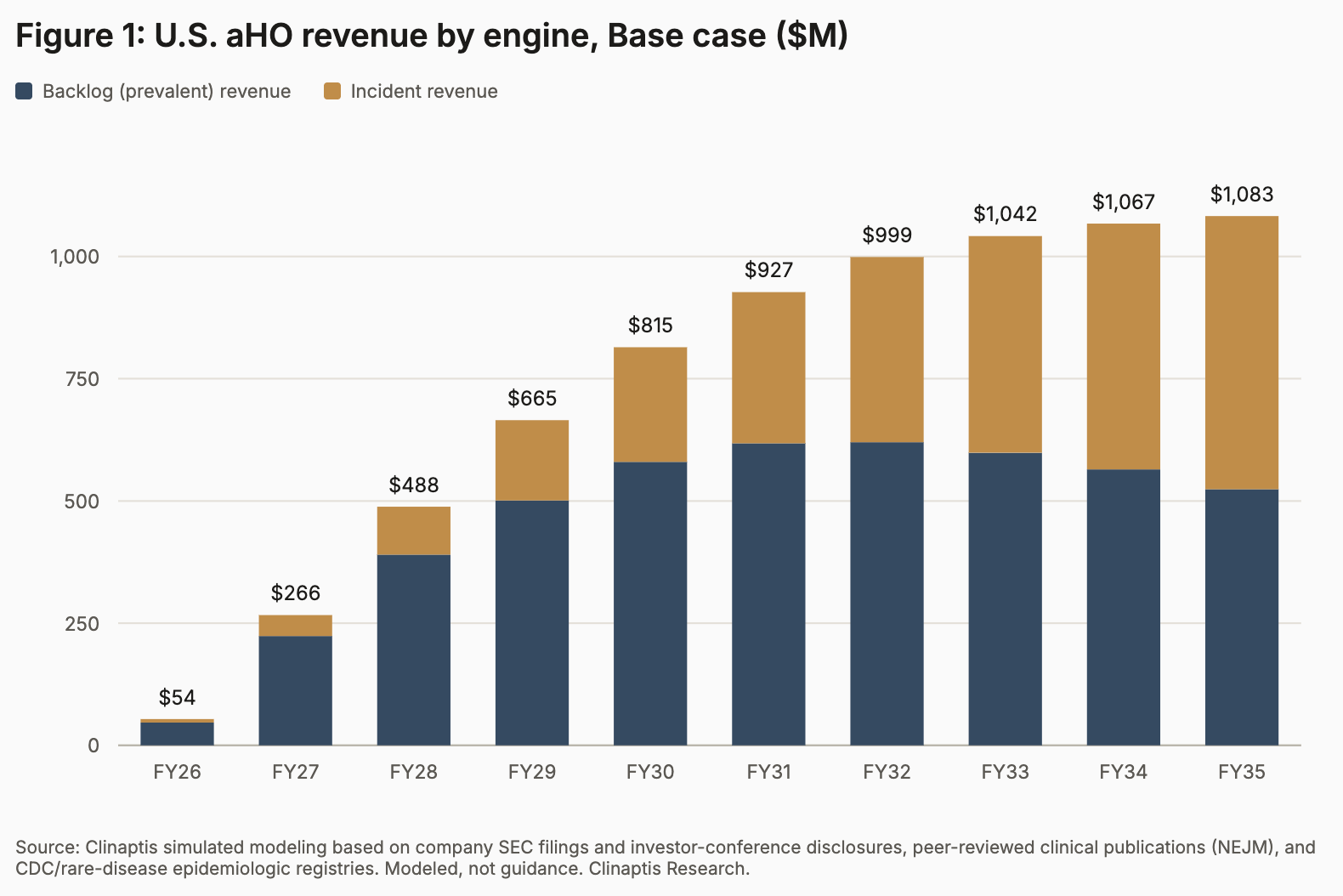
Base U.S. aHO revenue reaches $1.08B by FY35, on a stabilizing base of ~2,730–2,770 active patients (FY32–35). The mix shifts as it gets there: backlog revenue peaks near $620M in FY31–32 then declines, while incident revenue takes over, reaching ~$560M (52% of total) by FY35. Revenue also passes $266M in FY27 and $815M in FY30 along the way.
 Open full resolution ↗
Revenue does not fall away as the backlog matures; incident cohorts progressively replace it. The disagreement is over steady-state scale. At fixed patient volume, persistence is the main operating sensitivity: 82% a year throughout gives FY35 revenue of $832M, while 90%/92% gives $1.34B (§5 ranks this against patient volume across scenarios).
First-generation U.S. aHO is worth $2.00B (~$25/share): FY26–45 explicit cash flows at 10.5% with no terminal value, 55% mature EBIT margins, cash tax of 10% through 2030 on the NOL shield then 21%, a 3.5% LG Chem portfolio royalty from 2029, and generic erosion after July 2034. FY45 itself contributes ~$13M of present value (<1% of total), so where the explicit build stops makes little difference under our erosion assumptions.
4. How much duration does bivamelagon add?
SIGNAL made bivamelagon a credible oral successor. At 14 weeks, the 600 mg arm reduced BMI by 9.3% versus a 2.2% gain on placebo, with continued open-label loss through week 28 (−13.6%). The dataset is small, and Rhythm’s setmelanotide-parity comparison is post hoc and cross-trial. The FDA requires a 12-month, ~142-patient Ph3 that has not started; we assume U.S. approval in 2031.
In our Base, bivamelagon’s primary economic role is duration: preserving the patients and pricing that generic setmelanotide would otherwise take. Setmelanotide’s latest listed Orange Book US11129869B2 patent expires in July 2034; bivamelagon’s composition-of-matter patent runs to 2040, with potential extension to 2045. The question is how much of that post-2034 value an oral successor can actually preserve.
That value is smaller than the patent dates alone suggest. With no generic entry ever, U.S. aHO is worth $2.74B; under our Base erosion curve (75% of revenue retained in 2035, 27% in 2040) it is worth $2.00B. That $0.74B is the U.S. aHO preservation opportunity, not bivamelagon’s total potential value.
We assign a 65% probability that bivamelagon or RM-718 provides a viable successor and 50% economic migration, below clinical migration because payers can require generic setmelanotide first. Discounting for timing produces ~$0.1B of lifecycle credit. Reasonable assumptions produce ~$0.1–0.5B; near-certain full migration can exceed $1B globally.
A slower erosion curve raises first-generation setmelanotide value to ~$2.2B but reduces lifecycle credit to ~$0.04B. The curve reallocates value between setmelanotide and its successor more than it changes total franchise value. We carry any oral-driven initiation or persistence upside in the higher-commercial scenarios (§5, §6).
5. What patient volume does $8 billion require?
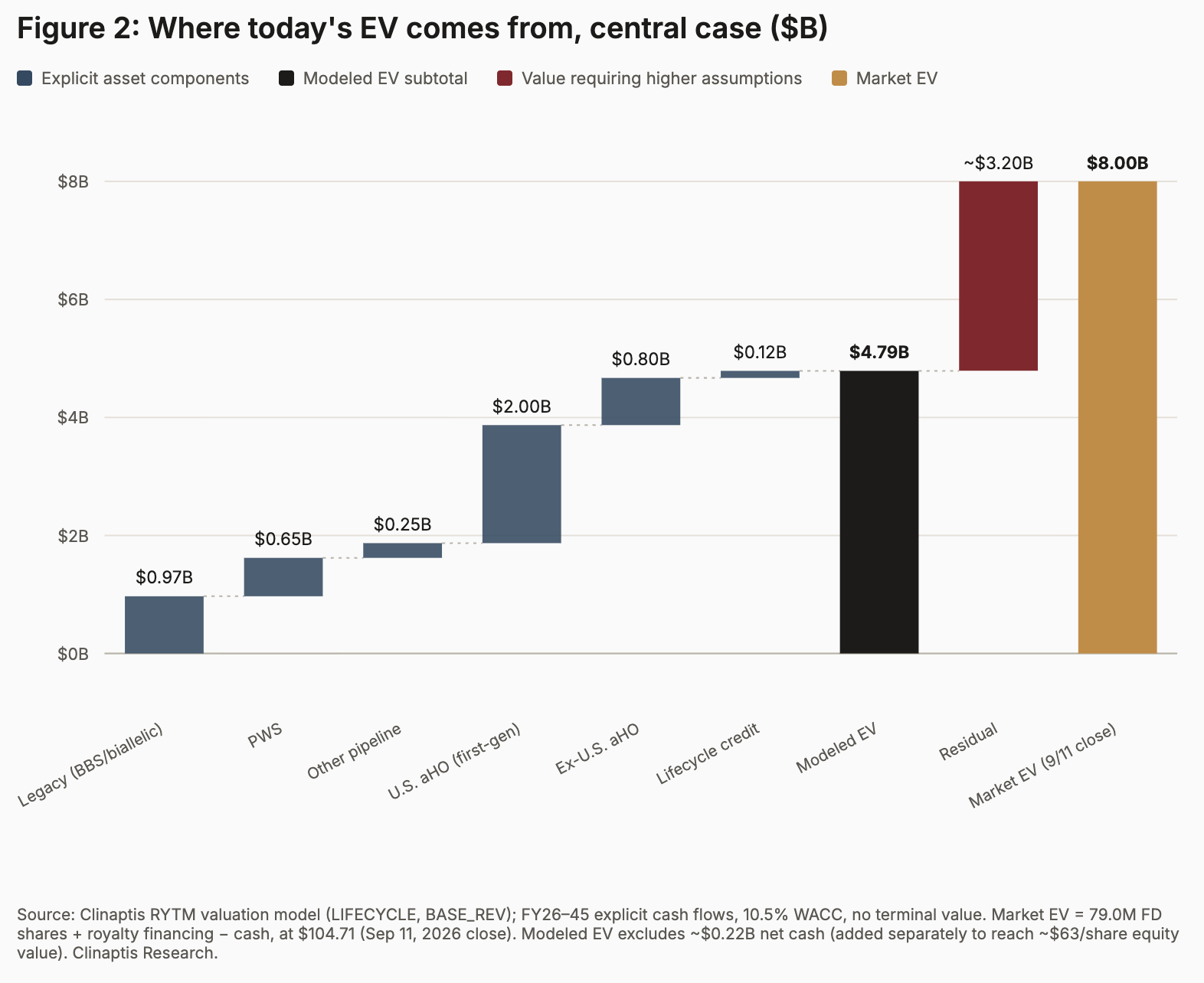
The $8B backsolve includes explicit value for legacy BBS/biallelic, PWS, other pipeline and lifecycle, not just aHO.
 Open full resolution ↗
Our central modeled EV is $4.79B, including a $0.12B risk-adjusted lifecycle credit. Adding ~$0.22B of net cash after the royalty obligation produces ~$63/share on 79.0M diluted shares, versus $104.71. The ~$3.20B gap matters only if reasonable commercial assumptions cannot close it. We therefore hold economics fixed (10.5% WACC, $345k net price stepping ~2%/yr, 55% mature margin, Base erosion) and move only patient volume: the eventual prevalent pool (TEP × penetration) and incidence.
 Open full resolution ↗
Six thousand eventual prevalent starts—~60% of Rhythm’s headline ~10,000 U.S. epidemiologic population—plus ~500 annual incident cases yields only ~$91 under Base economics. The market-implied boundary reaches ~$105 after adding 90%/92% persistence and more durable post-2034 economics; our formal Bull remains lower.
Persistence matters, but less than the patient denominator: at Base volume, moving from 82%/82% to 90%/92% shifts fair value from ~$57 to ~$71, versus ~$63 at Base. Generic erosion matters less still, since stronger setmelanotide durability reduces the value available for bivamelagon to preserve (§4).
Outside aHO and lifecycle, Base includes $0.97B for the legacy franchise, $0.65B for setmelanotide in PWS and $0.25B for other pipeline. PWS is the least mature meaningful component and the principal non-aHO SOTP sensitivity; even a several-hundred-million-dollar re-rate would not close the ~$3.20B Base-to-market gap.
Ex-U.S. aHO is the one component we model top-down, at 40% of lagged U.S. revenue. Ex-U.S. prevalence is roughly 1.5–1.8x the U.S., so 40% implies realizing ~22–27% of U.S. revenue per patient, and 30%/50% moves Base by ~$2.50/share and the 6,000-start case by ~$4.50. The ratio also ties ex-U.S. to U.S. volume, which flatters the higher rows if U.S. upside comes from pricing rather than patient capture.
6. What does it take to reach $105?
The long case is coherent: aHO patients are unusually identifiable for a rare disease; severe disease and limited alternatives support capture, persistence and payer tolerance; and an oral successor can preserve economics beyond 2034. In our model, that case reaches ~$105 with ~6,000 eventual prevalent starts, ~500 annual incident cases, 90%/92% persistence and durable post-2034 economics. The assumptions reinforce one another, but together they sit at the upper end of our commercial range; our formal Bull reaches ~$79.
7. What can 3Q and 4Q26 start to settle?
A backlog launch should look strong early; the test is the trajectory of paid patient-years. Our Base implies ~1,075 cumulative prevalent paid starts by YE27 and ~1,680 active U.S. patients by YE28. Track start forms, paid starts, active patients and recognized revenue separately.
Three disclosures matter most: paid-patient conversion from start forms, early discontinuation and the trajectory of new paid starts. Repeat prescribing, realized net revenue and GLP-1 step edits will show the quality of those patient-years. Injury-date mix will show whether the obvious backlog is thinning; European and Japanese pricing and bivamelagon Phase 3 initiation bear on duration.
We read RYTM as a small, evidence-dependent short. Base implies ~$63 versus the September 11 close of $104.71, which requires the §6 high-commercial case. A strong near-term launch is consistent with backlog harvest, so we would add only once paid-patient conversion or persistence is clearly tracking below the Base path.
Notes: (a) LG Chem’s royalty on U.S. setmelanotide is modeled at a fixed 3.5% from 2029 (§3); the trigger terms for the period before bivamelagon approval are not fully resolved, and a 0–5% royalty range moves first-generation U.S. aHO value by roughly ±$0.05B. (b) Bivamelagon’s Ph3 cost (~$145M) and milestone timing are provisional, pending trial initiation (§4). Neither is material to the Base valuation or the scenario conclusions in §5–6.
Sources:
-
Rhythm Pharmaceuticals, TRANSCEND Phase 3 topline results (NEJM; N=120, −19.8pp placebo-adjusted BMI reduction)
-
Rhythm Pharmaceuticals, EMANATE Phase 3 topline results (heterozygous-obesity substudies)
-
FDA approval of IMCIVREE (setmelanotide) for acquired hypothalamic obesity, March 2026 label expansion
-
Rhythm Pharmaceuticals, SIGNAL Phase 2 bivamelagon data (Week 14 and Week 28 open-label extension results)
-
Rhythm Pharmaceuticals 1Q26 and 2Q26 earnings calls and shareholder letters (launch metrics, identified-patient pool, priority-account concentration, prescriber mix, incremental U.S. aHO demand commentary)
-
Witte et al., Journal of Neuroendocrinology 2024 (DOI 10.1111/jne.13439), Rhythm-funded German statutory-claims analysis of acquired hypothalamic obesity prevalence
-
Rhythm Pharmaceuticals BBS/biallelic IMCIVREE launch history (reimbursement conversion, international scale-up)
-
LG Chem–Rhythm royalty agreement terms (SEC filings)
-
FDA Orange Book: setmelanotide and bivamelagon patent listings
-
Clinaptis RYTM Valuation Model V1 (HO_REV, LIFECYCLE, BASE_REV tabs): internal
-
Market data: RYTM closing price, September 11, 2026