
Persistence is the incretin class’s weak point. In a US real-world cohort, 64.8% of patients without type 2 diabetes and 46.5% with it stopped their GLP-1 receptor agonist within a year. Stopping is costly: patients withdrawn to placebo in SURMOUNT-4 regained more than half their tirzepatide weight loss within a year, and a 2025 meta-analysis describes metabolic rebound after discontinuation. Viking wants VK2735, its dual GLP-1/GIP agonist now in Phase 3, to be part of the answer, and less-frequent maintenance dosing is its pitch.
In the VK2735-102 maintenance study, twelve weeks of less-frequent dosing kept most of the weight off. After a full induction, cohorts switched to every-other-week or monthly dosing held 82–97% of their earlier loss on average, while those switched to placebo kept 61%. The result is real and raises the odds a less-frequent schedule can eventually carry a label—promising utility for an asset that will otherwise compete directly with entrenched market leader tirzepatide on weekly efficacy and tolerability.
It does not, however, justify the roughly $1.25 billion the stock added in a single session. The trial measured short-term retention of prior weight loss, not multi-year persistence or extra paid months. The schedule held.
The tape paid for duration the data have not yet earned.
What the maintenance study actually measured
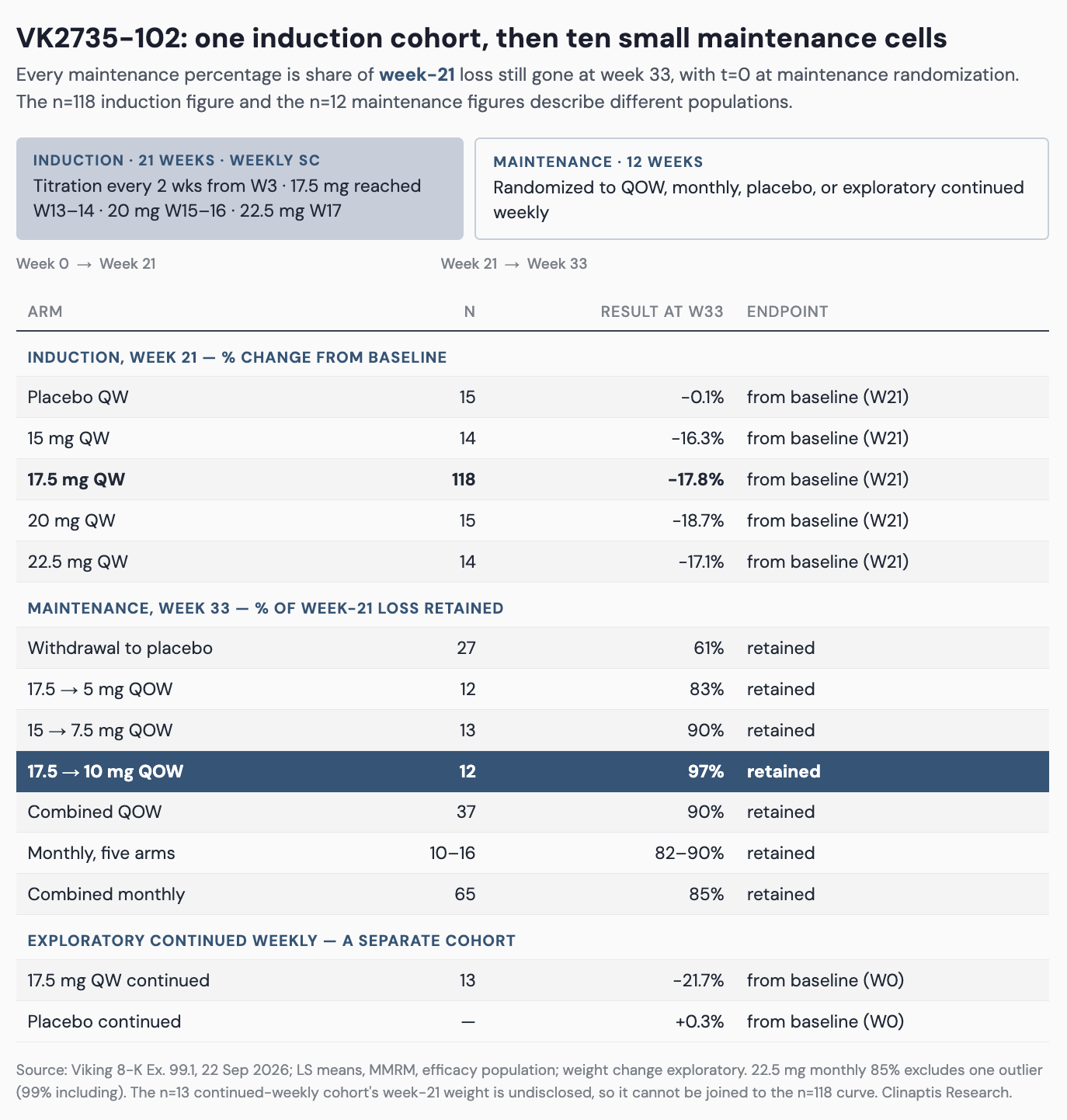
Viking ran 21 weeks of weekly VK2735, then randomized completers to 12 weeks at lower intensity. The maintenance readout is one quantity: the share of week-21 weight loss still gone at week 33, with the clock starting at maintenance randomization.
Every-other-week arms retained 83–97% of induction loss (n=12–13 per cell); combined QOW 90% (n=37). Monthly arms retained 82–90% across five dose cells (n=10–16); Viking reports the pooled figure as 85% (n=65). Withdrawal to placebo retained 61% (n=27) (Exhibit 1). Separation from placebo appeared by week four. Treatment-emergent adverse events during maintenance ran below placebo (QOW 38%, monthly 49%, placebo 52%) and GI event rates were not meaningfully different, in a population that had already survived induction.
“97% retained” is the share of prior weight loss still absent. It is not the share of patients still on drug, and not a percentage from the original baseline. Only the first is what this trial measured.
Two design facts limit how hard the result can be pushed. Weight change was an exploratory endpoint; the stated objectives were safety, tolerability and PK. And single patients rewrite the cells: one subject moved the 22.5 mg monthly cell from 85% to 99%. We are not inventing an interval around n=10.
 Open full resolution ↗
Why week-33 percent-from-baseline is the wrong scoreboard
Two tempting misreads. First, the blend: take the best arm (97%, n=12), pair it with the 22% continued-weekly figure, drop the titration schedule and the 61% placebo hold, and read “retained loss” as “patients stay on drug for years.” Second, the induction dose response: the 17.5 mg cohort’s 17.8% loss against 16.3% at 15 mg is mostly baseline weight (95.9 kg vs 108.4 kg; both lost 17.0 kg), not dose.
The 22% is placebo-adjusted: the exploratory continued-weekly cohort lost 21.7% from baseline (n=13) against a 0.3% placebo gain. It is a separate cohort of 13 selected completers, not the n=118 that produced the induction curve, and Viking has not disclosed its week-21 weight. Its 21.7% cannot be converted into retention or joined to the induction curve.
Calendar week is also not exposure. Viking escalated every two weeks and reached 17.5 mg at weeks 13–14; tirzepatide escalates every four weeks and reaches 15 mg around week 20. At week 33 the Viking cohort has had roughly 19–20 weeks at target dose, SURMOUNT-1 about 12–13.
The benchmark you pick decides the answer. Digitizing tirzepatide at Viking’s week 33 (unlabeled in either source) gives ~17.5% from the SURMOUNT-1 curve and ~20.0% from the SURMOUNT-4 lead-in: an apparent VK2735 advantage of 4.2 or 1.7 points from the same molecule on the same clock. That spread is wider than most of the differentiation being argued about this week, so neither goes in a table.
The strongest claim the induction data support: VK2735 is a potent weekly dual agonist under fast titration, still losing weight at week 21.
What the class comparison can and cannot settle
At Viking’s 12-week duration, VK2735 and reduced-dose tirzepatide look similar, within the limits of different trials, populations and windows (Exhibit 2). Lilly’s 5 mg weekly arm held 81.7% of its 60-week loss at week 84 and 70.5% at week 112 (reported; efficacy estimand, plateau subgroup, n=118). Week 72, matching Viking’s clock, has no labeled estimate. If retention falls monotonically and the arm’s front-loaded decay (0.76 pp per week to week 84, 0.40 after, derived) also holds inside the first window, week 72 sits at roughly 82–91%, an inferred range rather than a published estimate or a statistical bound. Viking’s combined QOW is 90%, combined monthly 85%. The same inference puts Lilly’s withdrawal arm at ~53–76% at 12 weeks against Viking’s 61%.
| Active | Withdrawal | Gap | |
|---|---|---|---|
| VK2735 QOW, 12 wks | 90% | 61% | +29.0 pp |
| VK2735 monthly, 12 wks | 85% | 61% | +24.0 pp |
| Tirzepatide 5 mg, 24 wks | 81.7% | 52.6% | +29.1 pp |
| Tirzepatide 5 mg, 52 wks | 70.5% | 44.3%† | +26.2 pp |
Lilly rows: reported, efficacy estimand, plateau subgroup (n=118 / 76); gaps derived. †With worst-observation-carried-forward; 6.0% without it, after 68% of that arm took rescue tirzepatide. Different trials and windows: read the gaps as directional, not as a decimal match.
Staying on reduced-intensity drug rather than stopping is worth roughly 24–29 points of retained loss in both programs, and Lilly still holds about +26 at a year, with 42.4% of its 5 mg arm maintaining at least 80% of the loss at week 112. Viking reports means only, with no responder rate, which matters more at n=12 than at n=118. Its 61% placebo hold looks mild partly because it is twelve weeks; SURMOUNT-4’s full-withdrawal arm kept 47.4% after 52 (n=335, derived).
The enthusiasm treats a dosing-flexibility study as unique pharmacology. Once induction is done, lower frequency and lower cumulative dose should help any agent in the class on weight stability and tolerability. Lilly has already de-risked dose reduction, and semaglutide every-other-week already exists in selected practice and in PK models. VK2735’s incremental claim is narrower: a 7–10 day half-life makes monthly dosing more natural than for a 5-day molecule; Viking ran the prospective, placebo-controlled version of the experiment first; it can write the schedule into Phase 3 extensions and later pair it with an oral, which Part 2 of this study will explore; and Lilly has little commercial reason to advertise taking Zepbound half as often. That last point is strategy, not science. Lilly reduced milligrams per week and stayed weekly; Viking reduced injections per month, and for a payer building a SKU those are different products.
Verdict. Every-other-week: suggestive as a 12-week labeled schedule, insufficient as evidence of a durable commercial edge. It sits inside the range Lilly’s reduced-dose weekly arm plausibly occupies at matched duration, and Lilly has held a similar gap four times longer. Monthly: suggestive at 12 weeks, not enough for durability or value. No superiority claim on weight-loss magnitude.
What we can update without a 52-week RCT
The hypothesis allowed to touch valuation is narrow: labeled every-other-week or monthly VK2735 holds ≥80% of induction loss for twelve months or more in a Phase 3-like population, without a material net-price concession. We carried it at 15–25% into Tuesday; the July SC rNPV already assumed chronic weekly therapy rather than a frequency moat.
The likelihood ratio on this print is favorable but modest, 2–4×: a schedule that fades at month six should also look good at week 12, since placebo alone kept 61%. At a 20% prior and a ratio of 3, P(H1) lands near 43%. The corners of those inputs span roughly 26–57%; 30–45% is our judgmental posterior, weighted to the middle of both ranges, not a calculated interval. P(the schedule works for a quarter) went up materially. P(it works for a year, at label, without another trial or a price give-up) went up modestly, and P(a monthly label without a further maintenance study) stays low. Only the last two feed the model.
How much SC rNPV that update can move
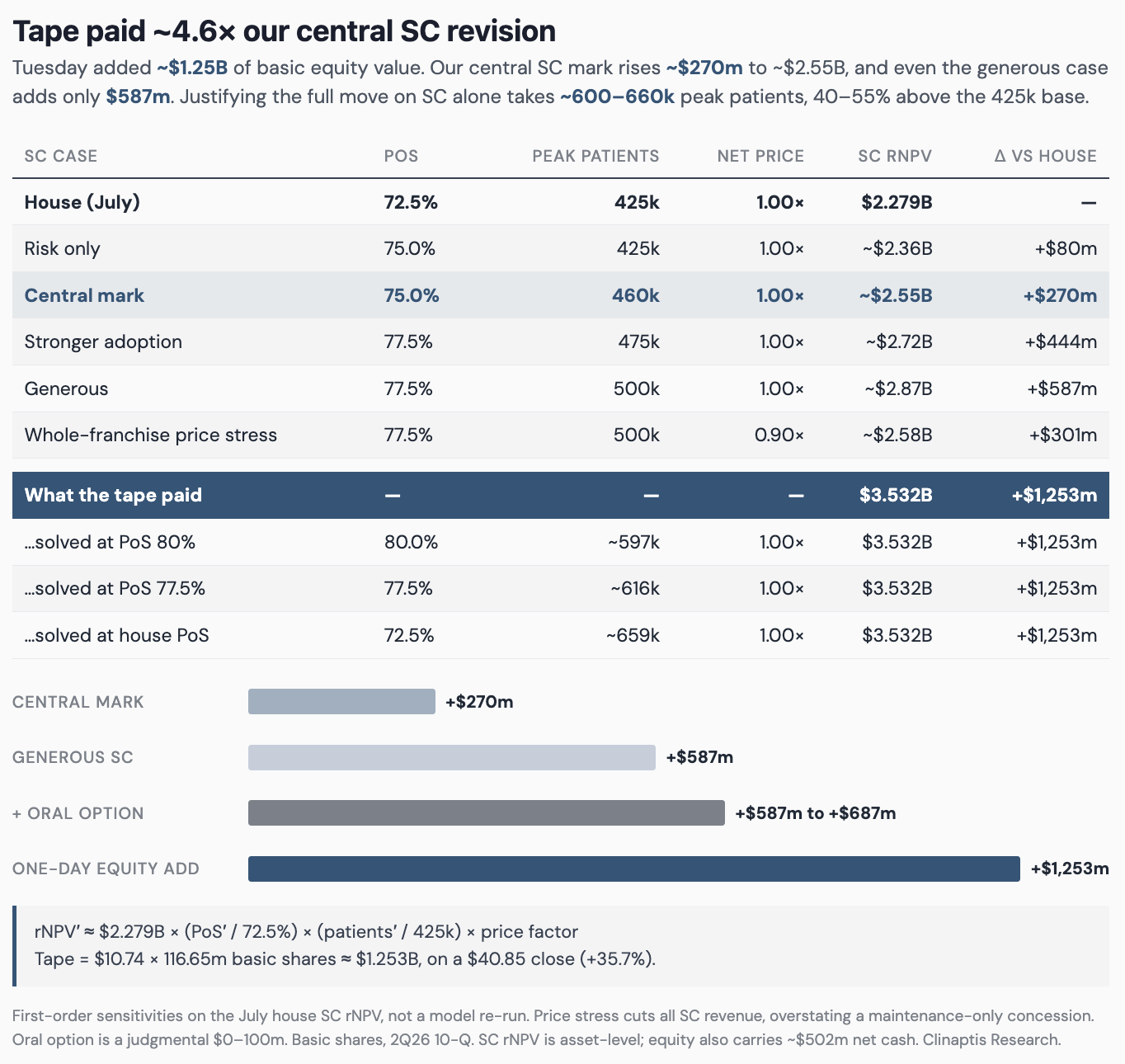
The house SC rNPV is $2.279B: the July model’s base scenario at 72.5% PoS, 425k peak treated patients and a 45% peak EBIT margin.
New SC rNPV ≈ $2.279B × (new PoS / 72.5%) × (new peak patients / 425k) × price factor
These are illustrative first-order sensitivities on the published $2.279B house SC rNPV. They are not a full model re-run. Peak patients are a stock, so extra paid months raise it at a stable start rate rather than sitting beside it.
 Open full resolution ↗
We move the illustrative SC mark to ~$2.55B, up ~$270m, inside a ~$2.36–2.72B sensitivity range (+$80–450m). A 30–45% posterior supports a risk revision and some adoption, which is what 75% PoS and 460k peak patients encode: between the 425k base and the 475k adoption case. It does not support the 500k July bull case, which came from the same late-entrant analog work as the base rather than a TAM build.
For any of it to hold: eligible completers × share electing a less-frequent schedule × extra paid months × net revenue per month. The model already carries a persistence multiplier on the patient stock; we do not turn that dial on top of a higher patient case.
The stress row applies a 10% net-price cut to all SC revenue, although exposure-based pricing would hit only the less-frequent SKUs, so it overstates the damage for any realistic maintenance mix. Even so it removes half the generous case, on top of the gross-to-net widening (20% at launch to 32% at peak) and 33% cumulative erosion from generic semaglutide in 2032 that the model already carries.
Against that, the tape. At a $40.85 close, +$10.74 on 116,652,937 basic shares (2Q26 10-Q) adds ~$1.253B, basic only and deliberately so. That is ~4.6× our central uplift and 2.1× the generous case ($587m) (Exhibit 3). Justifying it on the SC asset alone would require roughly 600–660k peak patients (80% to 72.5% PoS), 40–55% above the 425k base. A $0–100m judgmental option on oral maintenance does not close the gap and cannot be added where oral replaces injections. Some of the move may reflect spillover to oral VK2735, but unchanged cash does not reduce the day-over-day enterprise-value increase.
What to do with the stock
We would trim event-driven exposure into strength in the high $30s and above $40; retain the core for Phase 3 subcutaneous data and the 4Q26 oral protocol. Do not initiate or add on this readout, especially with EASD around the corner (September 28–October 2). If this re-rating is not sustained over the next few days, buying dips toward $30 still does not resolve the year-end catalyst skew.
Short interest was 22.2M shares (~20% of float) at the August 31 settlement, inside a stable 21–23M range and slightly above the ~18% median of the core $1–5B XBI cohort, so it was likely not building into the print. The first settlement covering Tuesday publishes in early October; until then the data cannot show how much of the move was covering.
If the bull case is that patients prefer fewer shots, prescribers can stretch intervals off-label today. If it is a formal every-other-week or monthly label plus an oral switch, it is more defensible and still years of execution away. This print widens Viking’s option set; it is not obvious to us that tirzepatide would fail the same schedule, and a large part of the move is the market paying for a narrative Lilly has chosen not to own: fewer injections rather than an oral switch.
The 12-week result improves the odds of a less-frequent VK2735 schedule: we put durable twelve-month differentiation at 30–45%, against 15–25% in July, and our illustrative SC mark rises roughly $270m to ~$2.55B. Tuesday added ~$1.25B in basic equity value. That gap requires evidence of durable retention, patient uptake and preserved net price that this trial did not measure. What would close it: 24- and 52-week retention on the same estimand against a pre-specified ≥80% threshold, an active-comparator maintenance study, and paid-month data on the less-frequent SKUs without a net-price concession.
The oral Phase 3 starts in early 4Q26, and we expect its doses toward the lower end of our July 45–75 mg range or below; the dose set, not this print, is the test from our August note, and neither it nor SC durability is settled here.
Sources
- Viking, 8-K Exhibit 99.1, September 22, 2026: all VK2735-102 efficacy, safety and design figures.
- SURMOUNT-MAINTAIN: Horn et al., Lancet, May 12, 2026 (results); Obesity 2025;33:1873–85 (design). Figures use the efficacy estimand, plateau subgroup (100% → 81.7% → 70.5%). The 82–91% week-72 figure is our inferred range, not a published estimate.
- SURMOUNT-4: Aronne et al., JAMA 2024;331(1):38–48. The 47.4% retention figure is derived (9.9/20.9).
- SURMOUNT-1: Jastreboff et al., NEJM 2022. Readings between reported weeks are digitized.
- Real-world discontinuation: Rodriguez et al., JAMA Network Open 2025;8(1):e2457349.
- Discontinuation rebound: systematic review and meta-analysis, eClinicalMedicine 2025 (PMC12702299).
- VENTURE: Bays et al., Obesity 2026. Dosing and tolerability context.
- Clinaptis SC rNPV model, July 2026: base $2.279B at 72.5% PoS, 425k peak patients and 45% peak EBIT margin. The §V figures, including the ~$2.55B central mark, are first-order sensitivities on this base, not a re-run of the model.
- Market data: 116,652,937 basic shares (2Q26 10-Q); short interest from FINRA bi-monthly settlement files via Fintel; September 22 close from vendor data.