
Amylin is the main mechanism still being tested as a second drug on top of an incretin. This is the first large type 2 diabetes trial to put eloralintide alone, tirzepatide alone and five combinations in one randomised study, so we can see inside a single trial how much of eloralintide’s effect survives on top of tirzepatide. Our prior comes from 11 obesity-to-T2D pairs across seven drug programs, plus the CagriSema component data: the combination adds substantially, but not fully. Stronger parts, not synergy. The Phase 1b oral at 10:30 CEST is the warm-up; the T2D data land in the amylin symposium at 16:30–17:30 CEST, or 20:00–21:00 IST.
 Open full resolution ↗
1. Why this trial matters
- This is the first 48-week T2D dose-response study for an amylin plus tirzepatide combination. The ten-arm trial has an enrolment goal of 367 and a primary endpoint of percentage weight change at Week 48.
- It carries eloralintide monotherapy at three doses, top-dose tirzepatide monotherapy and five combinations. The trial measures both eloralintide’s T2D monotherapy effect and its retention on top of tirzepatide 15 mg internally. Attenuation versus obesity still needs the obesity trial, so that step remains cross-trial.
- It reads out in the same symposium as Novo Nordisk’s REIMAGINE 1–3, so the CagriSema T2D data print alongside.
- Unknown going in are the milligram doses represented by D1–D3, the titration scheme and the baseline HbA1c mix. Our forecast assumes eloralintide 3, 6 and 9 mg and tirzepatide 5, 10 and 15 mg.
2. What the priors say
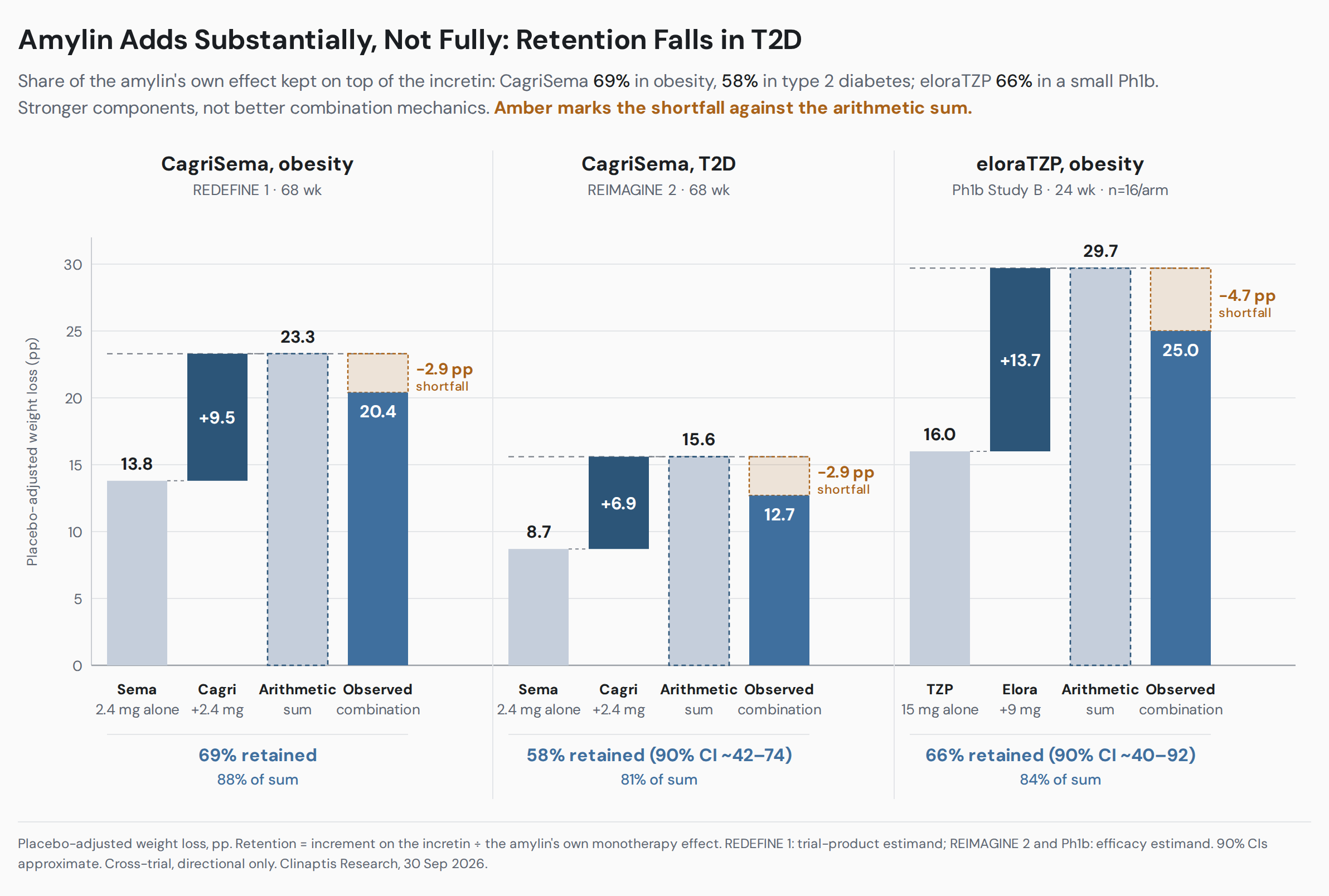
Retention is the share of the amylin’s own placebo-adjusted effect that survives on top of the incretin. We use the same definition in every row.
- CagriSema, obesity (REDEFINE 1, 68 weeks): 69%.
- CagriSema, T2D (REIMAGINE 2, 68 weeks): 58% (90% CI approximately 42–74).
- eloraTZP, obesity Phase 1b (24 weeks, n=16 per arm): 66% (approximately 40–92).
- eloraTZP, T2D: open until today.
 Open full resolution ↗
Four more facts:
- Across seven drug programs, T2D keeps approximately 0.64 of the obesity effect. That is 11 matched obesity-to-T2D pairs over 56–80 weeks: liraglutide 0.74, cagrilintide 0.73, orforglipron 0.48–0.72, retatrutide 0.64, CagriSema 0.62, semaglutide 0.53–0.63 and tirzepatide 0.53–0.62. Tested on each program left out in turn, a simple ratio misses by approximately 0.8 percentage points on average; a fixed percentage-point haircut misses by approximately 3.1 points. Cagrilintide’s 0.73 sits at the top of the range, within noise. We use 0.66.
- The cagrilintide pair is population-matched to our use case. Female share falls from 69% to 36% and age rises from 47 to 57 between REDEFINE 1 and REIMAGINE 2. Eloralintide’s obesity trial was 78% female with a mean age of 49, so it should shift about the same in T2D. Both cagrilintide trials reached 2.4 mg at Week 16.
- The CagriSema Phase 2 “118% synergy” was a weak semaglutide arm. It stalled at 5.1% on maintenance, had no placebo and used absolute changes. It is not our metric and not evidence of synergy.
- Treat the Phase 1b 66% with care. It ran 24 weeks, before plateau, and only 12 of 16 combination participants had an end-of-treatment value under an estimand that models dropouts forward.
Our read: eloraTZP’s edge over CagriSema is stronger components, not better combination mechanics. Eloralintide delivers 13.7 percentage points as monotherapy against 9.5 points for cagrilintide. The three retention figures are not distinguishable. We expect approximately 0.55 on top-dose tirzepatide in T2D. A deviation is the news. The level is not.
Where we started and where we landed: we went in suspecting something amylin-specific. Cagrilintide’s 0.73 looked like amylin holding up better in T2D than incretins do. The seven-program bridge talked us out of it: 0.73 sits at the top of an ordinary range, not outside it. Part of why amylin looks special is that it is the only add-on getting serious two-drug testing. GLP-1/GIP in tirzepatide, and later glucagon in retatrutide, were folded into single molecules, so the incretin side never needed a second drug. Amylin plus incretin is where the two-drug combination question actually lives. That makes it well studied, not unique.
What the Phase 1b actually shows
- Lilly calls the combination “additive”. Its own 2×2 factorial says sub-additive. Study B at 24 weeks, with 16 participants per arm, showed 16.0 percentage points for tirzepatide 15 mg alone, 13.7 for eloralintide 9 mg alone and 25.0 for the combination. That is 84% of the sum, an interaction of about −4.7 points (z approximately −2.4 in our reconstruction from the reported 90% CIs) and approximately 91% of Bliss independence. “Additive” holds only in the loose sense that the increment is above zero.
- Selectivity does not change the combination mechanics. Eloralintide is AMY1R-preferring and cagrilintide is CTR-heavy, yet they keep 66% and 69% on top of their incretins.
- Do not anchor on the −29% headline. It is the 32-week, 3 mg-start arm: three of 12 participants with an end-of-treatment value, the heaviest baseline at 102 kg, against a tirzepatide 15 mg comparator with five of eight. The 1.5 mg-start arm, at +5.8 points with a 90% CI of 2.7–8.9, is also weak and shows no sign of better-than-CagriSema combining.
- The 16-week dose-response is confounded. The gain over tirzepatide 5 mg rises with eloralintide dose (+7.0 to +8.2 to +10.5 points) while the share of participants with an end-of-treatment value falls from 83% to 67% to 50%. The 3 mg add-on is the only clean arm.
- Lilly’s own pitch is speed with low doses, not the 29%. The abstract says low-dose combinations may match high-dose tirzepatide with fewer escalation steps. Eloralintide 3 mg plus tirzepatide 5 mg lost 17.0% at 16 weeks, after one tirzepatide step, against 17.8% for tirzepatide 15 mg alone at 32 weeks after five steps. That is the Phase 1b version of our arm 4 approximately equals arm 8 call.
- Sixteen of 96 Study A participants are not shown. The footnote omits a second placebo plus tirzepatide 5 mg and eloralintide 6 mg plus tirzepatide 5 mg pair. The oral presentation should clarify this.
3. Forecasting the 48-week combination readout
We forecast Week 48 placebo-adjusted weight loss under the efficacy estimand. The arithmetic has four steps. Eloralintide’s obesity numbers come from people without diabetes, with baseline HbA1c of 5.5%.
- Start from eloralintide’s obesity result, placebo-normalised. The 3, 6 and 9 mg doses produced 12.0, 17.2 and 18.2 percentage points. The 9 mg figure pools the three arms that ended on 9 mg; there was no clear time-on-dose effect between fixed and titrated arms, while the fixed-dose anchor would add approximately 0.5 points to arm 7. That trial’s placebo group lost only 0.4%, against approximately 2% in comparable obesity trials: −2.3% in REDEFINE 1 and −1.7% in petrelintide ZUPREME-1. As a cross-trial standardisation—a judgment, not a proven bias—we take 1.6 points off each: 10.4, 15.6 and 16.6.
- Adjust for T2D by multiplying by 0.66, from the 11-pair, seven-program bridge above. The high case is 0.73, based on cagrilintide alone; the low case is 0.60.
- Add the tirzepatide backbone at Week 48: 7.3, 9.4 and 11.5 points for 5, 10 and 15 mg. These are borrowed from SURPASS-2 and SURMOUNT-2. Arm 8 replaces the borrowed estimate on the day.
- Add the amylin increment at 0.65, 0.60 and 0.55 retention on tirzepatide 5, 10 and 15 mg. A stronger backbone leaves less room: CagriSema kept 58% on a semaglutide backbone worth 8.7 points, while tirzepatide 15 mg is worth approximately 11.5.
 Open full resolution ↗
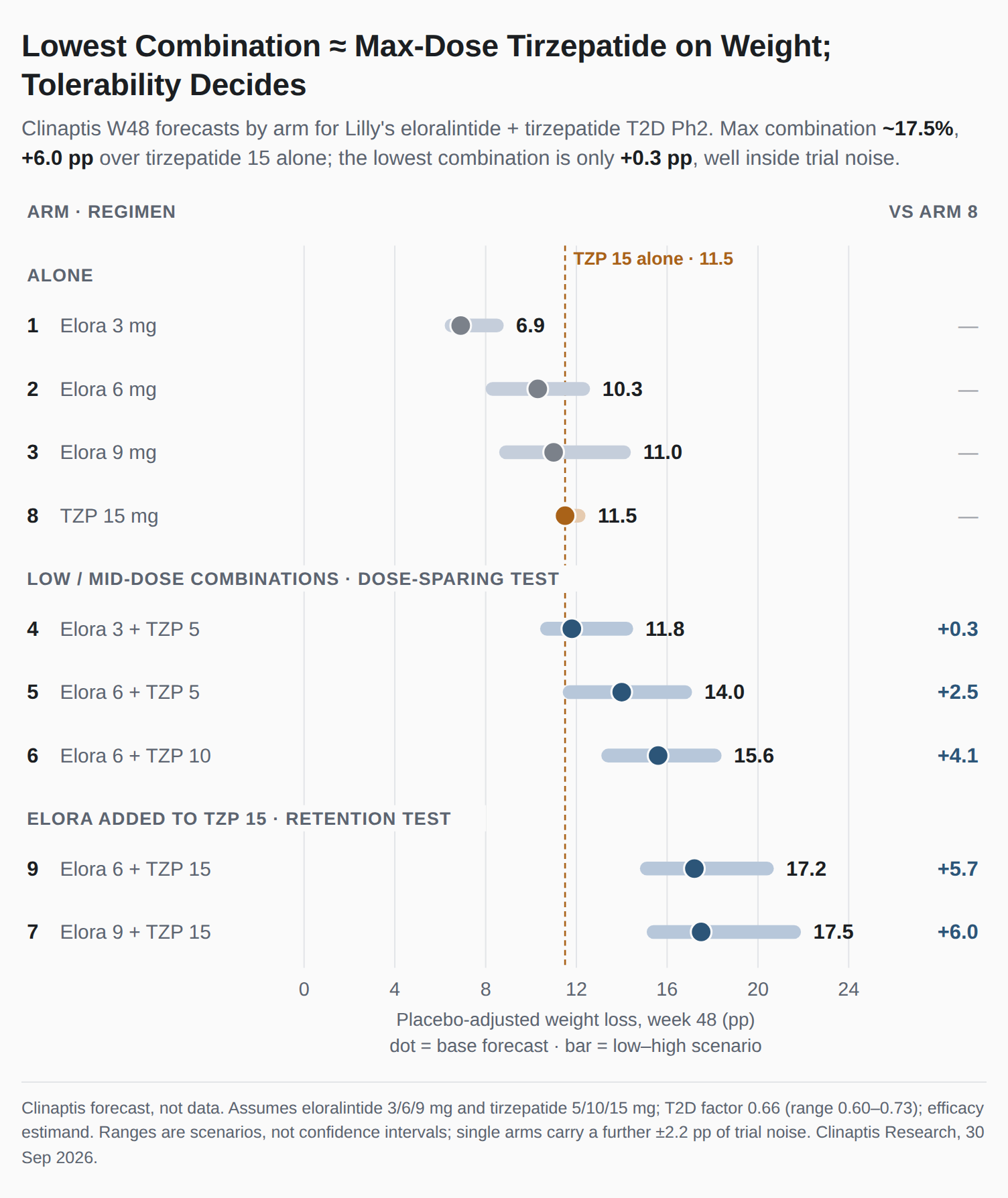
- Ranges are scenarios, not probability intervals. Low means an incretin-like 0.60 factor, lower retention and a lower backbone. High means cagrilintide’s 0.73 factor, no placebo normalisation, fixed-dose 9 mg, retention up to 0.70 and a higher backbone.
- Cross-check: arm 7 keeps 0.36 of eloralintide’s obesity effect. CagriSema kept 0.42 on cagrilintide’s higher 0.73 factor.
- Noise sits on top: approximately ±2.2 points at 90% for a single arm and ±3.1 points between arms, with approximately 37 participants per arm.
- The dose mapping is our assumption.
4. Five called shots
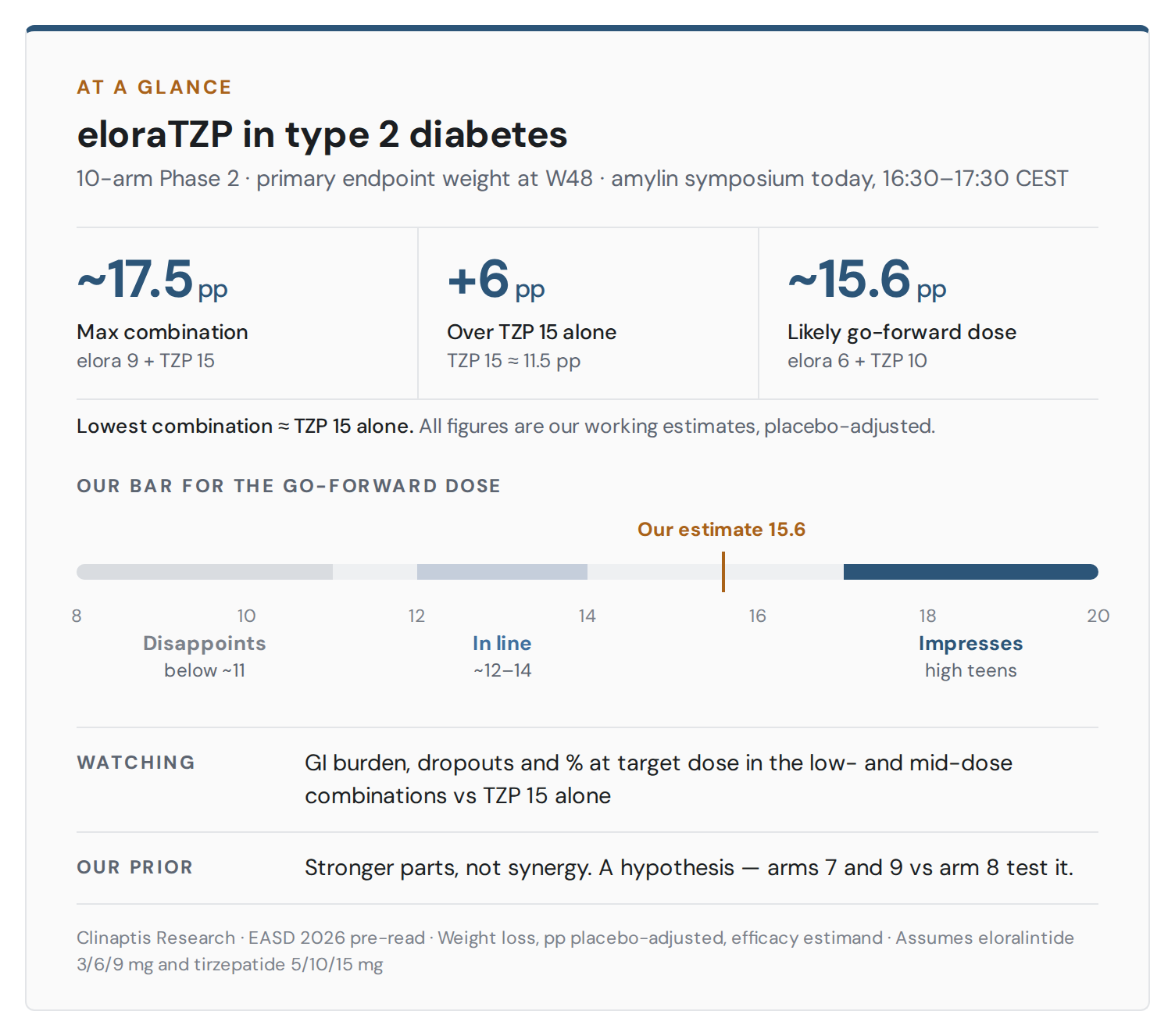
- Arm 7, the maximum combination, prints approximately 17.5 percentage points placebo-adjusted (15.1–21.9; approximately 19% absolute). That is approximately 6.0 points over arm 8 at 11.5.
- Arm 4 roughly matches arm 8 at approximately 11.8 versus 11.5, well inside noise. Arms 5 and 6 land at approximately 14.0 and 15.6, or +2.5 and +4.1 points over arm 8.
- Arm 3 is the attenuation test. It reaches approximately 11.0 at the class factor of 0.66, approximately 12.1 if eloralintide behaves like cagrilintide at 0.73 and approximately 10.0 in the 0.60 low case.
- Implied retention on tirzepatide 15 mg is approximately 0.55 (0.45–0.66). A single estimate carries approximately ±0.3.
- HbA1c: eloralintide adds −0.1 to −0.3 percentage points over matched tirzepatide. All combinations land at −2.1 to −2.8. HbA1c cannot rank them. The anchor is REIMAGINE 2 at −1.91 versus −1.75, for a treatment difference of −0.16 (95% CI −0.27 to −0.05).
Arm 7 approximately equals arm 9, at roughly 0.3 points apart, and arm 6 approximately equals arm 9, at roughly 1.6 points apart. These are the noise defaults, not evidence of saturation or a sweet spot.
5. The real test is cost
The REIMAGINE 2 template for adding an amylin—CagriSema 2.4/2.4 mg versus semaglutide 2.4 mg at Week 68—shows:
- +4.0 points of weight loss for +8.6 points of nausea (37.0% versus 28.4%).
- +8.0 points of constipation (20.9% versus 12.9%). That is more than cagrilintide alone adds over placebo (+3.9 points, a point estimate), and it does not fade.
- Adverse-event discontinuation was 8.5% versus 6.6%. Gastrointestinal discontinuation was flat at 4.5% versus 4.3%. The extra discontinuation was non-GI, approximately 4.0% versus 2.3%.
- Only 59.2% of the full-dose arm was at target dose at Week 68, against 72.4% on semaglutide.
- The low-dose pair, 1.0/1.0 mg versus semaglutide 1.0 mg, added more weight (+4.5 points) for less extra nausea (+7.2 points). This is not a like-for-like test because there is no cagrilintide 1.0 mg monotherapy arm.
The eloraTZP product question is therefore arms 5 and 6 against arm 8 on nausea, constipation, fatigue, non-GI discontinuation and percentage at target dose. Fatigue is eloralintide’s other signal in obesity, at 21–46% across arms. Whether arm 7 prints 17% or 20% matters less.
6. Our expectation bar
This is a watch-list, not a stock call. Here is the bar we will score against.
Weight at the go-forward dose—eloralintide 6 mg plus tirzepatide 10 mg, or tirzepatide 15 mg if Lilly pushes—placebo-adjusted at Week 48:
- Below approximately 11 points disappoints. That is no better than tirzepatide 15 mg alone at approximately 11.5; the second drug is not earning its place.
- Approximately 12–14 points is in line, or approximately 14–16% absolute. It is a clear margin over tirzepatide 15 mg alone at a lower tirzepatide dose.
- High teens impresses. It would put a mid-dose combination at or above our maximum-dose estimate.
- Our arithmetic sits in the upper half of “in line”: approximately 15.6 points for 6 mg plus 10 mg and 17.2 points for 6 mg plus 15 mg. We would not be surprised by a print at the top of the range. We would be surprised by one below it.
GI and tolerability for the combinations against arm 8, tirzepatide 15 mg alone:
- Priors: adding cagrilintide to semaglutide cost +8.6 points of nausea, +8.0 points of constipation and +1.9 points of adverse-event discontinuation, with vomiting roughly flat in REIMAGINE 2. For eloralintide alone in obesity, titrated 3 to 6 to 9 mg, nausea was 25%, fatigue 21%, vomiting 2% and adverse-event discontinuation 12%, compared with 13%, 12%, 0% and 8% on placebo. For fixed 9 mg, the figures were 33%, 43%, 11% and 7%. The Phase 1b says only that combination arms had more adverse events, mostly mild-to-moderate GI events.
- In line: combinations add no more than approximately 10 points of nausea and 2–3 points of adverse-event discontinuation over arm 8, in line with CagriSema.
- Concerning: nausea more than approximately 15 points higher, adverse-event discontinuation more than approximately 5 points higher, a fatigue signal near the fixed-dose 43%, or fewer than approximately 60% of arm 7 at target dose.
- Impressive: arms 5 and 6 are no worse than arm 8 on GI events and discontinuation while beating it on weight. That is the product.
- Caveat: with approximately 37 participants per arm, only large adverse-event differences are detectable. Read the pattern across arms 4, 5, 6 and 9, not single percentages.
7. Day-of scorecard
For the Phase 1b oral at 10:30 CEST, we want per-arm adverse events, discontinuation reasons and the two undisclosed Study A arms covering 16 of 96 participants.
For the Phase 2 T2D amylin symposium at 16:30–17:30 CEST, we will read the data in this order:
8. How we could be wrong
- Arm 3 below approximately 9. Eloralintide attenuates in T2D more than our 0.60 low case; 9 divided by 16.6 is approximately 0.54, at the bottom of the bridge range.
- Arm 7 minus arm 8 above approximately 11 points or below approximately 5 points. That implies retention near 1.0 or below approximately 0.45 of observed arm 3. Above would put the combination at or beyond arithmetic additivity—a point estimate, not proof of synergy with approximately 37 participants per arm. Below means amylin is partly redundant on top-dose tirzepatide.
- Arm 4 clearly below arm 8. The low-dose combination fails and the efficacy dose-sparing case is dead.
- The placebo normalisation cuts both ways. Without the 1.6-point placebo standardisation, eloralintide monotherapy arms print approximately 1.1 points higher and combinations approximately 0.6–0.7 points higher. That is inside our high case.
- Baseline HbA1c above approximately 8.5% pulls every arm down, tirzepatide included.
- Dose mapping, small arms and selective disclosure. A different milligram mapping re-anchors everything. With approximately 37 participants per arm, judge patterns across arms rather than one arm. If Lilly shows pooled safety only, the product-cost test cannot be scored.
Retention of approximately 0.55–0.60 is the working prior for the next amylin-plus-incretin readouts, including petrelintide plus CT-388 from Roche and Zealand Pharma. Petrelintide’s final ZUPREME-1 obesity data—10.2% versus 1.4% at Week 42, published in The Lancet Diabetes & Endocrinology—also print at EASD. Its T2D trial, ZUPREME-2 in the second half of 2026, will be the second pure-amylin T2D anchor. Deviations, not levels, should move the prior.
Three things not to lean on:
- Rat data overstate combination gains. In diet-induced obese rats, eloralintide plus tirzepatide was fully additive at −20% versus −9% and −10%; humans kept about two-thirds. Discount preclinical “superior combination” claims, including Ascletis’s ASC36/ASC35 poster at this EASD, by about a third.
- There is no heart-rate offset thesis. The −11 to −14 bpm seen in the 12-week Phase 1 did not replicate: placebo-adjusted pulse at 9 mg in the 48-week Phase 2 was +0.7 bpm.
- “Eloralintide is approximately 1.5 times cagrilintide as monotherapy” and “eloraTZP beats CagriSema” are consensus, not an edge.
We make no valuation call here.
Bottom line: expect approximately 17.5 percentage points placebo-adjusted, or approximately 19% absolute, at the maximum dose. For the go-forward dose, below approximately 11 points disappoints, 12–14 is in line and high teens impresses. Expect a low-dose combination that roughly matches tirzepatide 15 mg. Neither is the surprise. The tolerability and on-dose data for the low- and mid-dose arms decide the product.
Sources
- Phase 1b: EASD 2026 abstract, Bhattachar et al. (NCT06345066, NCT06297616).
- Eloralintide monotherapy: Billings et al., The Lancet 2025;406:2631–43.
- T2D trial: NCT06603571.
- CagriSema: REDEFINE 1, The New England Journal of Medicine 2025; REIMAGINE 2, Buse et al., The Lancet Diabetes & Endocrinology 2026; Frias et al., The Lancet 2023;402:720–30.
- Petrelintide: ZUPREME-1, Roche release of March 5, 2026 and Zealand release of September 29, 2026.
- Tirzepatide: SURPASS-2, Lilly release; SURMOUNT-1, The New England Journal of Medicine 2022; SURMOUNT-2, The Lancet 2023 and HbA1c-category analysis in Diabetes Care 2025.
- Additional obesity-to-T2D bridge pairs: STEP 1/2 for semaglutide; SCALE Obesity & Prediabetes and SCALE Diabetes for liraglutide, using LOCF analysis; ATTAIN-1/2 for orforglipron; TRIUMPH-1/2 for retatrutide.
Conventions
- Placebo-adjusted means drug percentage change minus placebo percentage change, shown positive.
- We use the efficacy estimand unless stated. REDEFINE 1 values are trial-product estimand, matched to REIMAGINE 2 efficacy.
- Eloralintide inputs are standardised to an approximately 2% placebo result. This is a judgment; unadjusted values form the high case.
- Cross-trial comparisons are directional. Forecasts are arithmetic scenarios. No simulations were run and no sell-side estimates are used.